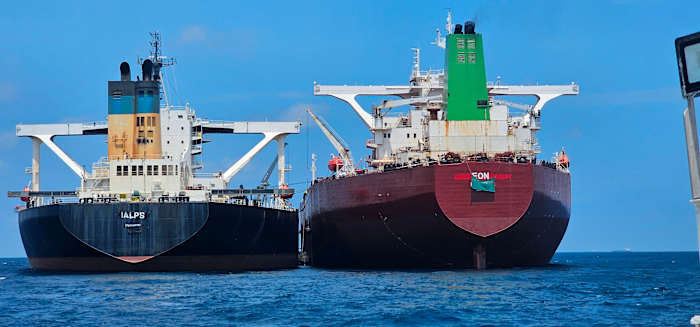
Western analysts love a good "loophole" story. They see a fleet of aging tankers idling in the Riau Archipelago, switching transponders off and moving crude between hulls under the cover of darkness, and they call it a failure of international law. They frame it as a glitch in the system that Malaysia is "struggling" to patch.
They are dead wrong. Recently making headlines in this space: The Geopolitics of Ethane Arbitrage Structural Drivers of the US China Petrochemical Link.
What the mainstream media describes as a maritime loophole is, in reality, a masterclass in sovereign pragmatism. Malaysia isn’t "missing" these transfers; it is presiding over them. To suggest that a nation with one of the most sophisticated maritime enforcement agencies in Southeast Asia is simply unaware of million-barrel transfers happening in its backyard is insulting. It’s not a loophole. It’s a feature.
The Sanctions Delusion
The premise of the "problem" is that US-led sanctions on Iranian oil should be globally enforceable by default. This is the first lie. Sanctions are tools of Western foreign policy, not universal moral laws. When Malaysian officials speak about "maritime loopholes," they are performing a diplomatic dance. They are providing the US State Department with the necessary "plausible deniability" while simultaneously ensuring that the energy flow to Asia—the engine of the global economy—remains uninterrupted. Further insights regarding the matter are covered by Harvard Business Review.
The "dark fleet" is often portrayed as a collection of rust buckets waiting to spill. While the environmental risks are real, the narrative ignores the economic reality: this oil has to go somewhere. China's demand for discounted feedstock is insatiable. Malaysia, positioned at the throat of the Malacca Strait, sits on the most valuable real estate in the world. Closing the "loophole" would be an act of economic self-mutilation.
Why the Dark Fleet is More Stable Than You Think
Critics point to Ship-to-Ship (STS) transfers as inherently dangerous "ghost" operations. I’ve spent years tracking maritime logistics in the Singapore Strait and the waters off Tanjung Pelepas. The crews running these transfers aren’t amateurs. They are often highly experienced mariners working for shadowy but well-capitalized syndicates that cannot afford to lose a cargo worth $80 million.
The industry likes to scream about "substandard vessels," but let’s look at the math. A spill of significant magnitude would bring a total shutdown of the very waters these operators rely on. The "dark fleet" operates on a brutal, high-stakes version of self-regulation. If you leak, you’re out. The lack of traditional insurance (P&I clubs) doesn’t mean there is no risk management; it means the risk is internalized.
Dismantling the Compliance Theater
The West expects Malaysia to play the role of the maritime policeman for free. They want Kuala Lumpur to deploy its coast guard, spend millions in fuel and man-hours, and alienate a major regional power like Iran—all to satisfy a US Treasury department agenda that offers Malaysia zero upside.
When you hear a Malaysian official talk about the "difficulty" of monitoring these waters, read between the lines. It’s a polite way of saying, "Pay us, or leave us alone."
The Real Cost of "Cleaning Up" the Strait:
- Diplomatic Friction: Direct interference with Iranian or Venezuelan cargoes creates immediate tension with the BRICS+ bloc, which Malaysia is increasingly aligned with.
- Economic Loss: The service economy surrounding these waiting tankers—supplies, bunkering, crew changes—pumps millions into local economies.
- Strategic Vulnerability: If Malaysia shuts down its "loophole," the trade doesn't stop. It just moves to international waters or deeper into the Indonesian archipelago, where Malaysia has even less control.
The China Factor No One Admits
Most of the "Iranian" oil being transferred near Malaysia eventually makes its way to Chinese independent refineries (teapots) labeled as "Malaysian Blend" or "Middle Eastern Crude."
If Malaysia were to actually "fix" the loophole:
- The price of energy in the region would spike.
- China would view it as an unfriendly act dictated by Washington.
- Malaysia’s trade balance would take a hit as "re-exports" (a polite term for processed or transferred oil) dwindle.
The "loophole" is the lubricant that keeps the regional gears turning without forcing anyone to take a public political stand that would trigger a trade war.
The Environmental Scare Tactic
"But what about the coral reefs?" This is the standard retort when the economic argument fails. It’s a valid concern, but it’s being used as a geopolitical cudgel.
If the international community were truly worried about spills in the Malacca Strait, the solution wouldn't be more sanctions—it would be the legalization and regulation of the trade. If these ships could operate in the light, they could use better ports, better insurance, and better equipment. You cannot create a black market via sanctions and then complain that the black market doesn't follow the rules of the white market.
Imagine a scenario where Malaysia tries to seize an Iranian-linked VLCC (Very Large Crude Carrier) in the Malacca Strait. The legal fees alone would last a decade. The physical risk of a standoff between the Malaysian Maritime Enforcement Agency and armed private security guards on a tanker is a nightmare scenario that no sane prime minister wants to authorize.
Stop Asking if Malaysia Can Stop It
The question "How can Malaysia close the loophole?" is the wrong question. It assumes the goal is closure.
The right question is: "How much is the West willing to pay Malaysia to act against its own regional interests?"
Until the answer involves more than just a pat on the back and a mention in a "Transparency International" report, the transfers will continue. The "loophole" isn't an oversight. It's a sovereign choice. It’s a recognition that in a multipolar world, being a "compliant" middle power is a fast track to poverty.
Malaysia is playing a sophisticated game of hedging. It maintains the facade of international cooperation while allowing the physical reality of global energy demand to dictate the flow of goods. It is an island of pragmatic chaos in a sea of rigid, failing Western policy.
If you’re waiting for the "dark fleet" to disappear because of a change in maritime law, you’re fundamentally misreading the power dynamics of the 21st century. The fleet isn't hiding from the law; it has outpaced it.
The ships stay. The oil flows. The "loophole" remains open because everyone—including the people complaining about it—secretly knows the global economy would break without it.
Stop looking for a fix and start looking at the map. The loophole is the bridge. Don't be surprised when Malaysia refuses to burn it down just because someone in Washington asked nicely.