The iron gates of Insein Prison swung open this Friday to the familiar theater of a military amnesty, a calculated ritual that has become the hallmark of Myanmar's junta. To mark the traditional Buddhist New Year, the regime announced the release of 4,335 Burmese nationals and 179 foreigners, a move framed by state media as a gesture of "peace and humanity." Yet, beneath the veneer of Buddhist merit-making lies the cold mathematics of a regime struggling for legitimacy after a sham election.
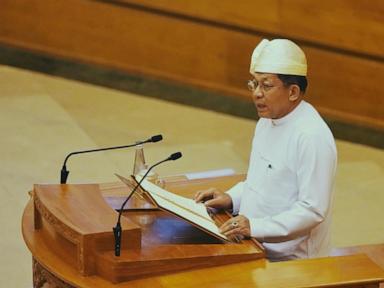
For the thousands of families waiting in the sweltering heat outside Yangon’s most notorious colonial-era jail, the joy is transactional and fragile. This is not a pivot toward democracy. It is a strategic venting of a bloated prison system, timed perfectly to distract from the recent inauguration of Senior General Min Aung Hlaing as a "civilian" president—a title earned through a widely condemned electoral process that excluded any real opposition. Read more on a connected subject: this related article.
The Calculus of Mercy
In Myanmar, amnesties are rarely about justice; they are about optics and logistics. By releasing over 4,500 individuals, the junta attempts to signal a "return to normalcy" to its few remaining regional allies. However, the fine print of the pardon reveals the regime's true anxiety. Every released prisoner remains under a sword of Damocles. If they are rearrested, they must serve the remainder of their original sentence plus any new penalty.
This is not a clean slate. It is a parole system designed to silence dissent through the threat of compounding imprisonment. Additional journalism by NBC News highlights comparable views on the subject.
The inclusion of 179 foreigners serves a different purpose. These individuals were pardoned on the condition of immediate deportation, a classic diplomatic lever used to ease friction with neighboring capitals. By purging foreign nationals from its cells, the junta hopes to buy a reprieve from international pressure while keeping the most "dangerous" domestic elements—the thinkers, the organizers, and the activists—firmly behind bars.
The Missing Names
The most telling aspect of Friday’s announcement was not who was released, but who remains. There was no mention of Aung San Suu Kyi. The 80-year-old Nobel laureate continues to serve a 27-year sentence in undisclosed locations, a living symbol of the junta's refusal to engage in genuine political reconciliation.
According to the Assistance Association for Political Prisoners (AAPP), more than 30,000 people have been detained since the 2021 coup. The vast majority of those released in these mass amnesties are common criminals—thieves, drug offenders, and those convicted of minor civil infractions. While a handful of low-level political detainees may trickle out to provide the regime with "proof" of its leniency, the backbone of the pro-democracy movement remains shackled.
Sentence Commutations as a Propaganda Tool
The regime also announced a series of sentence reductions that look impressive on paper but change little on the ground:
- Death sentences commuted to life imprisonment.
- Life sentences capped at 40 years.
- Short-term sentences reduced by one-sixth.
This blanket commutation of death sentences is a direct response to the international outcry following the junta’s resumption of judicial executions in 2022. By shifting from the hangman’s noose to the slow death of a 40-year term, the regime attempts to dodge the "pariah" label while maintaining the same level of neutralized opposition. It is a rebranding of brutality, not an end to it.
A Presidency Built on Sand
The timing of this amnesty is inseparable from the political events of the last fortnight. Min Aung Hlaing’s transition from military dictator to "President" is a desperate play for E-E-A-T—Experience, Expertise, Authoritativeness, and Trustworthiness—in the eyes of a skeptical world. He needs to show that he can govern, not just occupy.
But the reality of 2026 is that the junta controls less than 25% of Myanmar’s territory. Rebel forces, including the People's Defense Forces (PDF) and various ethnic armed organizations, have pushed the military out of critical border zones and trade hubs. The economy is in a tailspin, and the military’s forced conscription law has sparked a mass exodus of the country’s youth.
Releasing prisoners into a country that is effectively a war zone is a hollow gesture. Many of those freed today will return to villages that have been burned or townships that are under constant aerial bombardment. The "peace of mind" promised by the state-run MRTV is non-existent in a nation where the primary source of terror is the government itself.
The Failure of International Engagement
The international community’s response to these amnesties has fallen into a predictable, and largely ineffective, pattern. ASEAN continues to push its "Five-Point Consensus," a peace plan that the junta ignores whenever convenient. China and Russia provide the diplomatic cover and hardware necessary for the regime to survive, viewing these amnesties as sufficient "progress" to justify continued support.
This cycle of sham elections, followed by mass amnesties, followed by renewed crackdowns, is the junta's primary survival strategy. It creates a rhythm of false hope that keeps the international community divided and the domestic population exhausted.
True reform in Myanmar would not look like a New Year's Day parade. It would involve the unconditional release of all political prisoners, the restoration of the 2020 election results, and the military’s withdrawal from civilian governance. Until those steps are taken, every amnesty is merely a logistical shuffle in a failing police state.
The families hugging their loved ones outside Insein Prison today are right to celebrate. But for Myanmar, the "New Year" brings only the same old chains, just polished slightly brighter for the cameras.
The junta is not opening the gates because it is strong. It is opening them because it is running out of ways to hide its weakness.