There are houses built to keep the weather out, and then there are houses built to rewrite reality.
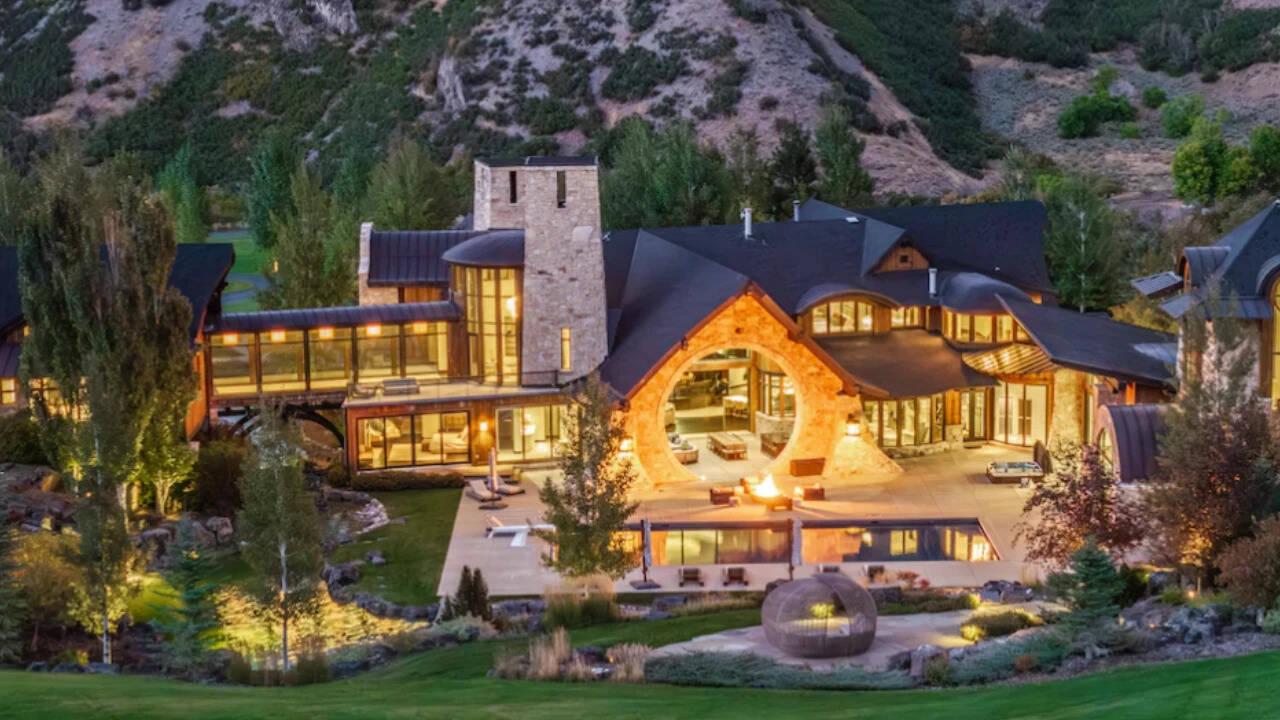
Up in the jagged folds of Utah, where the Wasatch peaks slice hard against an unforgiving blue sky, a heavy timber door stands ready to swing open for travelers who forgot which century they were in. It smells of cedar resin, ancient iron, and the kind of profound silence that only a mountain can manufacture. For years, people whispered about this place as the Utah estate, a $43 million monolith of stone and hand-hewn wood that looked less like real estate and more like a stolen film set.
Then came the quiet shockwave of a five-million-dollar price drop.
Suddenly, the fortress on the ridge was waving a different flag. Thirty-eight million dollars. A staggering sum by any mortal metric, yet suddenly untethered from its previous gravity, sliding down the mountain like an avalanche slowing to a rest.
To understand why a castle needs a price cut, you have to understand what happens when human ambition collides with sheer, breathtaking scale.
Imagine standing on the terrace just as dusk bleeds purple across the canyon. The air is thin enough to sting your throat. Below you, the valley lights flicker like fallen stars, but up here, you are entirely alone with the pines. This was never just a collection of square footage or high-end appliances. It was an obsession. Someone looked at the raw, brutal majesty of the American West and decided it needed an anchor, something heavy enough to match the geologic violence of the landscape. They built curved corridors that feel like subterranean tunnels, forged iron hinges that could withstand a siege, and hearths big enough to roast an ox.
Every great architectural marvel starts as an ego trip and ends as an existential crisis.
When you build a sanctuary for dragons, you inherently narrow the guest list. That is the hidden friction behind the luxury market. How many buyers exist in the global ether who possess both thirty-eight million dollars in liquid capital and an unironic desire to live inside a Tolkien fantasy? The Venn diagram is a very small, lonely circle.
The market does not care about your dreams. That is the cold, unyielding law of high-end real estate. You can pour millions of hours into hand-sculpted woodwork, you can import stones that remember oceans that dried up fifty million years ago, but when the bills come due and the estate sits empty, the mountain reasserts its indifference.
Price drops at this altitude are rarely about desperation. They are about gravity.
Consider what happens when a property lingers. Brokers whisper. Buyers grow suspicious. Is there a foundation issue? Is the roof leaking through the slate? In reality, the answer is far simpler and much more human. The house was simply waiting for the world to catch up to its peculiar brand of magic. At forty-three million, it was a museum piece, guarded by velvet ropes of expectation. At thirty-eight million, it becomes something dangerous. It becomes attainable to a slightly wider tier of eccentric billionaires.
It becomes a project someone might actually inhabit.
Walk through the vaulted great room. The ceiling rises so high that winter drafts could theoretically nest in the rafters, but massive stone fireplaces push back against the chill with primal fury. You can almost hear the phantom clink of tankards and the low hum of elven strings, even though the only sound is the wind groaning through the canyon.
This is the central paradox of ultra-luxury real estate. You pay an astronomical fortune to isolate yourself from humanity, only to realize that isolation is terrifyingly quiet.
The developers and creators who dream up these spaces are architects of modern folklore. They do not sell shelter; they sell an escape hatch from the banality of modern life. If you spend your days staring at algorithmic dashboards, trading futures, or managing sprawling corporate empires, perhaps there is a perverse, deeply comforting logic in retreating to a stone redoubt that mimics the Third Age. You want your walls to feel thick enough to stop a stray arrow from a Nazgul, even if the only enemy you are hiding from is your own exhaustion.
And yet, houses want to be lived in.
They decay when they are lonely. Floors miss the impact of boots; kitchens grow cold when no wine is spilled on the counters; stone walls need the warmth of human voices to keep the dampness at bay. A price reduction of five million dollars is not just a financial adjustment. It is an invitation. It is the seller blinking first in a game of high-stakes chicken, whispering to the market: Please. Come love this monument I made.
Down in the valleys, people read the headlines with a mixture of schadenfreude and awe. Thirty-eight million. The number rolls off the tongue like a foreign language. Most of us will never hold that much money in our collective lifetimes, let alone spend it on a mountain retreat designed to evoke a fictional continent across the sea. We look at the photos of the hand-forged chandeliers and the timber beams, and we project our own fantasies onto the empty rooms. We imagine reading a paperback by the fire while snow blankets the pines. We imagine hosting dinners where nobody talks about stocks or politics.
We forget the upkeep. We forget the heating bills that could fund a small municipal government. We forget the sheer, crushing isolation of being perched on a ridge three miles from the nearest pint of milk.
That is the secret the brochures leave out. Paradise requires maintenance.
When the price dropped, the property didn't just become cheaper; it became real. It stepped out of the realm of architectural fantasy and into the messy, pragmatic arena of commerce. Someone will buy it eventually. A tech titan seeking solitude, a filmmaker escaping Hollywood, or perhaps an anonymous collector who simply fell in love with the curve of a wooden beam.
They will move in. They will light the first fire. The stone will absorb the heat.
And for a little while, the mountain will stop feeling quite so lonely.