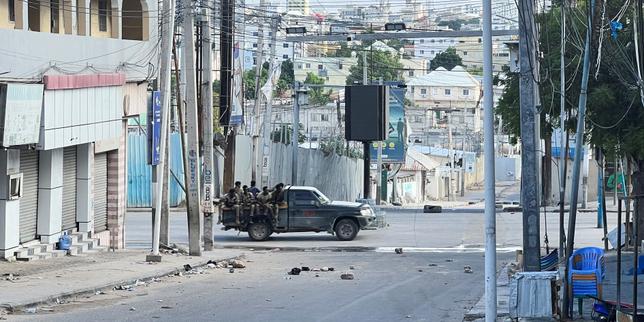
Mainstream geopolitical reporting loves a predictable script. When gunfire echoes in Mogadishu, the international press corps immediately dusts off its favorite, lazy template: "Somalia plunges back into open crisis." They paint a picture of a nation perpetually teetering on the edge of complete anarchy, a failed state trapped in a permanent loop of destruction.
This analysis is wrong. It misses the actual mechanics of Somali politics.
What the outside world views as a sudden, chaotic descent into madness is usually something entirely different: highly calculated, localized tactical friction. It is a violent form of political bargaining, not a systemic collapse.
The Myth of the Perpetual Blank Slate
Every time political factions clash over electoral mandates, constitutional amendments, or clan representation, Western analysts act surprised. They treat the incident as a brand-new tragedy that threatens to erase all progress.
This perspective ignores the last two decades of Somali history.
Somalia is not a fragile house of cards waiting for a single breeze to knock it down. It has developed a remarkably resilient, albeit highly unconventional, ecosystem of conflict resolution. Violence in Mogadishu rarely signals the end of the state; it functions as a brutal, high-stakes mechanism for resetting the balance of power when institutional negotiations stall.
When troops loyal to different political actors take up positions in the capital, it is not an attempt to burn the city to the ground. It is a physical veto. It is a manifestation of the checks and balances that the formal constitution has failed to codify. To view this purely as "chaos" is to misunderstand how power is negotiated, consolidated, and shared in the Horn of Africa.
Dismantling the Failed State Narrative
Let us look at the structural reality that the doom-mongering headlines consistently ignore.
- Economic Resilience: While the political elite clash in the green zones and checkpoints, the Somali private sector keeps moving. The remittance economy, powered by a sophisticated global diaspora, bypasses formal banking bottlenecks. Mogadishu’s markets do not close down permanently because of political gridlock; they adapt within hours.
- Decentralized Power: The obsession with the federal government's absolute control is a Western fixation. Somalia’s federal member states—from Puntland to Jubaland—operate with significant autonomy. A political crisis in the capital does not automatically paralyze the entire geography. Power is distributed, meaning the system is inherently redundant.
- The Nature of the Clashes: If you look closely at the actual casualty figures and territorial shifts during these "open crises," they rarely resemble total warfare. They are skirmishes designed to signal capability and resolve. Once the message is received, the elders step in, the underlying business interests align, and a compromise is reached.
The Flawed Premise of International Interventions
International observers constantly ask the wrong question. They ask: "How can we help the federal government impose total authority?"
The premise itself is flawed. The assumption that a highly centralized, top-down state model can be forced onto a traditionally egalitarian, decentralized society has failed for thirty years. The insistence on treating every localized conflict as an existential crisis only serves to justify more top-down, ineffective foreign intervention.
I have watched international entities pour hundreds of millions of dollars into building rigid institutional frameworks that look great on a PowerPoint presentation in Nairobi or Washington but fracture the moment they touch the ground in Benadir. These frameworks fail because they treat friction as an anomaly rather than a feature of the political landscape.
The Cost of the Counter-Intuitive Approach
Admitting that conflict is a form of political bargaining comes with a harsh reality. It means acknowledging that stability in Somalia will not look like stability in Switzerland. It will be messy, episodic, and frequently stressful.
The downside to this perspective is obvious: it requires accepting a level of structural volatility that makes international donors deeply uncomfortable. It means recognizing that the path to a functioning Somali state involves letting local actors fight, negotiate, and establish their own equilibrium without constant, heavy-handed external engineering.
Stop reading the sensationalist headlines that predict the imminent demise of Somalia every time a political dispute turns loud. The country is not collapsing; it is negotiating.