The air in Metz smells of wet limestone and old iron.
When the autumn mist rolls off the Moselle, it wraps around the Gothic ribs of Saint Stephen Cathedral like a damp shroud. This is a city that has worn scars for breakfast. For centuries, armies marched across these muddy fields, speaking German one decade, French the next, their blood sinking deep into the loamy soil of the Lorraine basin. Every cobblestone here holds a ghost. Every gable remembers fire.
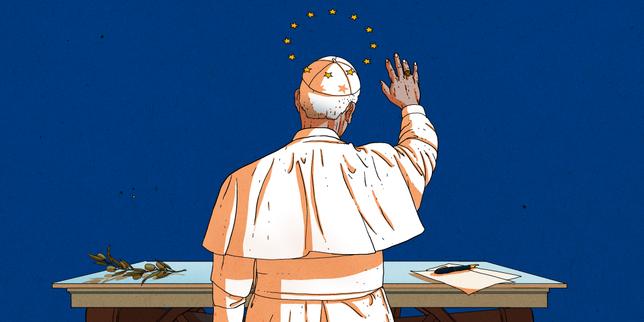
And yet, on a crisp morning that smelled faintly of woodsmoke and burnt candlewicks, the city held its breath for a man in white.
The visit was billed as a celebration of European unity, a diplomatic triumph etched in stone and stained glass. Dignitaries smoothed their ties in hotel lobbies. Security details swept dark corners with flashlights and stern silence. But beneath the polished rhetoric of brotherhood and transnational harmony lay a quieter, stranger alchemy. A detail that slipped past the briefing books. A secret forged in the furnace of Verdun and Sedan.
Look down at the sanctuary floor.
The altar where the Pope would lift the chalice was not carved from standard Carrara marble. It was born in the belly of a foundry, birthed from the melted bronze of old German cannons. Krupp steel and Imperial artillery, once primed to shatter bone and tear towns apart, had been cast anew. Weapons of slaughter turned into a table of peace.
Did the Holy Father know?
The question hung in the vaulted rafters like incense smoke.
To understand why that question matters, you have to step away from the velvet-roped galleries of modern diplomacy and walk the quiet lanes of Moselle. History here is not a textbook. It is skin.
My grandfather used to talk about the silence that followed the shelling. Not the dramatic quiet of an action movie, but a heavy, oppressive void where birds refused to sing for days. He lived through the border shifts, the sudden decrees posted on brick walls telling citizens overnight that their mother tongue was now foreign, that their prayers must be spoken with a different inflection. War in this region was never an abstract concept debated in Paris or Berlin. It was a knock on the door at dawn. It was the sound of church bells melting down into shell casings.
Metz knows what iron tastes like. It tastes like copper on the back of the tongue, metallic and dry, the flavor of fear when the horizon lights up orange in the night.
When nations decide to make peace, they usually prefer amnesia. They build glass monuments in Brussels, sign thick parchment documents with silver-plated fountain pens, and shake hands under the bright glare of television cameras. They talk about cooperation and supply chains and trade zones. They sanitize the past, smoothing over the jagged edges of grief until it resembles a clean corporate logo.
But Metz refused to forget. Instead, it did something infinitely more radical. It didn't bury the instruments of death. It baptized them.
Imagine the ironworkers standing over the glowing crucibles decades ago. Men with soot-stained faces and scarred knuckles, leaning into the intense heat of the blast furnace. They didn't see abstract geopolitics. They saw the metal that killed their cousins. They saw the tubes of brass and bronze that had hurled fire into their villages. And instead of burying the weapons in a secret trench or selling them off for scrap metal, they fed them to the fire. They forced the instruments of war to bear the weight of bread and wine.
That is the true crucible of Europe. Not treaties negotiated by men in tailored suits drinking lukewarm coffee behind closed doors, but the grinding, painful labor of transformation.
When the motorcade rolled through the cobblestone streets of Metz, the crowds surged forward. Faces pressed against metal barricades. Elderly women with rosary beads woven tightly through arthritic fingers watched the white robes pass. There was a desperate hunger in their eyes, not just for a glimpse of the pontiff, but for validation. For someone to look at the life they had survived—marked by graves and shifting flags—and acknowledge that the suffering mattered.
The Pope stepped out of the car. The autumn wind caught his vestments, billowing them like a sail.
He walked past the gargoyles, past the ancient buttresses that had absorbed centuries of cannon fire and mortar shrapnel, and entered the nave. The light filtering through the Chagall stained glass cast eerie pools of blue and yellow across the stone floor. It was breathtaking, but also sobering. You could feel the ghosts watching from the shadows of the vaulting.
As he approached the sanctuary, his hand brushed the edge of the altar.
Did he feel the coldness of the metal beneath the linen cloth? Did he sense the hidden history humming within the bronze?
History does not announce itself with a trumpet fanfare. It whispers in the texture of surfaces. An altar made of cannon bronze is a theological contradiction. It is the literal manifestation of beating swords into plowshares, executed not by divine magic, but by human sweat and stubborn hope. Every time the priest raises the Host above that table, he is offering sacrifice over the very instruments that once demanded human sacrifice.
There is a profound poetry in that irony.
For decades, politicians have tried to construct Europe out of bureaucracy and economic treaties. They attempted to legislate unity into existence through directives and tariff adjustments. But a continent cannot survive on trade agreements alone when its soil is saturated with unresolved grief. You cannot build a shared future while ignoring the graveyards of the past. You have to dig up the cannons. You have to melt them down. You have to force the old enemies to sit at the same table, even if that table is literally made from their own weapons.
The mass in Metz was not just a religious ceremony. It was an act of exorcism.
Think about what it takes to forgive an enemy who shelled your home. Think about what it means to look at a piece of artillery and decide that instead of returning fire, you will use it to hold the chalice of salvation. It defies ordinary human instinct. Revenge is natural; forgiveness is a miracle.
As the choir’s voices soared up into the gothic arches, filling the cavernous space with sound that made the chest vibrate, something shifted in the room. The cold stone seemed to soften. The weight of history felt less like a tombstone and more like a foundation.
Outside, the modern city went about its day. Delivery vans rumbled down asphalt roads. Cafes filled up with patrons sipping espresso and arguing about local politics. The borders that once ran red with blood are now invisible lines crossed daily by commuters heading to jobs in neighboring countries. They don't show passports anymore. They don't stop at checkpoints with leveled bayonets.
They take the train. They buy groceries in one country and sleep in another.
It is easy to take that ordinary peace for granted. We treat open borders and quiet nights like weather—something that just happens, needing no maintenance, demanding no sacrifice. But peace is an artificial creation. It is a fragile, high-maintenance machine built by people who looked into the abyss of total destruction and blinked.
When the service concluded and the bells of Metz rang out across the Moselle, echoing off the hills where armies once clashed, the sound carried a double meaning. It was a call to prayer, yes. But it was also a warning.
The cannons can always be recast. The metal is never truly gone. It is merely sleeping under a shroud of white linen and blessed oil.
That is the burden of living in Europe, and perhaps the burden of living in any place touched by history. We walk on battlefields disguised as parks. We eat off tables forged from weapons. We build our futures over the unexploded ordnance of our grandfathers' hatreds.
Did Pope Leo know?
Perhaps he did. Perhaps as he rested his fingers on that strange, heavy bronze altar, he felt the pulse of the Lorraine iron. Perhaps he understood that the true miracle of Metz was not that a religious leader came to visit, but that the metal of war had finally learned how to hold the weight of peace.
And as the last notes of the organ faded into the damp evening air, leaving only the sound of the river rushing past the ancient bridge, the city of Metz stood silent and enduring. A monument to what happens when human beings look at their own destruction and decide to build something holy out of the wreckage.


