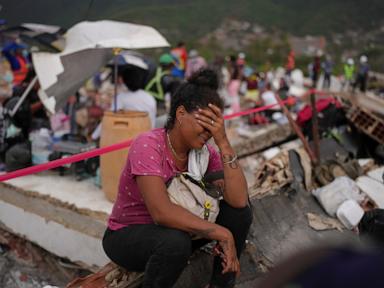
The headlines are screaming that 50,000 people are missing in the wake of the recent Venezuelan earthquakes. It makes for terrifying television. It drives clicks.
It is also a mathematical and logistical impossibility.
When a major disaster strikes a country already enduring severe infrastructure collapse, the international press defaults to a predictable playbook. They find the highest numbers available, strip them of context, and run them as a definitive body count.
I have spent over a decade analyzing disaster response logistics and crisis data modeling in high-risk zones. If you look at the raw mechanics of how communication networks, migration, and municipal registries actually function during a crisis, you realize the mainstream narrative is completely broken. They are treating a database lag as a mass grave.
The Lazy Math of the Unaccounted For
Mainstream reports are conflating "unaccounted for" with "buried under rubble."
In disaster logistics, a person is flagged as unaccounted for simply when a relative cannot reach them, or when their name appears on a localized registry but they haven't checked into an official government shelter.
Consider the baseline reality of Venezuela before the first tremor even hit:
- Grid Collapse: The national electrical grid, Corpoelec, was already suffering daily blackouts.
- Telecommunications Rupture: Cell towers lack functional backup batteries. When the power goes out, mobile networks die within hours.
- The Diaspora Factor: Over seven million Venezuelans have left the country in recent years. Many local family registries have not been updated since 2015.
When the earth shook, the remaining fragile communications infrastructure instantly shattered.
Imagine a scenario where a Venezuelan living in Madrid tries to call their aunt in Cumaná. The call fails because the local cell tower is offline. The worried relative logs a report with an international agency or an online missing persons database.
Multiply that scenario by tens of thousands.
What you get is a massive spike in "unaccounted for" data points. What you do not get is 50,000 casualties. You get 50,000 people without a cell signal.
Dismantling the Premise of Disaster Reporting
The public constantly asks: Why is the death toll climbing so fast?
The premise of the question is flawed. The death toll isn't skyrocketing because more bodies are being found; it is rising because bureaucrats are finally processing paperwork that was backed up for days.
Let's look at how actual crisis verification works versus how it is reported.
| Reporting Myth | Operational Reality |
|---|---|
| High initial numbers mean high mortality. | High initial numbers mean communication infrastructure has failed completely. |
| Government silence equals a cover-up. | Government silence usually means local officials lack gas to drive to the affected zone. |
| International aid solves the immediate bottleneck. | International aid often clogs local airports and delays actual supply distribution. |
When the United Nations or local NGOs estimate figures during the first 72 hours of a disaster, they use predictive algorithms based on population density. But these models are deeply flawed when applied to Latin America's current migratory realities. They assume apartment blocks are at 100% capacity when, in reality, entire floors have been sitting empty for years as citizens fled the economic crisis.
The media is running casualty models on ghost towns.
The Operational Risk of Panic Numbers
This isn't just about media criticism. Miscounting has lethal consequences on the ground.
When international agencies read headlines about 50,000 missing people, they misallocate scarce resources. They fly in heavy urban search and rescue teams with specialized sonar equipment and concrete cutters.
These teams require massive logistical support. They consume local fuel, occupy runway space, and demand security details.
Meanwhile, the actual survivor population is suffering from a completely different crisis: waterborne disease. The real threat in the weeks following a South American earthquake isn't being trapped under a beam; it is cholera and a total lack of clean drinking water.
By hyper-focusing on a sensationalized body count, the global response apparatus sends search dogs to empty buildings while rural survivors drink contaminated river water a few miles away. I saw this exact operational failure play out during the response to the 2010 Haiti earthquake, where billions in aid poured into high-profile search zones while basic medical distribution points a mile away ran completely dry.
The Brutal Truth About the Data
To get to the truth, look at the concrete production and construction standards of the region.
A significant portion of the affected populations live in informal settlements—barrios built with lightweight corrugated zinc roofing and unreinforced brick walls. While these structures collapse easily, they do not create the massive, suffocating concrete "void spaces" that trap thousands of people deep underground, as seen in the high-rise collapses of Turkey or Syria.
In informal housing collapses, casualties are either immediate or survivors escape quickly because the debris is light enough to be moved by hand. The idea that there are tens of thousands of people waiting to be extricated from deep rubble in these specific zones ignores the structural engineering of the slums themselves.
The local authorities are dealing with a broken registry, zero fuel, and a shattered power grid. Every person who has moved to Colombia or Brazil without updating their status is now part of a terrifying, fake statistic used to drive news cycles.
Stop reading the frantic updates from journalists sitting in hotel rooms three countries away. The grid is dark, the phones are dead, and the people are largely alive—they are just completely unable to tell you so.