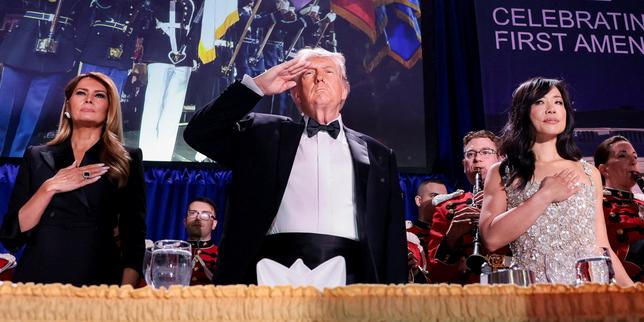
The narrative surrounding Donald Trump’s return to the press gala circuit—three months after a dramatic shooting led to a chaotic evacuation—is entirely backward. mainstream coverage wants you to believe this is a story about personal resilience, security failures, or a fragile truce between a politician and the journalists who cover him.
That consensus is lazy. It treats a calculated political strategy as a human-interest spectacle.
I have spent decades watching political operations stage-manage public appearances under high-stress conditions. When a political figure steps back into the spotlight after a life-threatening crisis, every single step is calculated. The return to the press gala was not a gesture of reconciliation or a routine calendar event. It was an offensive maneuver designed to exploit the mainstream media’s obsession with narrative symmetry.
While commentators debate whether the security perimeter was tight enough or if the atmosphere was overly tense, they miss the fundamental mechanics at play.
The Illusion of the Press Gala Truce
The media loves the idea of the press dinner as a neutral battleground. They sell it as a sacred tradition where power and press exchange jokes, temporarily suspending hostilities in the name of the First Amendment.
This is a complete illusion.
For a candidate who built a political identity on challenging institutional journalism, attending a press gala is not an olive branch. It is an invasion. By showing up, Trump forces the very institutions he criticizes to host him, cover him, and validate his narrative of survival and dominance.
The mainstream press falls for it every time. They focus on the seating chart, the awkward laughter, and the security protocols. They report on the event like a dinner party that almost went wrong, rather than a masterclass in media manipulation.
- The Narrative Trap: Journalists assume attending an event means respecting the institution hosting it.
- The Reality: Modern political figures use the host's platform to signal superiority over the host.
- The Security Distraction: Focusing endlessly on physical safety protocols obscures the strategic communication goals being executed right under the press corps' noses.
Why the Safety Debacle Was Played as a Political Asset
When an event gets evacuated due to gunfire or security threats, traditional crisis communications advice dictates laying low. The standard playbook says: minimize public exposure, tighten the circle, and let law enforcement handle the messaging.
That old playbook is dead.
In the modern political arena, returning swiftly to the exact type of venue where chaos occurred does two things:
- It weaponizes contrast. Standing in a brightly lit ballroom among tuxedo-clad reporters three months after being rushed out by armed agents creates an indelible visual of control restored.
- It shifts the burden of anxiety onto the press. The reporters in that room are the ones second-guessing security, feeling uneasy, and replaying the crisis. The candidate, meanwhile, projects unbothered authority.
I’ve seen political teams blow millions trying to manufacture an image of unshakeable strength. You cannot buy the kind of optical dominance created by casually returning to the scene of a high-profile crisis while your critics look visibly uncomfortable.
The Flawed Questions Everyone Keeps Asking
If you look at the search trends and panel discussions following the event, the public and the press are fixated on all the wrong details.
"Is it safe for political figures to attend these galas?"
This question misses the point entirely. Absolute safety does not exist in high-profile public life. The real question is whether the political reward outweighs the calculated risk. For a populist leader, the reward of visibly braving a potentially hostile environment—both physically and politically—is immense.
"Does this signal a new relationship between Trump and the media?"
No. It reinforces the existing relationship. The dynamic is purely transactional. The press needs the ratings and readers that conflict brings; the candidate needs the reach and validation that mainstream coverage provides, even when that coverage is hostile.
Assuming a dinner changes structural political animosity is fundamental naivety.
The Hidden Risk of the Return Strategy
To be clear, this aggressive strategy is not without major downsides.
When you lean heavily into the imagery of defiance, you risk alienating moderate audiences who are exhausted by perpetual tension. The spectacle of crisis-and-return appeals massively to a core base, but it can turn off voters who are looking for stability rather than continuous drama.
Furthermore, over-leveraging high-stakes public appearances creates a threshold problem. Once you set the bar at "returning to the stage after a shooting," standard political events begin to look dull by comparison. You force your own campaign into a cycle of needing ever-larger arenas and higher-stakes moments to maintain the same level of media saturation.
It is a high-wire act with zero safety net. If the rhetoric slips too far, or if another security breach occurs, the political cost isn't just a bad headline—it's a complete collapse of the candidate's control over the narrative.
Stop Reading the Headlines, Watch the Mechanics
If you want to understand modern political optics, you have to stop reading news coverage as a record of emotional moments and start reading it as a record of territory gained or lost.
The media reported on a gala. The campaign executed a tactical deployment.
The reporters in that room thought they were hosting a dinner to demonstrate the resilience of the press corps. In reality, they provided the stage, the lighting, and the audience for a high-value display of political theater that completely eclipsed whatever stories they published the next morning.
Stop expecting these events to produce civility. They are designed for collision. The moment you realize that every seat in that ballroom is a strategic asset, the lazy coverage collapses, and the real power dynamic becomes impossible to unsee.


