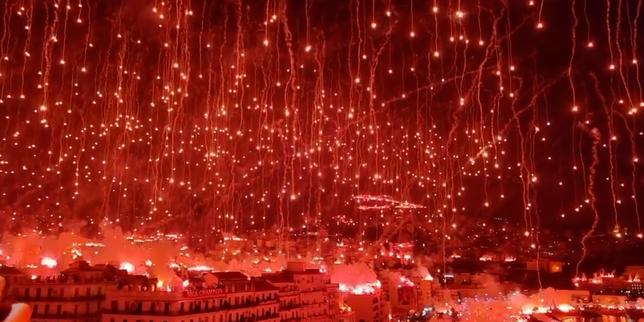
The scale of public celebration observed in Algiers for MC Alger (Mouloudia Club d'Alger) represents an extraordinary case study in urban crowd dynamics and socio-sporting mobilization. When thousands of supporters illuminate the capital with red flares—commemorating either historic championship victories or club milestones—the event moves beyond simple fan enthusiasm. It becomes a highly coordinated, decentralized logistical phenomenon. Analyzing these gatherings through the lenses of urban geography, collective psychology, and security infrastructure reveals a structured framework governing how mass passion transforms a modern metropolis.
The primary challenge in understanding these events lies in moving past the superficial media narrative of "spontaneous joy." Spontaneity on this scale is a structural impossibility. The synchronized lighting of maritime flares across distinct neighborhoods requires an informal yet rigid logistical network. To truly grasp the footprint of the Mouloudia phenomenon, we must break down the operational pillars that allow a football club to effectively commandeer the public infrastructure of a major Mediterranean capital. For a closer look into similar topics, we suggest: this related article.
The Tri-Centric Spatial Framework of Algiers Mobilization
The geographic layout of Algiers dictates the flow and density of any mass gathering. For MC Alger, the mobilization does not feature a single point of failure or a solitary gathering hub. Instead, it relies on a tri-centric spatial model that distributes the crowd load across distinct urban zones, each serving a specific tactical purpose for the collective celebration.
The Historic Core (Bab El Oued and Casbah)
This zone acts as the ideological incubator. Characterized by high-density residential structures and narrow street networks, the historic core maximizes acoustic resonance and visual density. A crowd of 5,000 people in Bab El Oued creates a sensory saturation point that would require 50,000 people in a modern, open-plan plaza. The bottleneck effect of these ancient corridors ensures that the celebration feels omnipresent, generating immediate psychological momentum. For additional information on this issue, detailed analysis is available at NBC Sports.
The Transnational Transit Corridors (Didouche Mourad and Audin)
Once the ideological momentum is established in the core, the crowd migrates toward the primary arterial roads of central Algiers. These wide nineteenth-century boulevards function as the commercial and visible theater of the mobilization. The structural width of these avenues allows for horizontal expansion, transforming a localized neighborhood rally into a city-wide disruption that halts vehicular traffic and reclaims transit infrastructure for pedestrian use.
The Coastal Amphitheater (Kittani and the Waterfront)
The final stage of spatial distribution utilizes the open maritime facade. The waterfront solves the physical limitation of the urban interior by offering infinite sightlines. This structural openness is critical for the visual climax of the celebration: the synchronized ignition of pyrotechnics. Without the spatial relief of the coastline, the accumulation of smoke and heat in the interior streets would create severe respiratory hazards, effectively self-limiting the duration of the event.
The Pyrotechnic Supply Chain and Thermal Risk Factors
The defining visual marker of the Mouloudia celebrations is the "red flood," driven entirely by the widespread use of handheld maritime distress flares (locally referred to as craqueurs or fumigènes). From a risk management and logistical perspective, the deployment of thousands of industrial-grade pyrotechnics within a civilian population presents a complex supply chain and public safety equation.
The availability of these items depends on informal maritime trade networks and localized stockpiling. Because these flares are designed for open-sea signaling, they burn at temperatures exceeding 1,000 degrees Celsius and are engineered to resist water extinguishment. The transformation of a survival tool into a consumer celebration product introduces a specific cost function:
$$C_{risk} = f(D_{crowd}, V_{pyro}, T_{burn})$$
Where risk ($C_{risk}$) scales exponentially based on crowd density ($D_{crowd}$), the volume of pyrotechnics ignited simultaneously ($V_{pyro}$), and the duration of exposure ($T_{burn}$).
The structural tolerance of the crowd prevents widespread panic during these ignitions due to an unwritten behavioral protocol. Supporters establish micro-clearances—small pockets of space roughly one to two meters in diameter—around the individual holding the flare. This informal spatial buffering minimizes accidental clothing ignition and allows the thermal plume to dissipate vertically rather than horizontally into the faces of bystanders. The second mitigation factor is the atmospheric drafting caused by the coastal wind, which continuously evacuates toxic particulate matter from the street level.
Socio-Economic Dynamics of Club Identification
The intensity of the MC Alger fan base cannot be decoupled from the socio-economic realities of the urban youth demographic in Algiers. The club, founded in 1921 with deep roots in the anti-colonial resistance movement, carries a historical brand equity that modern corporate sports franchises cannot replicate.
In a city where public spaces for youth expression are historically regulated, the football club functions as a parallel civil society. The weekly preparation for matches and the annual planning for major anniversaries serve as an informal training ground for project management, financial pooling, and creative direction. The production of tifos (giant stadium choreographies) and the coordination of neighborhood-specific musical anthems require significant capital allocation and labor division, handled entirely through decentralized fan committees known as Ultras.
This internal organization operates on a meritocratic structure based on commitment and geographic loyalty. The neighborhood cells manage their own micro-budgets, funded by merchandise sales and voluntary contributions. This financial independence ensures that when a milestone occurs, the mobilization can scale up instantly without relying on municipal funding or official club sponsorship.
Containment vs. Facilitation: The Security Dilemma
For municipal authorities and law enforcement, a red-bathed Algiers presents a stark operational dilemma: execute strict containment protocols or pivot to tactical facilitation. Traditional anti-riot tactics—such as cordoning, tear gas deployment, or physical dispersal—are fundamentally unsuited for a celebration crowd of this magnitude. Attempting to suppress a celebratory mass of over 100,000 individuals across multiple urban nodes would trigger catastrophic stampedes within the compressed geometry of the Casbah and Bab El Oued.
The operational strategy shifted toward structured elasticity. This approach relies on three specific tactical maneuvers:
- Dynamic Traffic Diversion: Rather than blocking pedestrian access to the city center, security forces systematically close vehicular entry points hours in advance. By removing cars from the equation, they eliminate the primary catalyst for accidental injuries and allow the crowd to behave as a liquid mass, filling the vacant asphalt without crushing points.
- Decentralized Surveillance: Law enforcement maintains a high-visibility, low-intervention posture. Officers are positioned at critical infrastructure nodes (such as government buildings and metro stations) to prevent property damage, while leaving the immediate perimeter of the celebration to be self-policed by the senior members of the fan groups.
- Temporal Toleration: Municipal services explicitly permit the disruption of standard noise and light ordinances for a predetermined window. By allowing the energy to expend itself naturally within a 6-to-12-hour cycle, authorities avoid the friction points that typically occur when trying to forcibly clear public spaces.
The primary vulnerability in this passive management strategy occurs during the transition phase, when the crowd begins to disperse in the early hours of the morning. As the collective psychological high wanes, the crowd loses its self-policing coherence, leaving smaller, fragmented groups vulnerable to traffic accidents on newly reopened roads and creating localized security vacuums.
The Strategic Play for Urban Planners and Global Brands
The mass mobilization of MC Alger fans offers a clear blueprint for managing large-scale cultural events in high-density Mediterranean environments. The success of these gatherings, despite minimal official oversight, proves that urban crowds are not inherently chaotic; they are highly ordered systems operating under internal social contracts.
Future municipal strategies must abandon the obsolete paradigm of static crowd control. Instead, urban planners looking to design resilient public spaces, and sports organizations aiming to build genuine community engagement, must incorporate the following operational adjustments:
Design urban plazas with built-in spatial relief zones along the perimeters to absorb sudden surges in crowd density. Establish formal, pre-vetted transit corridors that mimic the natural migratory paths used by the Algiers historic core populations. Finally, leverage the existing internal hierarchy of independent fan organizations by treating them as legitimate stakeholders in public safety discussions, rather than external disruptors. True structural control is achieved not through physical barriers, but by understanding and guiding the natural flow of collective human energy.e