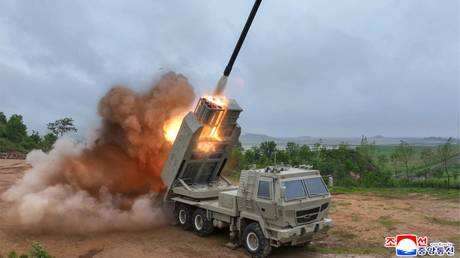
North Korea’s recent testing of an integrated strike complex—combining tactical ballistic missiles, 240mm rocket artillery, and low-altitude cruise missiles featuring Automatic Target Recognition (ATR)—signals a structural shift from indiscriminate mass deterrence to highly localized, algorithmic counter-force capabilities. By moving beyond long-range strategic deterrence, Pyongyang is actively addressing a critical operational vulnerability: the inability to defeat fortified tactical assets within a 100-kilometer envelope below the nuclear threshold.
This development transitions North Korean military doctrine from political posture to actionable battlefield execution. Understanding this shift requires looking past state media rhetoric and breaking down the engineering realities, data supply chains, and strategic calculus driving this modernization effort. For another view, check out: this related article.
The Three Pillars of the Integrated Precision Complex
The May 2026 tests demonstrate a shift away from isolated weapons procurement toward an integrated tactical complex. The architecture relies on three distinct vectors designed to overwhelm contemporary missile defense systems through variable flight profiles and synchronized arrival times.
1. The Low-Altitude Vector: ATR Cruise Missiles
The core technical advancement involves a short-range, tactical cruise missile operating within a 100-kilometer radius. Rather than relying solely on inertial navigation systems (INS) or spoofable commercial satellite signals, the platform integrates an optical or infrared seeker mated to an algorithmic processing unit. The core function is Automatic Target Recognition (ATR). The missile maps terrain features or radar cross-sections in real time, comparing sensor inputs against pre-loaded onboard digital libraries to confirm and lock onto high-value targets during the terminal phase. Similar coverage on the subject has been provided by Associated Press.
2. The Ballistic Vector: Tactical Ballistic Missiles with Specialized Warheads
Operating at higher altitudes and velocities, these platforms create a dual-tier interception dilemma for defenses like the Patriot (PAC-3) or South Korea’s L-SAM. The testing of a "special mission warhead" points to a payload optimized for sub-munitions dispersion or hard-target penetration, intended to neutralize regional command centers, airbases, or staging areas.
3. The Volume Vector: 240mm Long-Range Rocket Artillery
The 240mm multiple-launch rocket system (MLRS) provides the saturating volume needed to deplete interceptor stockpiles. By equipping these rockets with basic trajectory-correction kits, the system ensures that high-volume barrages arrive with sufficient accuracy to pin down defensive assets, opening corridors for the precision cruise and ballistic vectors to strike their intended targets.
The Machine Learning Bottleneck: Compute and Data Constraints
Western analysts frequently question the validity of North Korean "artificial intelligence" claims given the strict international sanctions on advanced silicon. However, achieving automated target recognition does not require multi-billion-parameter large language models or ultra-high-end enterprise GPUs. ATR systems can operate efficiently on edge-computing hardware, utilizing mature convolutional neural networks (CNNs) trained on modest physical footprints.
The true operational constraint rests on two specific components:
The Compute Function
The onboard processing unit must execute computer vision algorithms within milliseconds during high-speed terminal maneuvers. Sanctions evasion networks, combined with domestic research into industrial-grade field-programmable gate arrays (FPGAs) and application-specific integrated circuits (ASICs), provide sufficient, low-power computational capacity to handle basic edge-inference tasks.
The Training Data Supply Chain
An algorithmic guidance system is only as accurate as its training dataset. To map and identify South Korean military infrastructure, North Korean intelligence must feed its models high-resolution imagery. This asset-mapping requirement is fulfilled through two primary channels:
- Commercial Imagery Exploitation: Utilizing open-source intelligence, satellite imagery purchases via front companies, and corporate cyber espionage.
- State-Level Cyber Financing: Operations by entities like the Lazarus Group. In 2025 alone, North Korean cyber campaigns extracted over $2 billion in digital assets. This capital directly finances the procurement of dual-use technology, server infrastructure, and the high-density storage arrays needed to build and maintain military-grade machine learning datasets.
The Ukrainian Feedback Loop: Empirical Data Acquisition
Weapons development requires iterative testing against active countermeasures. While North Korea’s domestic testing provides basic telemetry, its defense industrial base has secured a vital source of empirical performance data through its strategic relationship with Moscow.
[North Korea Weapon Deliveries to Russia (Late 2023 - Present)]
                        │
                        ▼
         [Active Use in Ukraine Conflict]
                        │
                        ▼
   [Telemetry, EW Failure Modes, & Interception Data]
                        │
                        ▼
     [Direct Feedback to Pyongyang Labs]
                        │
                        ▼
[Algorithmic & Structural Modifications to Missile Systems]
Since late 2023, North Korea has supplied thousands of conventional artillery shells and tactical ballistic missiles (such as the Hwasong-11 series) for use in the Ukraine conflict. This arrangement yields an invaluable return for Pyongyang: live combat telemetry.
The integration of North Korean hardware into a contested, high-intensity electronic warfare environment serves as an external research and development lab. This pipeline delivers real-world performance metrics on how specific guidance packages perform against Western-supplied air defense systems, radar arrays, and GPS-jamming assets.
If a guidance system fails due to electronic warfare spoofing, that failure mode is documented, analyzed, and used to write software patches or modify hardware configurations for the systems deployed along the Demilitarized Zone. The automated launch systems validated in the recent tests are a direct product of these design iterations.
Sub-Nuclear Counter-Force: Shifting the Escalatory Calculus
The deployment of a highly accurate, 100-kilometer-range precision strike complex fundamentally alters the regional balance of power. For decades, North Korea’s conventional option for striking Seoul relied on unguided, massed artillery barrages. While highly destructive, this approach lacked the precision required to surgically neutralize specific military targets, leaving nuclear escalation as Pyongyang's only reliable method for deep strategic interdiction.
By introducing ATR-equipped tactical weapons, the regime builds a credible sub-nuclear counter-force capability. The strategic intent is to create a conventional option capable of paralyzing key infrastructure—such as radar installations, communication nodes, and command bunkers—without crossing the nuclear threshold.
This presents a serious dilemma for South Korean and allied defense planners. A localized, highly accurate conventional strike along the border cannot be easily met with a strategic nuclear response, giving North Korea greater flexibility to apply tailored military pressure.
Operational Limitations and System Vulnerabilities
Despite the tactical advantages presented by automated guidance systems, the integrated complex faces distinct operational liabilities that prevent it from becoming an absolute battlefield solution.
- Environmental Sensitivity: Optical and infrared ATR systems are inherently restricted by atmospheric conditions. Heavy fog, cloud cover, sandstorms, or dense smoke can degrade seeker performance, blind the onboard computer vision algorithms, and force the missile to revert to less accurate inertial navigation.
- Susceptibility to Passive Countermeasures: Because automated target recognition relies on matching real-time visual or radar profiles against a pre-existing database, it can be mitigated through deliberate deception. Fast, low-cost modifications to high-value targets—such as multispectral camouflage netting, decoy deployments, or structural alterations to buildings—can prevent the missile's algorithms from achieving a confidence score high enough to lock on.
- The Single-Point-of-Failure Risk: Moving toward automated, algorithmic command-and-control systems introduces new vulnerabilities. If an adversary successfully compromises the pre-launch data pipeline or injects adversarial examples into the training data, the entire automated precision complex can be degraded simultaneously without firing a shot.
Counter-Precision Mobilization
To neutralize the operational impact of North Korea’s algorithmic strike complex, regional defense strategies must shift away from a reliance on kinetic interception alone. The high volume of an integrated ballistic, cruise, and artillery attack can rapidly deplete finite air defense stockpiles like Patriot and L-SAM batteries.
Defenders must deploy an asymmetric, multi-layered counter-strategy focused on disrupting the automated guidance loop at every stage of execution:
- Algorithmic Spoofing and Deception: Defensive infrastructure must be updated with dynamic visual and thermal signatures. By rapidly altering the physical and radar cross-section profiles of static command locations, forces can induce terminal correlation failures within the missile's edge-computing algorithms, forcing target abandonment or miss states.
- Electronic Warfare at Scale: Deploying wide-area GPS spoofing and local, high-power infrared countermeasures can degrade sensor inputs during the final 10 kilometers of the flight profile, blinding the terminal seeker.
- Targeted Supply Chain Interdiction: Disrupting the flow of dual-use microelectronics and securing the digital assets targeted by state-backed cyber groups directly limits the processing power and data cultivation necessary to keep these guidance libraries updated.


