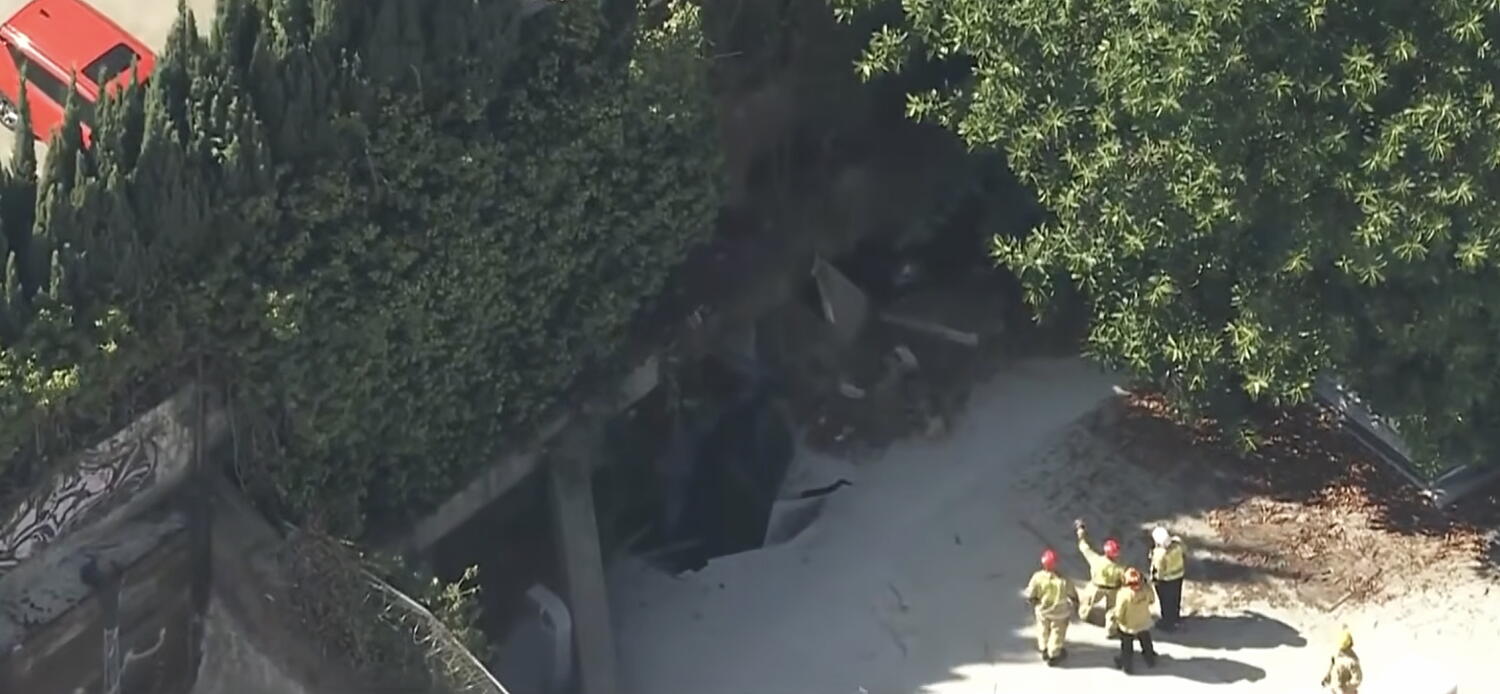
Geotechnical stability in urbanized sloped terrain operates on a delicate equilibrium between gravitational load, soil shear strength, and drainage capacity. When thousands of gallons of unmanaged water enter a closed hillside system, that equilibrium fails catastrophically. The partial slope collapse on North Wilcox Avenue in the Hollywood Hills, precipitated by an overflowing residential swimming pool, illustrates the severe vulnerability of high-density hillside architecture to localized hydrological mismanagement.
Deconstructing this failure requires examining the mechanical vectors that transformed a continuous water source into structural collapse.
The Vector of Failure: Hydrological Surcharge
The proximate trigger of the Wilcox Avenue slide was an unmonitored garden hose left running into a swimming pool over an extended period. To understand why this input caused a systemic failure, one must evaluate the volumetric parameters involved. Emergency responders from the Los Angeles Fire Department extracted approximately 6,000 to 7,000 gallons of water via siphon injectors to stabilize the remaining structure, translating to roughly 50,000 to 56,000 pounds of water removed from the upper tier.
Before extraction, that volume had already escaped the pool vessel. Water introduction into a hillside slope alters the geotechnical profile through three distinct physical mechanisms:
- Matric Suction Loss: Unsaturated hillside soils maintain shear strength largely through matric suction—negative pore-water pressure that binds soil particles together. As water infiltrates the soil matrix, saturation drives matric suction down to zero, eliminating apparent cohesion.
- Unit Weight Increase: Introducing water into void spaces dramatically increases the bulk unit weight of the soil. A saturated cubic yard of earth exerts significantly more downward and lateral gravitational force on underlying strata than a dry counterpart.
- Pore-Water Pressure Accumulation: As water percolates downward through colluvial soil layers and hits less permeable bedrock or compacted fill, it creates perched water tables. This generates positive pore-water pressure, which pushes outward against retaining structures.
The Cost Function of Retaining Wall Failure
Retaining walls built into urbanized hillsides are engineered to counteract specific lateral earth pressures based on calculated soil friction angles and anticipated surcharge loads. They are rarely engineered to act as hydraulic dams holding back liquefied soil.
When the overflowing pool water saturated the upper slope, the lateral earth pressure coefficient shifted. The dry weight assumption used in the wall's structural design was replaced by the hydrostatic pressure of a semi-fluid mud slurry.
The structural sequence of the failure followed a precise vector:
- The upper soil mass liquefied, increasing lateral thrust beyond the bending moment capacity of the retaining wall.
- The concrete-block (cinder block) retaining wall experienced structural shear failure.
- Heavy masonry units and debris broke free, cascading down the slope as a localized debris flow.
- The kinetic energy of the falling debris and mass of earth impacted the roof of the lower, vacant apartment structure, breaching the building envelope.
This demonstrates how a secondary asset—the lower apartment building—absorbed the kinetic and material debt generated by an unmanaged top-of-slope utility source.
The Absence of Operational Redundancies
Urban planning and property management in high-risk topography require active and passive redundancies. The Hollywood Hills incident exposes the fragility of systems reliant on single points of human attention.
In residential engineering, water management systems must feature overflow drains, backflow preventers, and automated shut-off valves. When an asset lacks an overflow drainage pipe tied directly to the municipal storm drain system, the pool margin becomes the primary spillway. If that spillway directs water toward the retained cut rather than away from the slope, the architecture actively channels destructive forces toward its own foundations.
Furthermore, the absence of automated water-level sensors in residential pools leaves property safety entirely dependent on continuous visual monitoring. In densely built environments where properties interface directly via shared retaining walls, individual operational negligence creates systemic exposure for adjacent parcels.
Geotechnical Mitigation and Structural Resilience
Preventing a recurrence of slope failures in high-density gradient zones requires shifting from reactive emergency response to predictive infrastructure hardening.
Property owners and municipal regulators must implement structural monitoring protocols:
- Subsurface Drainage Networks: Installing perforated sub-drains (french drains) behind retaining walls to intercept migrating moisture before hydrostatic pressures accumulate.
- Inclinometer and Tiltmeter Integration: Deploying low-cost displacement sensors on retaining structures to measure micro-movements long before catastrophic shear thresholds are reached.
- Mandatory Overflow Routing: Enforcing strict building codes that require pool and spa overflow systems to pipe excess water entirely away from unpaved soils and directly into engineered street drainage channels.
The Hollywood Hills incident was classified by emergency officials as entirely avoidable. By treating water management as a critical structural variable rather than a routine utility task, operators can eliminate the primary catalyst for artificial slope destabilization.
This video provides on-the-ground news footage of the apartment complex and the affected hillside area following the emergency response.