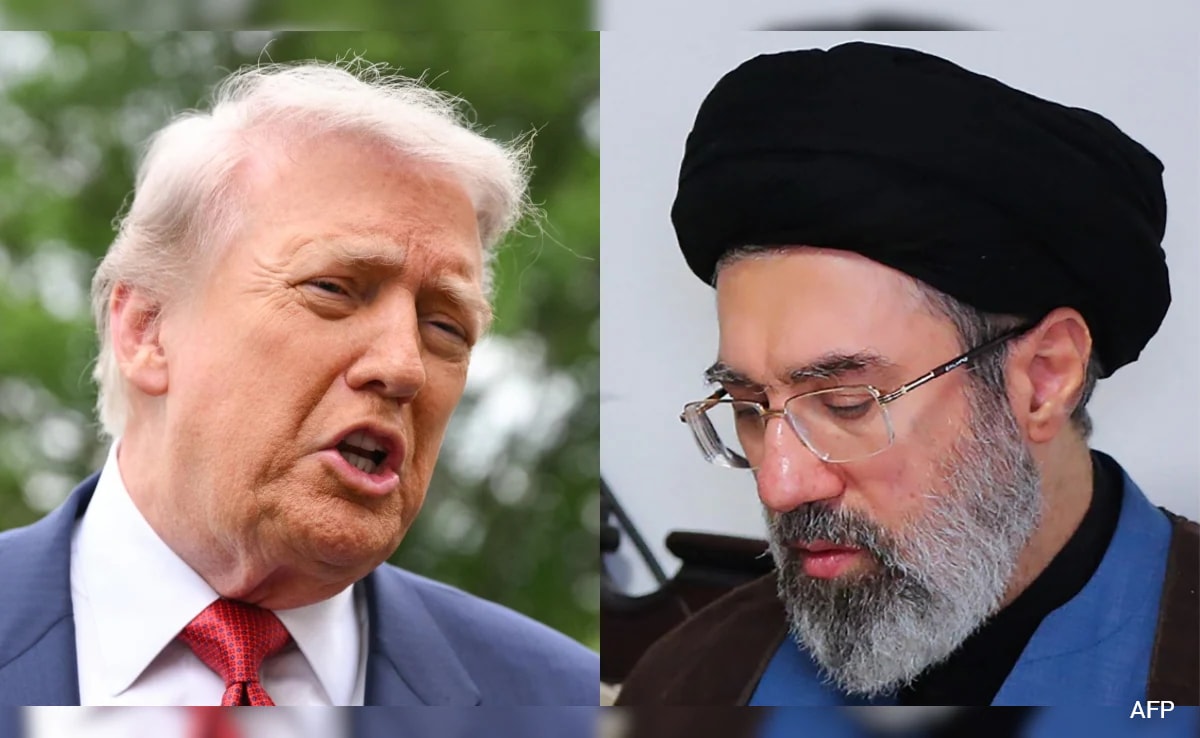
The issuance of a strict directive by Iran’s Supreme Leader, Ayatollah Mojtaba Khamenei, prohibiting the export of the country's highly enriched uranium stockpile exposes the core structural friction in the ongoing Pakistan-mediated peace negotiations with the United States. This executive order directly challenges a non-negotiable security prerequisite established by U.S. President Donald Trump and Israeli Prime Minister Benjamin Netanyahu: the complete physical extraction of Iran's near-weapons-grade material.
To evaluate the probability of a diplomatic resolution versus a resumption of kinetic operations, the standoff must be analyzed through strategic game theory and operational security frameworks. The current impasse is not a mere dispute over terms; it is an irreconcilable clash between Iran’s asymmetric deterrence survival strategy and the U.S.–Israeli counter-proliferation doctrine.
The Strategic Value Function of the 60 Percent Stockpile
Tehran’s refusal to export its highly enriched uranium—specifically its inventory of material enriched to the 60 percent threshold—is dictated by a strict defensive cost-benefit equation. In international relations theory, this behavior aligns with the concept of strategic hedging under severe security deficits.
                       [ Iran's 60% Stockpile ]
                                  |
         +------------------------+------------------------+
         |                                                 |
         v                                                 v
[ Leverage Multiplier ]                          [ Deterrence Threshold ]
Compensates for economic collapse                Prevents decapitation strikes
and maritime blockades.                          by maintaining a rapid breakout option.
1. The Leverage Multiplier
The International Atomic Energy Agency (IAEA) noted that Iran possessed an estimated 440.9 kg (roughly 900 pounds) of 60 percent enriched uranium at the onset of the U.S.–Israeli air campaign. Following intensive kinetic strikes on Iranian atomic infrastructure, this material represents Tehran’s primary remaining geopolitical asset. With the Iranian economy reeling from a U.S. Navy maritime blockade and parallel shipping restrictions in the Strait of Hormuz, the physical possession of this material functions as Iran's sole high-yield mechanism to compel a permanent ceasefire and economic sanctions relief.
2. The Deterrence Threshold
From the perspective of the Iranian security establishment, exporting the highly enriched stockpile introduces an acute vulnerability bottleneck. If Tehran relinquishes the material before securing legally binding, ironclad security guarantees from Washington and Tel Aviv, it permanently lowers its defensive threshold. The regime views the current pause in hostilities not as a good-faith diplomatic opening, but as a tactical deception by the United States designed to establish a permissive environment before resuming structural degradation strikes. Retaining the 900-pound stockpile inside domestic territory preserves a rapid breakout option to 90 percent weapons-grade material ($U^{235}$), which serves as a psychological check against foreign-led regime destabilization.
The Counter-Proliferation Doctrine of the United States and Israel
Conversely, the U.S. administration operates under a zero-tolerance counter-proliferation mandate where the total denuclearization of Iran is the baseline definition of victory. President Trump’s public declaration that the U.S. will "retrieve" and "destroy" the material illustrates a posture rooted in absolute risk elimination.
The U.S.–Israeli strategic position is governed by three operational variables:
- The Zero-Stockpile Requirement: Under the parameters communicated by Israeli officials, no regional settlement can be achieved while near-weapons-grade material remains under sovereign Iranian custody. The removal of the enriched uranium is prioritized alongside the elimination of long-range ballistic missile delivery systems and the cessation of regional proxy architecture.
- The Inefficacy of Aerial Burial: While U.S. and Israeli airstrikes succeeded in structurally burying and isolating significant portions of the nuclear infrastructure, the physical material survived. Because kinetic operations cannot permanently erase scientific knowledge or fully secure sub-surface stockpiles, physical extraction or verifiable destruction remains the only absolute safeguard against a future Iranian breakout.
- The Re-escalation Threat Curve: The U.S. executive branch has utilized a compressed negotiation window to prevent Tehran from exploiting the indefinite ceasefire to re-engineer damaged centrifuges. By publicly stating that the U.S. is prepared to execute "nasty" alternative measures within a matter of days, Washington attempts to distort Iran's risk calculus by making the preservation of the status quo economically and physically unsustainable.
Technical Compromises and Structural Bottlenecks
While the political rhetoric from both capitals suggests a binary, zero-sum outcome, technical frameworks exist that could theoretically bridge the gap. However, each potential compromise introduces distinct operational vulnerabilities that limit its viability.
The Dilution Alternative
The most technically viable compromise under IAEA protocols is the domestic down-blending or dilution of the 60 percent enriched uranium back to low-enriched uranium (LEU) levels (under 5 percent $U^{235}$), which are suitable only for civilian research or power generation.
[ 440.9 kg of 60% Enriched Uranium ]
                 |
                 v
     ( Down-Blending / Dilution )
                 |
                 v
  [ Low-Enriched Uranium (< 5% U-235) ]
This protocol would satisfy Iran's requirement that the material physical remain within its borders, while satisfying the Western requirement that the immediate breakout threat be neutralized.
The primary limitation of this strategy is verification asymmetry. Dilution requires extensive, uninterrupted access for international inspectors to oversee chemical conversion processes. Given the deep mistrust between the clerical establishment and Western intelligence agencies, Tehran views pervasive inspections as a Trojan horse for operational target acquisition, while Washington views any domestic processing as a potential screen for covert diversion.
Sovereign Security Guarantees
Iran's diplomatic sequencing requires a permanent, legally binding ceasefire and the lifting of maritime blockades before any granular technical execution can begin. This creates a classic negotiation bottleneck:
[ Iran's Sequenced Requirement ] ──> Permanent Ceasefire & Blockade Lift ──> Nuclear Technical Execution
                                                                                       ^
                                                                                       │ (Impassable Bottleneck)
                                                                                       v
[ U.S. Sequenced Requirement ]  ──> Physical Stockpile Extraction       ──> Permanent Cessation of War
Because neither actor possesses the strategic trust required to execute their steps concurrently, the negotiation remains frozen in a state of high-risk brinkmanship.
Strategic Playbook and Tactical Forecast
The negotiation has reached a terminal point where the utility of ambiguity has been exhausted. Given the structural constraints governing both regimes, the situation will likely evolve along one of two operational trajectories over the coming weeks.
Scenario A: Managed Technical Cap
Under a highly fragile diplomatic breakthrough, Oman and Pakistan broker a multi-stage framework. The United States provides temporary, rolling sanctions waivers and suspends active naval interdictions in the Persian Gulf in exchange for Iran placing its entire 60 percent stockpile under dual-key IAEA seals. The material remains physically within Iranian territory, but is rendered chemically un-releasable without triggering an immediate, automated Western kinetic response. This path preserves Iranian sovereignty while freezing the breakout clock, offering an exit ramp from the catastrophic economic toll of the maritime blockade.
Scenario B: Resumption of Counter-Value Kinetic Operations
If Ayatollah Mojtaba Khamenei maintains an absolute veto on material modification or verification access, the Trump administration will likely conclude that the diplomatic track has been weaponized as a delaying tactic. The U.S. will terminate the indefinite ceasefire and resume targeted aerial operations. Unlike previous rounds that focused on hardened nuclear research facilities, subsequent military actions would likely pivot toward counter-value and economic targets, specifically targeting Iran's domestic energy refining capacity and port infrastructure along the Persian Gulf to force a structural collapse of the regime's remaining financial lifelines.
The strategic imperative for Tehran is to recognize that the 60 percent stockpile functions as a diminishing asset. As containment technologies advance and the economic costs of the blockade compound, the defensive utility of the material will be completely eclipsed by the systemic decay of the state's internal stability.