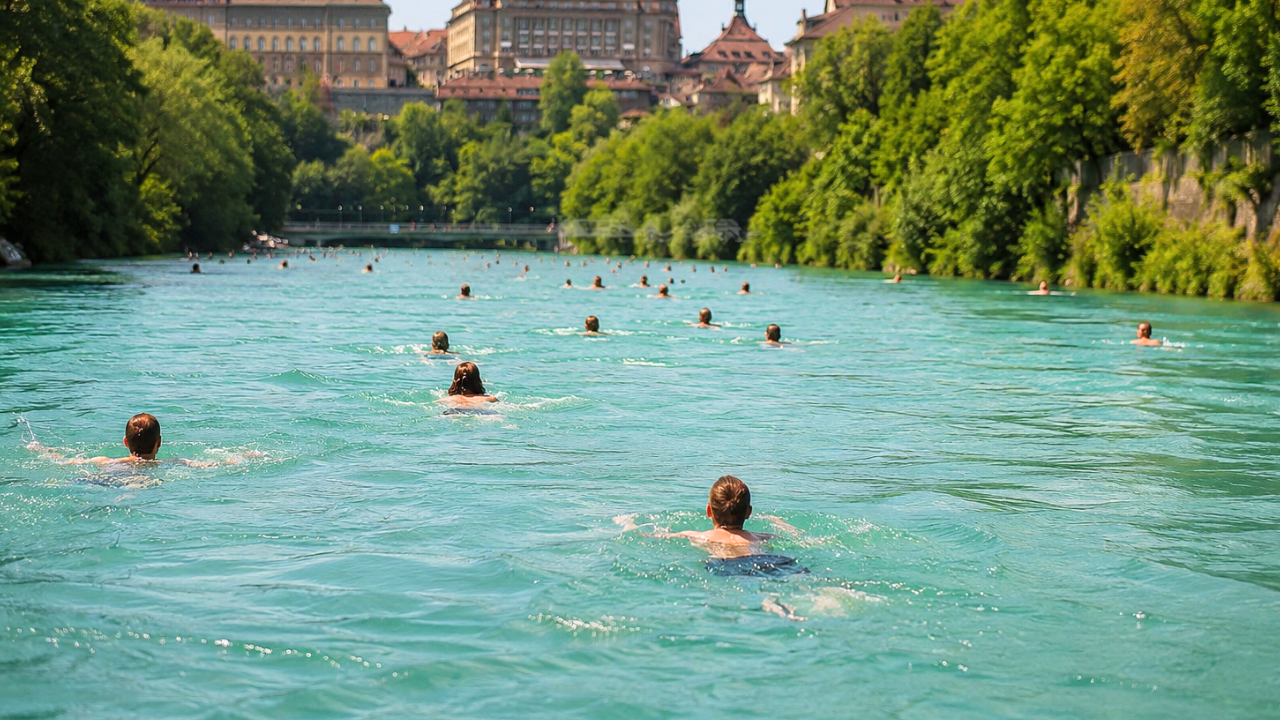
The utilization of the Rhine River as a seasonal transit artery in Basel, Switzerland, represents a rare alignment of hydraulic engineering, urban planning, and socioeconomic behavior. While often framed as a leisure activity, the practice functions as a high-efficiency multimodal transportation hack that bypasses traditional urban friction points. The feasibility of this "swim-to-work" or "float-home" phenomenon rests on three non-negotiable pillars: predictable river velocity, specialized waterproof hardware, and high-density urban infrastructure situated directly on the riparian axis.
The Hydrodynamic Advantage and Flow Mechanics
The Rhine provides a consistent kinetic energy source that acts as a natural conveyor belt. In Basel, the river flows at an average speed of 6 to 10 kilometers per hour depending on seasonal melt and precipitation levels. This velocity is critical. If the flow were slower, the energy expenditure required for propulsion would negate the utility of the transit. If it were faster, the safety risks and difficulty of navigating to specific egress points would rise beyond the acceptable threshold for a general population.
The system operates on a low-friction physics model. By entering the water at a point upstream (e.g., near the Museum Tinguely) and exiting downstream in the Grossbasel or Kleinbasel districts, a commuter utilizes the river’s discharge rate to achieve transit times that frequently rival or beat the city’s tram network during peak congestion hours.
The Wickelfisch as a Critical Infrastructure Component
The primary failure point in aquatic commuting is the "dry-state requirement" of the destination. Without a reliable method to transport professional attire, electronics, and documentation, the river ceases to be a transit option. The solution is the Wickelfisch—a teardrop-shaped, roll-top dry bag that serves two distinct mechanical functions:
- Hermetic Storage: It maintains an airtight seal through a multi-fold closure system, ensuring that high-value assets remain dry despite total immersion.
- Buoyancy Assistance: When rolled correctly, the bag traps a specific volume of air, providing enough displacement to act as a safety buoy. This allows the commuter to maintain a neutral or positive buoyancy profile, minimizing the muscular effort required to stay afloat and allowing the river’s current to do the majority of the work.
This hardware removes the need for locker-room infrastructure at the point of origin. A commuter can transition from an office environment to the water in under three minutes by simply packing their clothes and entering the river.
Urban Integration and the Egress Problem
A river is only a viable transit corridor if the points of entry and exit are frequent and safe. Basel’s riverbanks are engineered with this specific human-water interface in mind. The presence of stone steps, fixed handrails, and "Buvettes" (refreshment stands with adjacent changing areas) transforms the natural bank into a series of transit terminals.
The density of the city plays a decisive role in the cost-benefit analysis of this method. Because Basel is compact, the distance from the riverbank to major employment hubs or residential blocks is typically less than a 10-minute walk. This minimizes the "last-mile" problem. The river serves as the "trunk" of the journey, while the final walk provides the necessary transition to the indoor environment.
The Socioeconomic Logic of Aquatic Commuting
The decision to swim home is a rational choice governed by a specific utility function. The primary variables include:
- Thermal Regulation: During summer months, urban heat islands increase the discomfort of traditional tram or bus travel. The Rhine, fed by alpine runoff, maintains temperatures between 18°C and 23°C, providing immediate heat dissipation.
- Temporal Efficiency: During the 5:00 PM rush hour, bridge traffic and tram frequency can lead to unpredictable delays. The river’s flow rate is constant, offering a high degree of "on-time" reliability.
- Psychological Decompression: The transition from a high-cognitive-load work environment to a sensory-deprived aquatic environment acts as a definitive boundary between professional and personal time.
The economic cost is negligible. After the initial investment in a dry bag (approximately 30 to 40 CHF), the marginal cost per trip is zero. Compared to a monthly transit pass or the upkeep of a vehicle, the river offers the highest possible return on investment for seasonal travel.
Risk Assessment and Boundary Conditions
The Basel model is not a universal solution; it is a niche optimization that requires specific environmental conditions. There are several factors that can break the system's logic:
Water Quality and Public Health
The Rhine in Basel benefits from rigorous upstream chemical management and sewage treatment. If the bacterial count (specifically E. coli) exceeded safety thresholds, the public health cost would immediately outweigh the transit benefits. The Swiss government maintains real-time monitoring stations to ensure the water remains "Class A" for swimming.
Hydraulic Hazards
The river is a shared space. Large Rhine barges and passenger ships have restricted maneuverability and significant blind spots. The "commuter" must adhere to a strict lateral separation, staying within designated swimming zones—typically the banks of the Kleinbasel side—to avoid the central shipping channel. Failure to respect the "Vortritt" (right of way) of motorized vessels introduces a terminal risk factor.
Thermal Limits
The utility of this system is strictly seasonal. Once the water temperature drops below 15°C, the risk of cold-water shock and hypothermia makes the transit unfeasible for the general public without specialized neoprene gear, which increases the friction of the transition process.
Strategic Replicability in Global Urban Centers
City planners in other river-adjacent metropolises often view the Basel model as a cultural quirk rather than a logistical blueprint. This is an oversight. For a city to replicate this aquatic transit success, it must address the "Three Cs": Cleanliness, Current, and Connection.
Many cities (such as London, Paris, or New York) possess the necessary current and urban density but fail on the cleanliness and connection metrics. The lack of accessible ladders or steps makes the water a "trap" rather than a corridor. Furthermore, the psychological barrier of water quality prevents the critical mass of users required to normalize the behavior.
The Basel case study proves that when a city treats its waterway as a piece of functional infrastructure rather than a decorative backdrop, it can successfully offload a significant portion of seasonal transit volume to a zero-carbon, high-reliability natural system.
The most effective strategy for city administrators looking to optimize urban movement is to move beyond the "park-centric" view of riverbanks. Transforming a river into a transit asset requires the installation of high-frequency egress points every 200 to 400 meters and the aggressive enforcement of water quality standards. For the individual, the tactical move is the adoption of buoyancy-assisted dry storage, turning the commute from a period of passive congestion into a period of active, high-efficiency transit. As urban temperatures continue to rise, the "blue corridor" becomes the most logical relief valve for overloaded terrestrial networks.