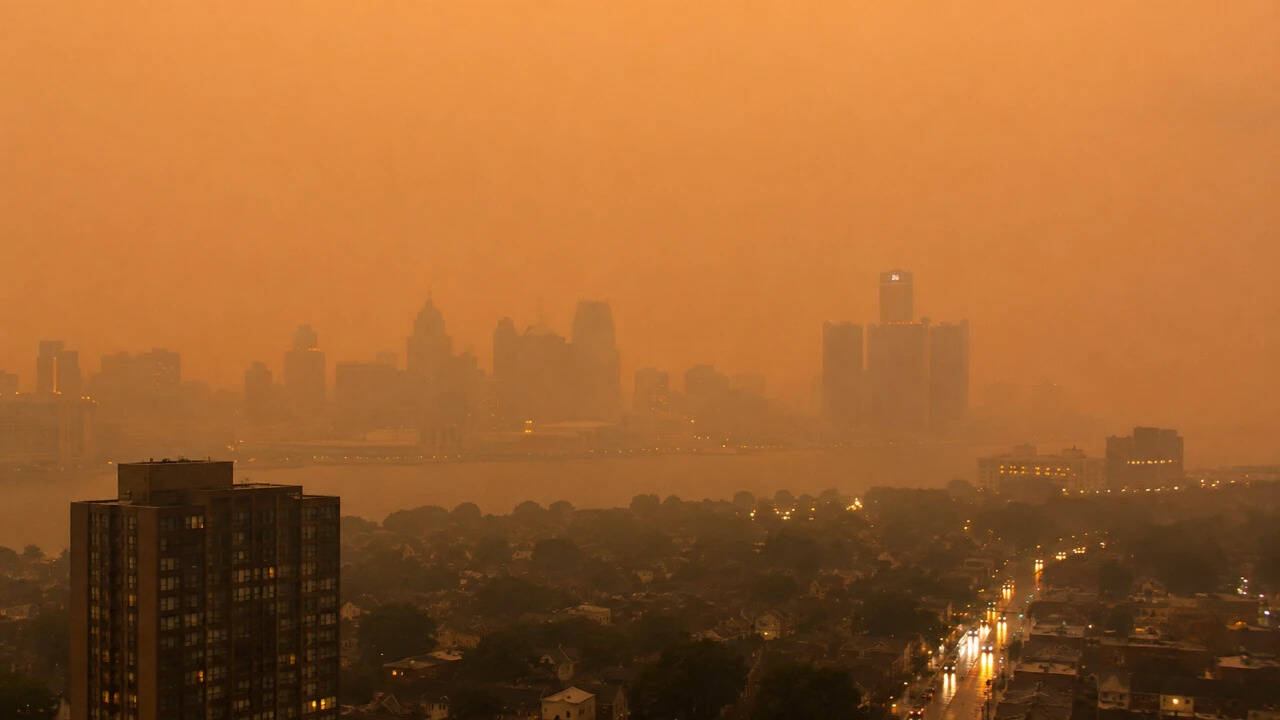
When the Air Quality Index breached 616 in parts of Michigan during the recent transboundary smoke transport from Ontario, standard environmental monitoring models effectively malfunctioned. The Environmental Protection Agency officially caps its scale at 300, designating anything beyond that threshold as hazardous. Readings surpassing double that upper bound indicate a systemic failure in how regional authorities assess atmospheric toxicity, exposing populations to particulate loads that historical regulatory frameworks never anticipated.
To understand how a regional air shed degrades to an index value of 616, one must evaluate the physical mechanics of long-range particulate transport. Wildfires do not merely burn timber; they act as high-temperature thermal reactors that vaporize organic matter, minerals, and synthetic compounds, releasing them into the free troposphere.
The Transport Mechanics of Fine Particulate Matter
The velocity and trajectory of smoke plumes depend on mid-tropospheric steering winds. When intense high-pressure systems stall over the Great Lakes while low-pressure zones anchor over central Canada, a persistent northerly channeling effect occurs. This atmospheric configuration creates an uninhibited transport corridor.
Fine particulate matter, specifically particles with an aerodynamic diameter under 2.5 micrometers known as PM2.5, dominates these plumes. Because of their microscopic scale, these particles possess negligible settling velocity. They remain suspended in air masses for days or weeks, traveling hundreds or thousands of miles without significant gravitational deposition.
As the plume migrates southward, interaction with solar radiation triggers secondary organic aerosol formation. Volatile organic compounds cooking within the drifting haze react with ambient oxidants, compounding the total particulate mass before the front ever crosses the international border.
The Structural Breakdown of the Air Quality Index
The Air Quality Index is a dimensionless number designed for public communication rather than toxicological precision. It converts pollutant concentrations into a segmented scale from 0 to 500, mapped against specific health breakpoints.
- The Index assumes a linear or piecewise constant relationship between concentration and health risk up to the 300 ceiling.
- Values exceeding 500 fall outside federal reporting standards, forcing regional agencies to extrapolate or adopt local emergency indices.
- The metric measures mass concentration in micrograms per cubic meter, failing to account for the toxicological variance of the underlying chemical composition.
Smoke from Canadian boreal shield fires carries distinct chemical signatures compared to urban smog. It contains high concentrations of polycyclic aromatic hydrocarbons, heavy metals absorbed by vegetation, and cellulose pyrolysis products. Measuring total mass concentration via PM2.5 hides the qualitative toxicity of the specific combustion byproducts.
Physiological Vulnerability and the Absence of a Safe Threshold
Epidemiological tracking of high-exposure episodes reveals clear physiological damage across distinct organ systems. When particulate concentrations spike exponentially, biological defense mechanisms break down immediately.
Mucociliary clearance in the upper respiratory tract becomes overwhelmed by sheer particle volume. Particles smaller than 2.5 micrometers bypass the nasal passages and bronchial filters, lodging directly in the pulmonary alveoli. From there, ultra-fine fractions cross the alveolar-capillary membrane, entering the systemic circulation directly.
This systemic translocation triggers acute systemic inflammation. Circulating cytokines increase rapidly, elevating blood viscosity, promoting endothelial dysfunction, and destabilizing existing atherosclerotic plaques. Clinical data demonstrates that exposure spikes correlate directly with acute myocardial infarctions, ischemic strokes, and severe exacerbations of chronic obstructive pulmonary disease within seventy-two hours of initial inhalation.
Recent evaluations published in academic literature indicate that no safe threshold exists for PM2.5 exposure. Every incremental increase in concentration yields a measurable rise in all-cause mortality, proving that emergency episodes like the Michigan event represent acute manifestations of a chronic, systemic threat multiplier.
Strategic Mitigation and Structural Adaptation
Mitigating the impacts of transboundary smoke requires shifting public health strategy from reactive advisories to infrastructure hardening. Traditional guidance advising individuals to stay indoors fails when building envelopes lack positive-pressure filtration systems. Most residential HVAC units recirculate unfiltered indoor air or draw in unconditioned outdoor air through loose seals.
Effective operational defense relies on three structural adjustments:
- Retrofitting municipal and commercial buildings with MERV 13 or HEPA filtration arrays capable of scrubbing sub-micron particles from indoor air spaces.
- Establishing localized clean-air sanctuaries equipped with continuous particulate monitoring and dedicated high-capacity air purification units for vulnerable populations.
- Redesigning wildland fuel management policies through increased controlled burns, reducing the available biomass fuel load that feeds high-intensity, catastrophic crown fires.
Until regional land management and international climate trajectories align to reduce the frequency of high-intensity boreal fires, extreme air quality episodes will remain a recurring structural shock to North American population centers. Public health architecture must evolve to treat atmospheric smoke not as an anomaly, but as a persistent, transboundary variable of modern environmental risk.


