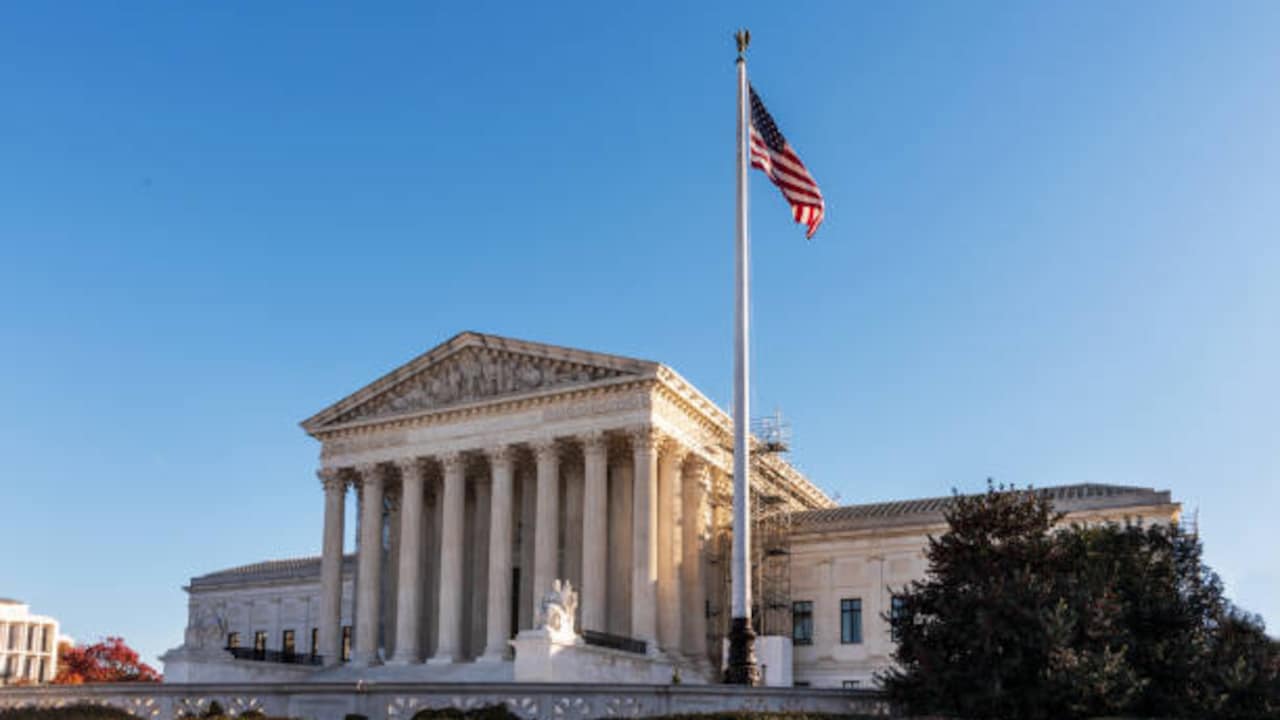
The ink on a legal brief is rarely red, but to the people standing outside the courthouse on a damp morning in Washington, it might as well have been.
Inside the marble chamber, justices had just weighed the architecture of movement, sovereignty, and escape. Outside, the air smelled of wet asphalt and diesel exhaust. A man named Mateo stood by a transit shelter, clutching a manila envelope with fingers calloused by cement work. He didn't speak English well enough to parse the headlines scrolling across a news ticker overhead, but he knew the grammar of sudden changes. When the law shifts, the ground beneath your boots tends to drop an inch or two. Don't forget to check out our recent coverage on this related article.
For months, the debate had rolled through federal courts like a slow-moving front. The central question was deceptively clinical: Can a government send asylum seekers away to a third country—a nation not of their origin, not of their choosing—while their legal pleas remain half-written?
To the architects of the policy, the answer was a matter of math and logistics. Borders have limits. Systems have capacities. If an arriving traveler steps off a plane or crosses a river, the state must have valves to release the pressure. They called it deterrence. They called it orderly management. To read more about the context here, Al Jazeera offers an in-depth summary.
To Mateo, and thousands like him, it was something else entirely. It was a blank space drawn over the map of their lives.
To understand why the Supreme Court’s green light on third-country deportations matters so intensely, you have to look past the dense terminology of administrative law and immigration statutes. You have to look at what happens when a human being becomes a jurisdictional footnote.
Imagine walking for weeks across inhospitable terrain, sleeping under plastic tarps, dodging extortionists, and trading your last savings for a chance at a hearing in a room with a flag and a judge. You arrive at the threshold. You state your fear—the specific, named men back home who marked your house, the threats whispered through telephone wires, the quiet disappearance of your cousin. You expect, at the very least, to be heard where you landed.
Instead, under the mechanism cleared by the high court, the destination changes. The destination is no longer the safety you aimed for, but a third nation that agreed to take you in exchange for diplomatic favors, financial aid, or regional alignment.
It is the bureaucratic equivalent of handing a lost traveler a bus ticket to a city they have never heard of, in a country where they know no one, speak no dialect of the local market, and possess zero legal footing.
Legal scholars call this burden-shifting. Historians call it a familiar playbook. But on the ground, it feels like vanishing.
The legal mechanism rests on the concept of safe third countries. The theory goes like this: If a nation is deemed stable enough to process human rights claims, transferring an asylum seeker there does not violate the foundational principle of non-refoulement—the international law doctrine forbidding countries from returning people to places where they face persecution.
It sounds tidy on paper. But paper is remarkably patient. It absorbs whatever ink is spilled onto it.
In practice, the nations designated as safe havens often struggle to provide basic safety, employment, or due process for their own citizens, let alone a sudden influx of displaced populations. When thousands of asylum seekers are rerouted to a state with an overwhelmed infrastructure, the safety net frays instantly. Legal aid vanishes. Housing turns into overcrowded encampments. The promise of an adjudication becomes a multi-year waiting game in a bureaucratic limbo, where work permits are scarce and local resentment runs high.
This is where the emotional core of the ruling reveals itself. It is not merely about where a person sleeps tonight; it is about the erasure of agency.
When you strip away a person's right to present their case in the jurisdiction they reached, you tell them that their specific story does not matter. The journalist who fled censorship, the shopkeeper who refused to pay protection money to cartels, the political dissident whose scars are still fresh—their individual narratives are flattened into a single administrative category: transferred.
We have watched this pattern unfold across different continents over the past decade. Whenever migration meets political fatigue, borders harden not just by building taller fences, but by outsourcing the problem. Governments pay neighbors to hold the line. They draw legal circles that push the responsibility over the horizon, out of sight of domestic cameras and evening news broadcasts.
Out of sight, however, does not mean out of consequence.
When the Supreme Court allowed these third-country removals to proceed, it signaled a profound shift in how modern democracies handle the pressure of global displacement. It confirmed that expediency often triumphs over individual equity when systems are stretched to their breaking points. The court's decision did not invent this reality; it merely removed the judicial speed bumps that were slowing it down.
Yet, laws written in the abstract always crash against the concrete reality of human persistence.
Mateo didn't read the ruling. He didn't need to. He saw the shift in the eyes of the volunteer at the legal clinic, the way her shoulders dropped when she looked at the new filing requirements, the quiet urgency with which she told him to keep his phone charged.
Systems can draft rules to redirect human rivers, but rivers do not stop flowing simply because a dam is built upstream. They find new crevices. They carve new channels through the dark.
The courtroom doors closed hours ago. The reporters packed their gear, and the legal briefs were filed away in heavy cabinets. But out on the street, under a gray sky that threatened rain, the map remained incomplete, waiting for the next step.