Borders are not lines drawn on parchment with dry ink. They are scars cut into the flesh of families, maintained by the stubborn weight of history and the nervous twitch of politicians three hundred miles away.
Listen to the silence in South Armagh after midnight. It is a quiet punctuated only by the low rumble of a diesel tractor crossing an invisible boundary that no longer holds a customs post, but still holds an opinion. To an outsider, a map of the British Isles looks clean. Neat blue water, tidy green polygons, a tidy red line splitting a small northern shoulder from the rest of the island.
To the people who live there, the map is a heartbeat. And lately, that heart has begun to race.
It started with a casual sentence dropped across the Atlantic, the kind of political shibboleth that sounds harmless in a Washington ballroom but acts like a dropped match in a dry barn. When Donald Trump floated comments that touched upon the eternal, tender nerve of Irish unification, the shockwaves did not stay in the realm of cable news pundits. They traveled instantly eastward across the dark water of the Irish Sea, landing directly on the mahogany desks of London and Dublin.
Instantly, the diplomatic machinery cranked into motion. Emergency phone calls. Steely communiqués. A swift, synchronized reaffirmation of the Northern Ireland agreement—that fragile, hard-won peace built on compromise, exhaustion, and the shared realization that nobody wanted to return to the decades of smoke and sirens known locally as the Troubles.
Prime Ministers and Taoiseachs rushed to lock the doors against a draft they never invited. But why? Why does a stray remark from an American politician cause such immediate, localized panic?
Consider what happens when a fragile equilibrium is treated like a game of Jenga.
To understand the sudden diplomatic scramble, you have to look past the press releases and step inside a kitchen in Derry. Imagine Sarah, a fifty-year-old nurse whose mother carries the lifetime habit of checking under the hood of her car every morning out of an old, deep-seated reflex. Sarah lives in a dual-identity reality. She holds an Irish passport because it makes European travel simpler, works for a National Health Service funded by Westminster, and drinks in pubs where the currency in her pocket changes its symbol depending on which side of a concrete bridge she happens to be standing on.
For Sarah, the political status quo is not an abstract constitutional debate. It is the plumbing that works. It is the peace that allows her twenty-two-year-old son to study in Belfast without his parents wondering if a checkpoint will delay his ambulance.
When outsiders start debating unification as if it were a fantasy football trade, they treat a delicately balanced peace process like an academic thesis. They forget that the Good Friday Agreement—signed back in 1998 after thirty years of bloodshed—was never about resolving the irreconcilable. It was about shelving the irreconcilable so that children could grow up without learning the sound of a kneecapping or a car bomb.
The agreement created a system of diplomatic duct tape. It allowed nationalists to feel Irish and unionists to feel British, all while pretending the border between them was transparent. It worked because everyone agreed to blur the lines.
Then Brexit happened.
Suddenly, a bureaucratic wedge was driven right through the heart of that ambiguity. Customs checks in the Irish Sea became a physical manifestation of division, a stark reminder that paperwork can tear open old stitches just as effectively as bullets. Trade protocols were hammered out, collapsed, renegotiated, and protested. The machinery of governance in Stormont stuttered and stalled for years, caught in a tug-of-war between identity and economics.
And into this simmering pot dropped the casual rhetoric of unification debates.
London and Dublin know something the casual observer misses: peace in Northern Ireland is an ongoing act of will, not a permanent state of nature. It requires daily maintenance. It requires politicians on both sides to swallow their pride and bite their tongues. When a high-profile international figure starts agitating the constitutional question—treating a delicate peace as a rhetorical plaything—the governments of the UK and Ireland have to move with lightning speed to douse the spark before it hits the powder keg.
That is why the reaffirmation of their alliance was so swift, so unified, and so resolute. It was not just a diplomatic courtesy. It was a firewall.
Yet, underneath the polished statements from Downing Street and Government Buildings, a quiet anxiety remains. Because the fundamental question has not vanished. It has simply been tucked back under the rug, waiting.
Demographics are shifting. Economics are speaking a new language. The younger generation in Northern Ireland, raised in the peace dividend of the post-1998 era, views the border through a completely different lens than their grandparents did. For many, the debate is no longer about tribal loyalty, flags, and tribal history. It is about housing prices, job prospects, and whether the health service can survive another winter.
If unification ever happens—or if it is ever seriously put to a border poll as mandated by the peace accords—it will not be decided by romantic notions of a 32-county republic or the preservation of the Union Jack. It will be decided by ledger books. It will be decided by whether people believe their families will be safer, wealthier, and more stable under one flag or another.
That is the terrifying part for the architects of the status quo. Ledger books are cold. They don't care about history. They only care about the bottom line.
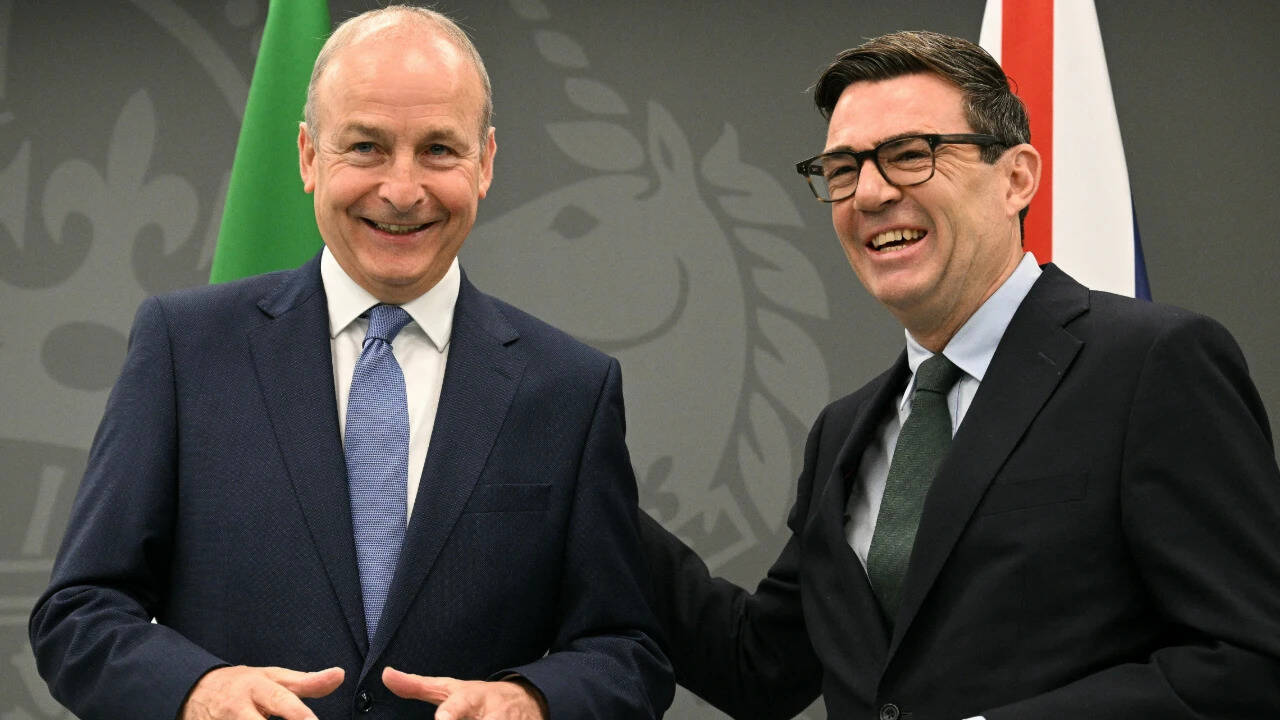
For now, the leaders have locked arms. They have reaffirmed the treaties. They have signaled to the world—and more importantly, to the communities on the ground—that the rules of the road have not changed. The border remains open, the peace holds, and the fragile architecture of the Good Friday Agreement stands against the wind.
The politicians have gone back to their desks. The diplomatic cables have stopped flashing red.
But out in the borderlands, where the road signs change color and the mobile phones switch network providers without warning, the mist is rolling in over the hills. A farmer finishes his chores, looks across a stone wall into the neighboring county, and wonders how much longer the invisible line will stay quiet.


