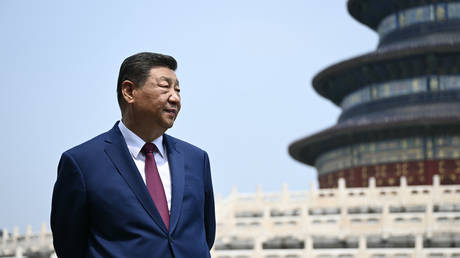
The rain in Beijing doesn’t fall; it hangs. It mixes with the exhaust of ten million lives and settles as a heavy, gray dampness on the wide avenues of Changan Avenue. If you stand outside the Great Hall of the People on a Tuesday morning, the air tastes faintly of coal dust and wet asphalt. It is a sensory detail that stays with you long after you leave. It reminds you that history isn't made in sterile briefing rooms. It is forged in places that smell like work.
For decades, the global compass pointed decisively West. If you wanted to broker a deal that could shift the global economy, you boarded a flight to Washington, London, or Brussels. You sat in rooms with crown molding and drank filtered coffee while discussing tariffs and treaties.
That compass is spinning. It is spinning so fast the needle is a blur.
Over the past few months, a quiet but relentless procession has been moving through the terminal gates of Beijing Capital International Airport. European prime ministers, Latin American trade envoys, African heads of state, and American corporate titans are stepping off tarmac stairs into that heavy northern Chinese air. They are not coming for standard photo opportunities. They are coming because the center of gravity has moved, and no one can afford to be left standing on the periphery.
To understand why the world’s attention has swung so drastically eastward, you have to look past the official press releases. You have to look at the quiet anxieties of the people catching those flights.
The Meeting in Room 4
Consider a hypothetical diplomat we will call Marcus. He has spent twenty-five years in the foreign service of a mid-sized European nation. Marcus grew up believing in a specific set of rules. He believed that global trade was anchored by the Atlantic, that the dollar was the undisputed language of human ambition, and that supply chains were simple, linear paths from factory to consumer.
Last month, Marcus found himself in a brightly lit conference room in Beijing, sitting across from a Chinese vice-minister half his age.
On the table between them was not a grand ideological treaty, but a spreadsheet detailing the future of lithium-ion battery production and high-speed rail infrastructure for Marcus’s home country. The Chinese team did not lecture Marcus on political philosophy. They did not demand a military alliance. They simply offered a logistical reality: we have the materials, we have the capital, and we have the capacity to build what you need before your own parliament can finish debating the budget.
Marcus looked out the window at the Beijing skyline, a jagged silhouette of cranes and glass stretching toward the horizon. He realized, with a sudden sinking feeling in his stomach, that his country was no longer the one driving the conversation. They were the ones asking for a seat at the table.
This is the invisible stake of the current diplomatic rush. The leaders visiting China right now are not necessarily converting to a new ideology. They are acknowledging a massive, inescapable gravity.
When the President of France or the Chancellor of Germany flies to Beijing accompanied by dozens of CEOs, it is an act of economic survival disguised as statecraft. They are trying to secure access to the world’s largest consumer market while simultaneously begging for the components that keep their own domestic industries alive. Without Chinese solar ingots, European green energy targets evaporate. Without Chinese consumers, German automakers face a terrifyingly quiet assembly line.
The Illusion of Separation
For years, a comfortable myth circulated through Western capitals. The myth whispered that the global economy could be cleanly divided. We could buy our cheap consumer goods from the East while keeping our critical technology, our financial systems, and our geopolitical loyalties firmly rooted in the West. It was a beautiful, symmetrical idea.
It was also completely wrong.
You cannot decouple from a country that has woven itself into the literal fabric of how humanity survives. Let us trace a single, ordinary object: a smartphone. The glass might be engineered in Kentucky. The software might be written in California. But the raw neodymium inside the speakers was mined in Inner Mongolia. The cobalt was processed in Ningbo. The microscopic capacitors were soldered together in Shenzhen.
If you pull on that single thread, the entire global garment begins to unravel.
This interdependence creates a profound sense of vertigo for global leaders. They are caught between two conflicting pressures. At home, their voters are nervous about the rise of an authoritarian superpower. They want tough talk, trade barriers, and promises of national self-reliance. But when those same leaders sit down with their economic advisors, the math tells a completely different story. The math says that a total rupture with China would mean immediate, catastrophic inflation, shuttered factories, and millions of lost jobs.
So, they pack their bags. They board the planes. They fly into the Beijing dampness because the alternative is economic isolation.
The Language of the New Silk
The shift is not merely economic; it is psychological.
Historically, Western aid and diplomacy came with an thick book of rules. If a developing nation in Southeast Asia or East Africa wanted a loan to build a port or a highway from a Western-backed institution, they had to agree to structural adjustments, fiscal austerity, and political reforms. It was a transactional relationship wrapped in a moral lecture.
China changed the script.
When a nation wants a bridge now, Beijing offers to build the bridge. They don't ask about domestic policy. They don't demand a rewrite of the local tax code. They bring the engineers, the concrete, and the state-backed loans. To a leader in the Global South trying to keep the lights on in a rapidly growing city, this approach feels less like an imperial demand and more like a business partnership.
It is easy to see the flaws in this model. The debts can become crushing. The infrastructure sometimes benefits Chinese state-owned companies more than the local population. It is a system filled with risks, compromises, and hidden costs.
Yet, for much of the world, it is the only game in town.
When leaders from Asia, Africa, and Latin America arrive in China, they are looking at a mirror of what they wish their own countries could be. They see a nation that, within living memory, was defined by rural poverty and devastating famine, but now boasts maglev trains, quantum computing labs, and a space program targeting the moon. That transformation is an incredibly intoxicating sight for a leader from a developing country. It suggests that poverty is not a permanent condition, and that Western models are not the only path to the modern world.
The Weight of the Unspoken
What makes these high-level visits so fascinating to watch is the sheer amount of tension left unsaid during the public handshakes.
Watch the footage of these arrivals. The red carpets are rolled out on the tarmac. The military bands play with flawless, mechanical precision. The smiles are wide, practiced, and rigid. But look closely at the eyes of the visiting dignitaries. You can see the exhausting mental calculation happening in real time.
Every leader visiting Beijing is playing a high-stakes game of three-dimensional chess. They must secure the trade agreements their economies desperately need without alienating their traditional security allies in Washington. They must walk a tightrope over a canyon of shifting global power. One wrong word, one poorly phrased joint statement, and they risk triggering retaliatory tariffs from China or a diplomatic freeze from the United States.
It is an agonizing way to govern.
I remember talking to an old trade negotiator who spent his career working the Pacific routes. He told me that diplomacy used to be about finding common ground. Today, he said, it is about managing common fear. The West fears losing its centuries-long dominance. The East fears being encircled and contained before it can reach its full potential. The rest of the world simply fears being caught in the gears when these two giants collide.
The Quiet Turning of the Wheel
The headlines will tell you about the official communiqués. They will analyze the carefully worded paragraphs about regional stability, maritime borders, and balanced trade. They will argue about who won and who lost during each specific state visit.
But the real story is much larger than any single summit.
The real story is the tectonic shift in how human beings organize their world. For five hundred years, the Atlantic Ocean was the grand arena of human history. The wealth, the power, and the ideas that shaped the planet flowed across that cold blue water.
That era is closing. The arena has moved to the Pacific and the old lands bordering it.
This is not a sudden revolution. It is a slow, steady accumulation of reality. It happens every time a container ship clears the port of Shanghai, every time a new tech hub opens in Hangzhou, and every time a foreign leader realizes they must go to Beijing to ask for permission, or partnership, or time.
The map of global power is being rewritten right now, not with weapons or dramatic declarations, but in the quiet, invisible ink of economic necessity. We can choose to ignore the new lines being drawn. We can pretend the old compass still works perfectly, that the North Atlantic is still the undisputed center of the universe.
But the planes keep landing in the Beijing rain. The leaders keep stepping onto the tarmac. They know exactly which way the wind is blowing, and they are simply trying to make sure they aren't left standing alone in the cold when the storm finally arrives.