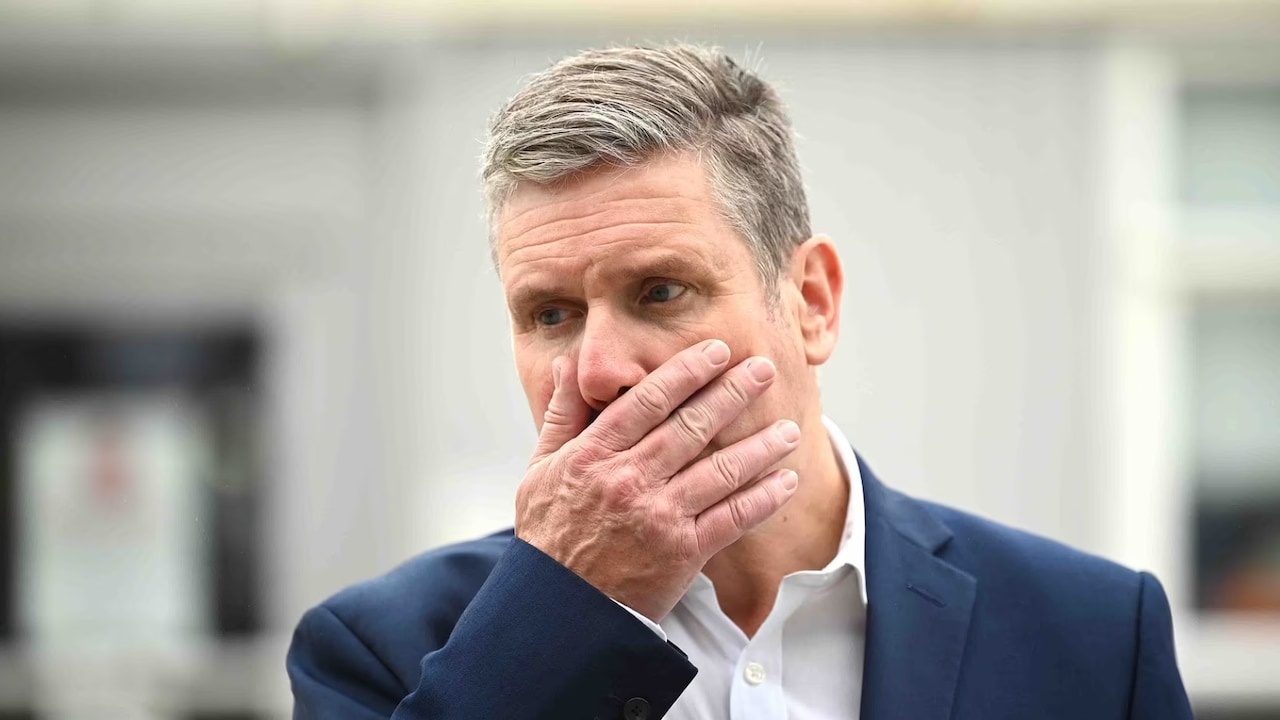
The rain in London has a particular way of dampening ambition. It doesn't pour with dramatic, cinematic fury; it drifts horizontally, a cold, gray mist that blurs the edges of the neoclassical buildings around Whitehall until everything looks exactly the same. On the afternoon Keir Starmer packed up his papers and stepped away from the most powerful office in the United Kingdom, the weather felt less like a atmospheric condition and more like a political metaphor.
Power in Britain is a strange, loud thing until the exact moment it vanishes. Then, the silence is deafening. Don't miss our previous coverage on this related article.
For months, the hallways of Number 10 Downing Street had been filled with the hurried footsteps of policy advisors, the clinking of teacups, and the low, urgent murmurs of strategists trying to map out a vision for a country fracturing at the seams. But as the door clicked shut behind the former Prime Minister, a troubling question hung in the damp air, left entirely unanswered by his tenure.
What, exactly, did he stand for? If you want more about the context of this, TIME offers an in-depth breakdown.
To understand the weight of that silence, you have to look past the official press releases and the dry, analytical post-mortems clogging the weekend broadsheets. You have to look at the people who actually stood in the polling booths.
The Ghost in the Polling Booth
Consider a voter named David. He lives in a town outside Leeds, a place where the local high street features more boarded-up windows than functioning businesses. In the summer of 2024, David did something he hadn't done in over a decade: he voted for the Labour Party. He didn't do it out of burning ideological passion. He did it because his local hospital had a six-month waiting list for routine scans, because his energy bills looked like mortgage payments, and because the previous government had exhausted the nation’s patience.
David voted for a pause in the chaos. He voted for a technician. He voted for Keir Starmer.
But a funny thing happens when you hire a technician to fix a house that is structurally compromised. You expect them to bring blueprints. Instead, Britain watched a leader who arrived with a massive toolbox but spent his entire time in office arguing about which wrench to use, without ever explaining what the finished room was supposed to look like.
The political trajectory of Starmer’s leadership was defined by an obsession with what he wasn’t. He wasn't the radical left-wing predecessor who had alienated the middle class. He wasn't the chaotic, scandal-plagued Conservative leaders who had turned governance into a reality television show. This strategy of definition-by-subtraction works brilliantly during an election campaign. It is a vacuum that allows every voter to fill the empty space with their own hopes.
Once you are inside the building, however, the vacuum collapses.
The core of the problem wasn't a lack of industry. Starmer worked punishingly long hours. He possessed the forensic mind of a former Director of Public Prosecutions, a man accustomed to reading thousands of pages of legal briefs. Yet, governance requires a different muscle group than prosecution. A prosecutor reacts to a crime that has already occurred; a leader must invent a future that does not yet exist.
The Strategy of the Shifting Sand
Every time the public leaned in to catch the melody of Starmer's grand project, the tune changed. One week, the priority was economic growth driven by green energy investment. The next, under the pressure of fiscal reality and media scrutiny, those financial commitments were scaled back, watered down, and rendered safe. The bold declarations were replaced by technocratic jargon—talk of "missions," "delivery units," and "structures."
It was political prose without any poetry.
Think of it as a captain who is masterful at navigating through a storm but refuses to tell the crew where the ship is sailing. At first, the crew is just glad not to capsize. They cheer the steady hand on the wheel. But as the days turn into weeks, and the rations dwindle, they begin to look at the horizon. If the captain merely promises more steering, mutiny or apathy becomes inevitable.
The tragedy of this approach is that it misunderstands the nature of modern public grief. The British public wasn't just tired of incompetence; they were starved for meaning. Decades of austerity, the profound dislocation of Brexit, and a pandemic had left a psychological scar on the nation. People wanted to know that the sacrifices meant something, that there was a collective destination at the end of the long, gray highway.
Instead, they received a lecture on fiscal responsibility.
This caution was structural. Those close to the inner circle often whispered that the fear of losing power was far greater than the desire to use it. Every policy proposal was run through a gauntlet of focus groups until any sharp, distinctive edges were completely sanded off. What remained was a smooth, unassailable, and entirely uninspiring surface.
The Language of the Bureaucrat
When a leader speaks entirely in the language of management, they lose the ability to translate political pain into national purpose. When public services are crumbling, telling citizens that you are "optimizing the procurement pipeline" feels less like a solution and more like an insult. It lacks the human blood code.
Consider how different history looks when leaders choose clarity over caution. When the post-war Labour government built the National Health Service in 1948, it wasn't presented as a complex bureaucratic restructuring. It was presented as a moral imperative: that no person should ever have to look at their bank balance before saving their child's life. That is an idea you can fight for. That is an idea that survives the rain.
Starmer's team believed that competence alone would be their shield. They genuinely thought that if the trains ran slightly more on time and the inflation numbers ticked down by a fraction of a percent, the narrative would take care of itself. They forgot that human beings do not live their lives in spreadsheets. We live our lives in stories.
When the history books write the chapter on this era, they will not find a definitive crisis that toppled the administration. There was no single, cataclysmic scandal. Instead, there was a slow, agonizing leak of public enthusiasm. The voters who had swept them into power with a historic majority simply looked at the lack of visible transformation and quietly drifted away.
The Long Road Back to Nowhere
On his final walk down that famous street, there were no massive crowds cheering, nor were there angry protesters throwing stones. There was just the click of news cameras and the fluttering of a few damp umbrellas.
The greatest indictment of that political experiment is that the exit felt remarkably like the entrance. The country was left in the exact same state of suspended animation, waiting for someone to articulate what the modern nation is supposed to be.
Security is a fine ambition for a government, but security without purpose is just a well-guarded waiting room. As the car pulled away from the curb and disappeared into the London traffic, the front door of Number 10 stood empty again, a dark wooden rectangle reflecting the gray sky, waiting for the next occupant to try and find the words that were never spoken.


