Listen.
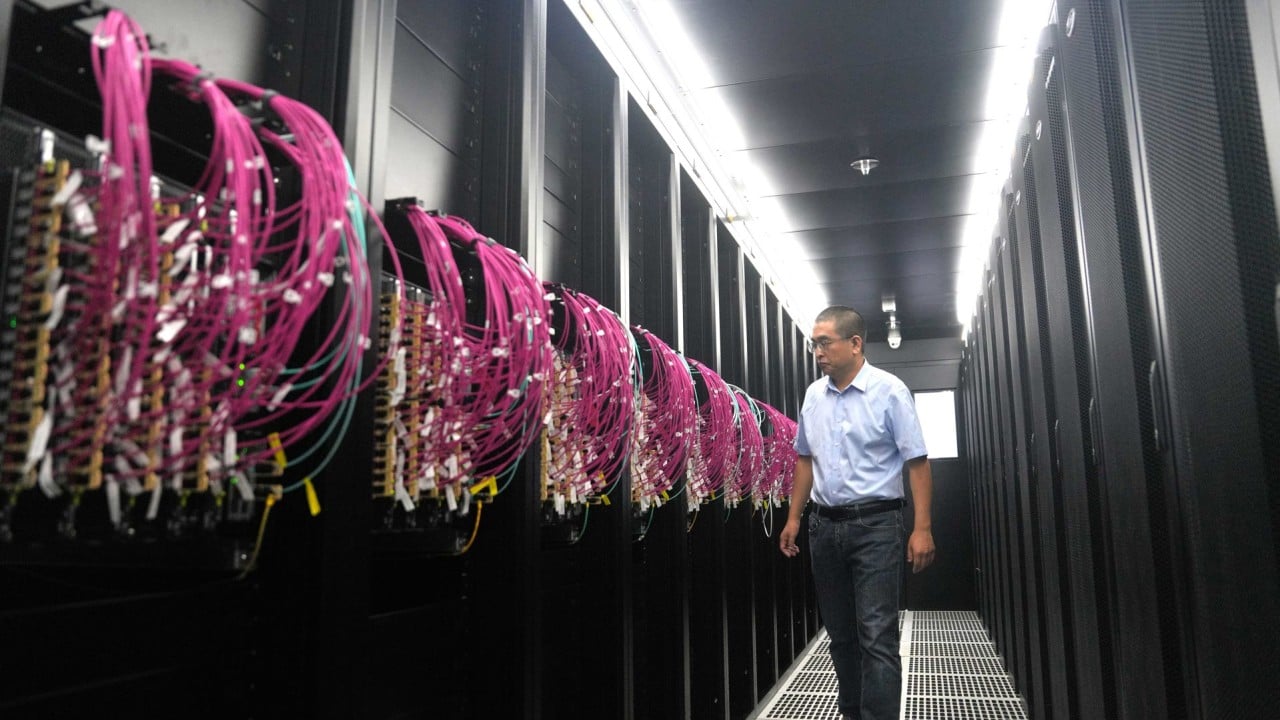
A cold aisle in a data center smells faintly of ozone and warm aluminum, and the low, steady roar of cooling fans settles right into your teeth after twenty minutes. I have stood inside rooms like that watching blinking lights track trillions of tiny pieces of text—words, syllables, punctuation marks that artificial intelligence systems call tokens. For years, the story of building smart machines was a story of feeding them. You shoveled books, articles, code, and conversations into giant clusters of silicon until the weights inside the neural network shifted enough to sound human. Now, officials and researchers in China are pointing to a threshold that flips the ledger: artificial intelligence models are generating more tokens than were ever used to train them.
That sounds like a neat accounting trick at first glance. A spreadsheet milestone. A bragging right for engineers and policy makers who want to prove their ecosystem has hit maturity.
It is not.
When output overtakes input on a national scale, the center of gravity in artificial intelligence moves from training to inference. Training is school—long nights with textbooks, memorization, and practice exams before a student ever steps into a real job. Inference is the job itself: showing up every morning, reading new requests, reasoning through messy problems, writing drafts, debugging software, answering customer questions, and doing it billions of times a day.
To make this shift tangible, picture a hypothetical software engineer named Lin working in Shenzhen—not a real person whose private life I am recounting, just a composite stand-in for the thousands of builders sitting in front of glowing monitors across the country. Lin used to spend half her week worrying about training runs: whether a GPU cluster would stay cool through a summer heatwave, whether export restrictions had slowed access to top-tier accelerators, whether a dataset had enough clean Chinese and English text to avoid glaring blind spots. Those worries have not vanished. Yet lately, Lin spends far more time watching what happens after a model is deployed. A single coding assistant or enterprise reasoning agent might chew through ten thousand generated tokens just to plan, check, revise, and answer one thorny prompt from a user at two in the morning. Multiply that by millions of workers, students, analysts, and automated workflows, and the flood of generated words quickly dwarfs the static archive the model studied in the first place.
I admit something freely here: when I first heard claims about generated tokens surpassing training tokens, part of me rolled my eyes. Metrics in tech love to flatter their owners. A verbose chatbot that rambles for eight paragraphs when a two-sentence answer would do can inflate token counts without adding a shred of wisdom. Anyone who has spent hours wrestling with a model that overthinks simple tasks knows that more tokens do not automatically mean better thinking.
Still, dismissing the shift as mere verbosity misses what is happening underneath.
From Memorizing the Library to Living in the Room
Think of training as walking through a vast library once or twice and absorbing the shelves. To keep this explanation grounded, I am using a metaphor here—a library does not actually hold mathematical weights—yet the mental picture captures the scale problem. Every book you read in that library takes time, energy, and careful curation. Once the doors close and your exam begins, you are no longer reading the shelves; you are writing new pages on your own desk.
For a long time, observers outside and inside China framed the AI race almost exclusively around pre-training compute and frontier model size. If you had fewer cutting-edge chips or slightly smaller training runs, the assumption went, you were permanently playing catch-up. That framing had real teeth during the early wave of large language models, when sheer scale on massive datasets produced sudden leaps in capability.
But real-world utility lives in daily execution. An enterprise logistics coordinator does not care how many trillions of tokens a model read last year if the system cannot parse a delayed shipping manifest in real time. A hospital administrator triaging routine paperwork or a bank risk analyst reviewing compliance notes cares about speed, cost per query, local deployment, and reliability under load.
When models generate more tokens than were used to train them, it signals that inference demand has become a self-sustaining engine. The models are no longer sitting quietly on a shelf waiting to be admired; they are working shifts. Reasoning models in particular—systems trained to generate hidden or visible chains of thought before giving a final answer—have multiplied token output per user request. Instead of guessing an answer in a single pass, the system drafts steps, tests logic, corrects itself, and produces far more tokens than earlier chat interfaces ever did.
That changes economics in a way many people overlook.
The Quiet Cost Hidden Inside Every Prompt
Every token an AI system generates costs electricity, silicon cycles, memory bandwidth, and cooling water. When a model generates a hundred tokens to answer a question, the hardware works one way. When a reasoning model generates five thousand tokens while debating itself internally before speaking, the hardware works much harder.
In my own experience testing reasoning-style models on complex troubleshooting, watching the live token counter climb feels thrilling and eerie at the same time. You see the machine pause, backtrack, try another angle, and finally land on a clean answer. You also realize that every extra sentence of internal monologue is billing someone—a cloud provider, a startup founder, a state-backed lab, or an enterprise IT budget.
Now scale that dynamic across an entire national economy where open-weight models, low-cost APIs, and aggressive price wars have pushed adoption into factories, clinics, law offices, and schools. Cheaper inference invites heavier usage. Heavier usage generates more tokens. More tokens demand even more efficient chips, smarter quantization, better caching, and denser data centers.
Consider what happens next: once inference becomes the dominant consumer of compute, hardware design shifts too. A chip built mainly to train giant models in massive synchronized clusters has different trade-offs than a chip optimized to serve millions of concurrent users with low latency and low power draw per token. China's push into domestic AI chips, specialized inference accelerators, and software optimizations looks less like a side quest when viewed through this lens and more like a survival necessity. If you are going to generate mountains of tokens every single day, paying a steep energy and silicon tax on every word will eat your margins alive.
A Warning Wrapped in a Milestone
Let us not turn a milestone into blind optimism.
Generating more tokens than were used in training is a measure of volume, not truth. Anyone who has worked closely with language models knows the bitter truth: fluency is cheap, and confidence is dangerous. A system can generate ten thousand plausible-sounding tokens while quietly hallucinating a citation, misreading a contract clause, or reinforcing a subtle bias baked into its training data.
Worse, there is a feedback loop here that deserves real scrutiny. As AI models churn out vast oceans of synthetic text, code, and summaries, the public internet and corporate repositories fill up with machine-generated prose. If future models train carelessly on their own exhaust—a problem researchers call model collapse—the signal can grow thinner over generations. More output does not guarantee deeper insight; sometimes it just creates louder echo chambers.
There is also a human question that numbers alone cannot answer. Imagine another hypothetical character—say, Chen, a junior analyst in a mid-sized trading or consulting firm—who leans on AI tools all day to summarize reports, draft memos, and scan market chatter. At first, the speed feels liberating. Hours of grunt work shrink to minutes. Yet over time, Chen notices something subtle: reading long machine-generated breakdowns takes mental energy too, and skimming polished paragraphs makes it easier to miss a quiet flaw in the underlying assumption. Speed without scrutiny is just a faster way to arrive at the wrong conclusion.
I feel that tension in my own work every week. AI can draft faster than I can type, lay out options I might not have considered on a tired afternoon, and untangle dense technical syntax in seconds. Yet the hardest part of real thinking has never been generating words. The hardest part is deciding what matters, noticing what is missing, and taking responsibility when the answer turns out to be wrong.
What This Shift Really Means for the Rest of Us
When China highlights that its AI models generate more tokens than were used to train them, the deeper message is not merely about geopolitical scorekeeping or raw data volume. It is about an inflection point where artificial intelligence stops being an experimental laboratory curiosity and becomes continuous operational infrastructure.
Training taught the machines how to speak. Inference is where they live—and where our habits, energy grids, software architectures, and judgment are tested every single day.
A server room hums in the dark, rows of tiny lights blinking in rhythm with invisible rivers of math, turning questions into answers long after the lessons are over.