Silicon Valley used to avoid the Pentagon like the plague. Engineers protested military contracts, and venture capitalists stuck to enterprise software or consumer apps. That era is officially dead.
The defense tech sector isn’t just growing; it’s exploding. Look no further than Huntington Beach, California, where a three-year-old startup called Mach Industries just locked in a $300 million Series C funding round. The deal pushes the company’s valuation to a massive $1.8 billion. That is nearly a fourfold jump from its $470 million valuation just a year ago.
Led by Infinite Capital and Ribbit Capital, with participation from heavy hitters like Sequoia, Khosla Ventures, and Bedrock, this capital injection signals a fundamental shift in how modern wars will be fought. It also highlights a massive change in how the United States government buys weapons.
If you think this is just another overhyped startup bubble, you are missing the bigger picture. Mach Industries represents a core structural shift toward cheap, mass-produced, expendable military tech. Here is the breakdown of why this $1.8 billion valuation matters, what the company is actually building, and the massive manufacturing hurdles it faces.
The Trillion Dollar Pivot to Drone Dominance
To understand why investors are throwing hundreds of millions at a company run by a 22-year-old MIT dropout named Ethan Thornton, look at the Pentagon's wallet.
The defense procurement strategy of the last fifty years favored what insiders call "exquisite platforms." Think billion-dollar stealth bombers, massive aircraft carriers, and highly complex tanks. These machines take decades to build, cost fortunes to maintain, and are nearly impossible to replace quickly if destroyed.
Recent global conflicts changed everything. The war in Ukraine and the intense drone-heavy clashes across the Middle East proved that cheap, autonomous, mass-produced hardware can easily disable or bypass those multi-billion-dollar legacy systems. It is simple math. A $20,000 one-way attack drone can knock out a multi-million-dollar radar installation or armored vehicle.
The Pentagon noticed. In the fiscal 2027 budget proposal, defense officials carved out a staggering $53.6 billion specifically for what they call drone dominance. To put that in perspective, that is a fivefold increase over previous years' spending on unmanned systems. Out of that massive pot, $39.2 billion is earmarked purely for the procurement and domestic manufacturing of autonomous hardware.
Mach Industries sits directly in the crosshairs of this budget shift. Investors are betting heavily that the company can secure a massive slice of that $39.2 billion pie.
Five Vehicles and a Pre-Revenue Gamble
Most tech startups reaching a $1.8 billion valuation have a proven product generating steady cash flow. Or, like Anduril Industries with its Lattice operating system, they have a deeply integrated software framework anchoring their government partnerships.
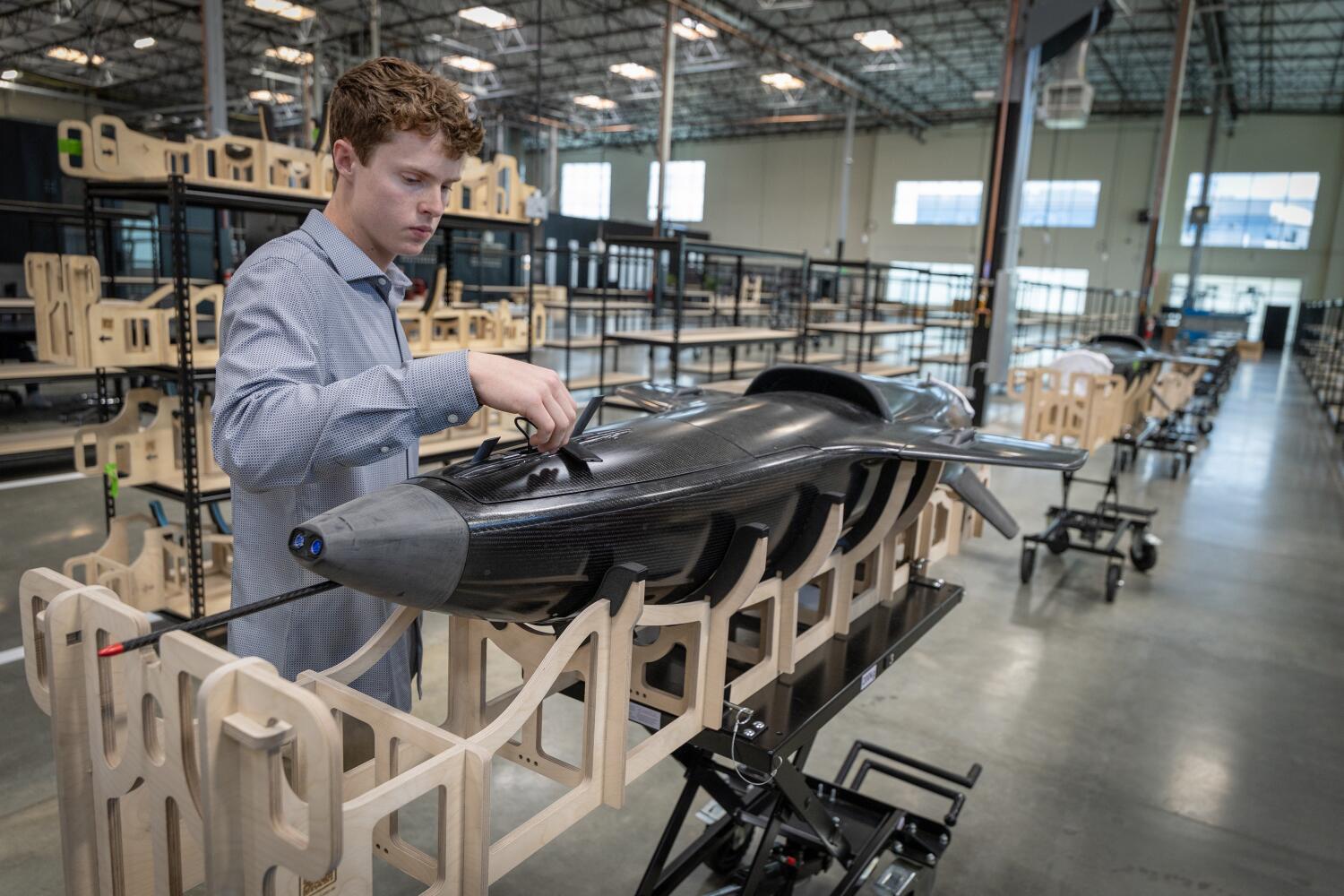
Mach Industries is doing something far weirder, riskier, and more ambitious. They are building a broad hardware ecosystem containing five distinct autonomous systems simultaneously, all while being pre-revenue at scale.
The company started in 2023 with a hyper-focus on hydrogen-powered weaponry. While they still leverage deep tech in energetics, Thornton pivoted the company's core focus toward immediate deployment needs. The current product roadmap contains five distinct autonomous vehicles:
- Viper: A turbojet-powered, vertical-takeoff, one-way attack unmanned aircraft system. It requires no runway or traditional launching infrastructure, functioning essentially like a miniature fighter jet that two people can launch from the field.
- Glide: A high-altitude, long-range strike glider capable of launching weapons over massive distances using energy-free terminal gliding.
- Stratos: An airborne, high-altitude surveillance and communication platform designed to provide a "pseudo-satellite" link in electronic warfare environments where standard satellite signals are jammed.
- Dart: A low-cost, mass-producible counter-drone interceptor designed to knock out incoming enemy swarms without burning million-dollar air defense missiles.
- Pike: A long-range munition-launch platform engineered to extend the strike capabilities of front-line units.
This sprawling portfolio is an incredible engineering load for a company that grew from a dozen people to around 350 employees in three years. If Thornton can pull it off, Mach becomes a diversified defense giant. If even two of these platforms stall in development, that $1.8 billion valuation faces a harsh market correction.
The Manufacturing Bottleneck
When a startup targets a 9,900 percent production increase in twelve months, you should look closely at their supply chain.
Thornton states that Mach Industries produces about 10 vehicles per week. He wants to hit 1,000 vehicles a week within the next year. To achieve this, the company plans to use its new funding to double its engineering and manufacturing headcount to 700 people. They are leaning heavily on their 115,000-square-foot production facility in Huntington Beach, alongside a manufacturing network called Forge that uses common tooling and printed components.
But hiring more people and buying more 3D printers won't solve the core issue. The primary bottleneck in defense tech has historically been slow government contracting and rigid engineering cycles. Now, the bottleneck is purely supply chain.
The surge in defense spending means everyone is fighting for the exact same components: solid rocket motors, specialized jet engines, microchips, and optical sensors. Mach tried to get ahead of this bottleneck in April by acquiring rocket-maker Exquadrum for $50 million, absorbing its testing infrastructure and solid rocket motor production.
Mach is investing capital to build components not just for themselves, but to act as a primary supplier to other defense firms. It’s a smart defensive play. If you control the rocket motors and the engines, you control the pace of the entire market.
The Silicon Valley Defense Landscape
Southern California is the undisputed capital of the new defense tech gold rush. Mach Industries isn't operating in a vacuum; it’s building right down the street from Costa Mesa-based Anduril Industries, which hit a massive $61 billion valuation this year.
This boom is driving a deep cultural divide in the broader tech ecosystem. While venture capital firms pour billions into autonomous weapons, thousands of workers at mainstream AI firms like Google, OpenAI, and Anthropic have signed petitions or voiced deep ethical concerns regarding mass surveillance and autonomous kill chains.
The political momentum is heavily favoring the defense builders. The White House and the Pentagon are actively seeking out agile tech firms to bypass legacy defense primes like Lockheed Martin or Raytheon, who are frequently criticized for missing deadlines and blowing past budgets. In April, the Pentagon signed an agreement with eight tech giants, including Nvidia and SpaceX, to build out an AI-first fighting force.
Startups like Mach are the mechanical muscle for that digital brain. Investors like Ribbit Capital aren't just underwriting an aerospace company; they are funding a high-volume manufacturing company designed to out-produce foreign industrial bases.
What to Watch Next
Keep your eye on Mach's production metrics over the next six months. The true test of this $1.8 billion valuation isn't a flashy press release or a successful prototype test. It is whether they can successfully transition from building 10 custom Vipers a week to pumping out hundreds of uniform units on an assembly line.
Watch the upcoming Pentagon contract announcements for the specific allocations of the $39.2 billion autonomous procurement budget. If Mach secures a Program of Record (a formal, multi-year government commitment to fund a system), their valuation will look like a bargain. If those contracts go to legacy defense firms trying to build their own cheap drones, the startup defense tech market will face a reality check.
If you are tracking the intersection of venture capital and national security, stop looking at software algorithms. The real battle is happening on factory floors in Huntington Beach, where the challenge isn't writing code, but bending metal at scale.