Imagine walking down a quiet coastal street at night and coming face to face with a prehistoric animal weighing hundreds of pounds. It sounds like a scene from a science fiction movie, but for residents along a coastal stretch in Ecuador, it was a bizarre and heartbreaking reality. A massive endangered leatherback sea turtle crawled straight out of the surf, hauled her heavy shell over a curb, and ended up stranded on a concrete sidewalk.
Most people see headlines like this and shake their heads at the sheer strangeness of wildlife wandering into urban spaces. But this incident isn't just a quirky viral moment. It's a flashing red siren about how completely human development is altering the natural world. When a marine reptile that has navigated ocean basins for millions of years mistakes a paved road for a nesting beach, something is fundamentally broken in our coastal ecosystems. You might also find this related article insightful: The Price of an Unobstructed Horizon.
The Ancient Navigation System Meets Modern Chaos
Leatherback turtles are masters of the open ocean. They cross entire ocean bodies, diving down thousands of feet in search of jellyfish, guided by magnetic fields, ocean currents, and celestial light. For a hundred million years, their roadmap has stayed remarkably consistent. Female leatherbacks spend almost their entire lives at sea, returning to land only under the cover of darkness to lay their eggs on dark, quiet sandy shores.
That reproductive instinct relies entirely on coastal darkness. For millennia, the brightest horizon was always the open sea reflecting starlight and moonlight. When a female turtle approaches a nesting beach, she looks for low, dark dunes where she can dig her nest safely away from the high-tide line. As reported in detailed coverage by Associated Press, the implications are notable.
Then humans arrived with concrete, asphalt, and high-intensity sodium streetlights.
Coastal urbanization completely rewrites the visual cues these animals depend on. Instead of a dark silhouette of dunes backed by a starlit sky, modern beaches are framed by towering hotels, bright street lamps, and glowing promenade lights. To a leatherback emerging from the surf with clouded vision adapted for underwater depths, a brightly lit coastal boulevard looks like an open, glowing horizon. The sidewalk doesn't look like a barrier; it looks like a continuation of the beach.
What Happened on That Ecuador Street
When the leatherback hauled herself out of the Pacific and onto an Ecuadorian sidewalk, she was experiencing severe disorientation. Local reports and viral videos captured the massive reptile resting against concrete curbs, completely out of her element. Her flippers, built for slicing through deep ocean currents, scraped uselessly against abrasive asphalt.
Witnesses on the scene quickly realized the danger. Leatherbacks are fragile when they leave the water. Their massive bodies are supported entirely by water pressure in the ocean; on land, their own weight puts immense pressure on their internal organs and flippers. Without intervention, a stranded turtle can quickly overheat, dehydrate, or suffer fatal exhaustion.
Local residents and environmental officials stepped in, setting up barriers, keeping crowds at a safe distance, and eventually helping guide the disoriented giant back toward the surf. She eventually found her way back to the water, but the encounter left conservationists asking tough questions about how much longer coastal wildlife can coexist with unchecked shoreline development.
The Real Threat of Light Pollution
We talk endlessly about plastic pollution in our oceans, and for good reason. But light pollution is the silent killer of sea turtle populations worldwide. It operates quietly, subtly altering behavior in ways that prove fatal.
Artificial lighting disorients nesting females, causing them to abandon nesting attempts altogether or wander into dangerous areas like roads, parking lots, and drainage ditches. When females get turned around by streetlights, they waste precious energy reserves that they need for egg production and migration.
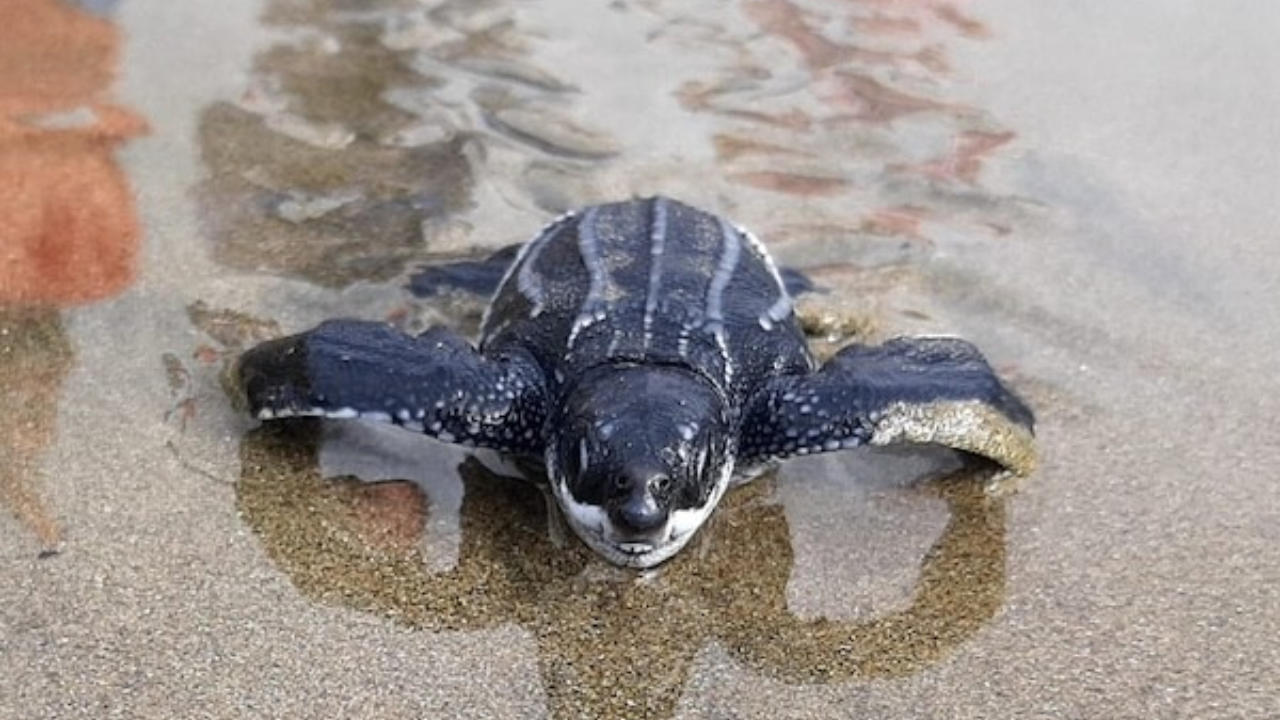
The problem is even worse for hatchlings. When baby leatherbacks hatch on a poorly managed beach, they instinctively crawl toward the brightest horizon. In a natural setting, that means crawling toward the ocean where the moon reflects off the water. On a developed beach, hatchlings crawl toward the inland streetlights, highway headlights, or beachfront patios. They wander onto roads where they get crushed by cars, picked up by predators, or die of dehydration before reaching the water.
Fixing this problem doesn't require tearing down coastal cities. Simple, practical solutions exist right now.
How Coastal Communities Can Adapt
If we want to share the planet with creatures that outlived the dinosaurs, our coastal management needs a serious attitude adjustment. Conservation isn't just about setting up protected areas; it's about changing how we build and light our shorelines.
Implement Turtle-Friendly Lighting Codes
Cities along known nesting routes must adopt strict lighting ordinances. This means using low-pressure sodium or amber LED bulbs that emit wavelengths less attractive to sea turtles. It also means requiring shielded fixtures that cast light downward onto the ground rather than outward toward the beach and the ocean.
Enforce Dark Sky Windows
During nesting and hatching seasons, coastal towns should mandate curfews for unnecessary exterior lighting. Turning off beachfront billboards, lowering patio lights after 10 PM, and installing window tints on high-rise hotels can drastically reduce the number of disoriented marine animals.
Protect and Restore Dune Buffers
Natural sand dunes act as visual barriers between urban development and the beach. When developers flatten dunes to build oceanfront properties, they eliminate the dark shadow zone that female turtles look for. Preserving natural dunes and vegetation creates a physical and visual buffer that keeps wildlife safely on the sand.
Educate Locals and Tourists
Most people don't harass wildlife out of malice; they do it out of ignorance. When tourists crowd around a stranded leatherback with flash photography flashing in its eyes, they add massive amounts of stress to an already terrified animal. Public awareness campaigns can teach beachgoers how to respond when they encounter marine life, emphasizing the importance of keeping a respectful distance and turning off flashlights.
The Bigger Picture for Marine Conservation
The leatherback turtle is the largest turtle on Earth and one of the most ancient lineages in the animal kingdom. They are swimming history books. Yet, Pacific leatherback populations face a high risk of extinction due to a combination of commercial fishing bycatch, egg poaching, climate change, and habitat loss.
When a leatherback ends up on a city sidewalk, it acts as a mirror reflecting our own encroachment on nature. It proves that the boundaries we draw between human spaces and wildlife habitats are entirely artificial. The ocean doesn't stop where the concrete begins, and marine animals don't understand property lines or municipal zoning laws.
Protecting these creatures requires more than emergency rescues when a turtle makes national news for ending up in the middle of town. It demands proactive urban planning that respects the natural rhythms of the coastline. If we continue to turn every inch of coastline into a brightly lit playground, we will slowly push these ancient mariners off the edge of existence.
The next time you visit a beachside town, take a look at the lights shining out toward the water. Consider what they look like from the perspective of a two-thousand-pound turtle trying to find a quiet place to lay the next generation. We have the technology and the knowledge to turn down the lights and give them space. All that's missing is the collective will to do it before the coastline becomes entirely uninhabitable for the very creatures that define its wild beauty.