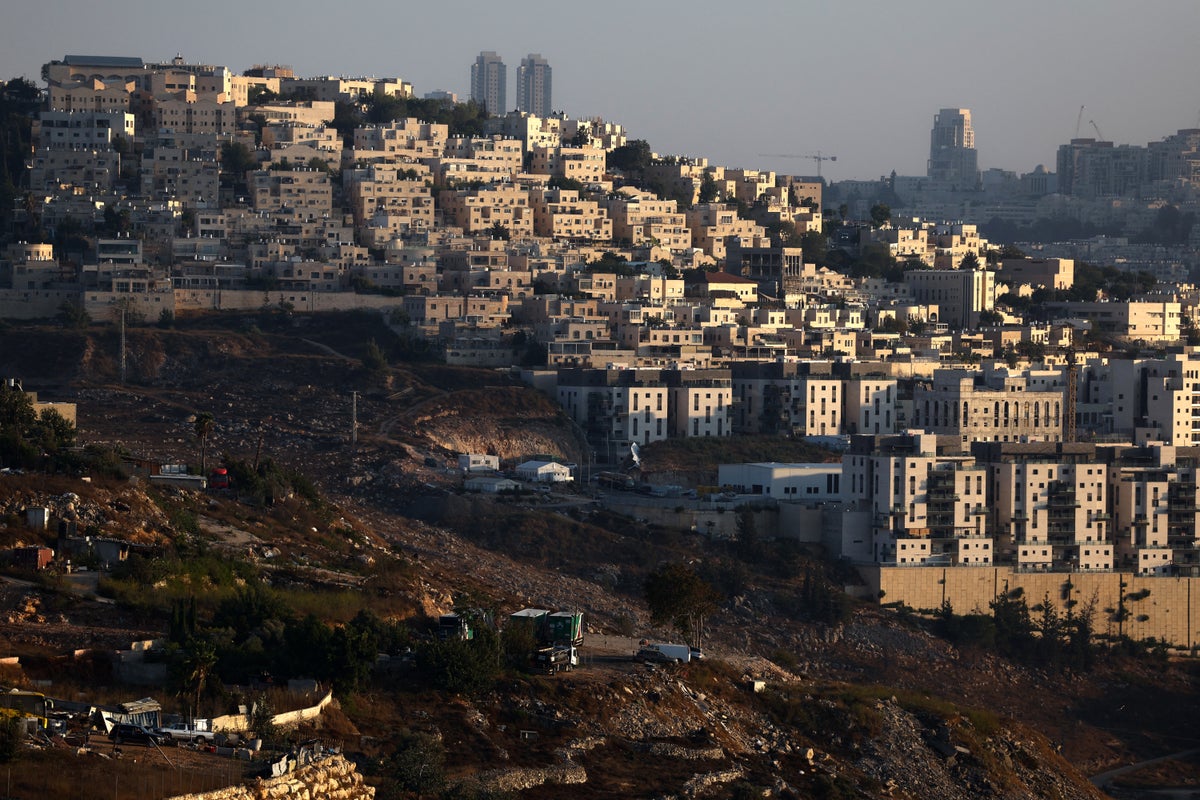
The limestone dust of the West Bank hills gets into everything. It coats the leaves of ancient olive trees, dusts the windshields of passing trucks, and settles quietly into the creases of calloused hands that have worked the same patch of earth for generations.
To look at a map from twenty thousand feet, the territory looks like a jigsaw puzzle gone wrong. Red splotches of concrete and orange-tiled roofs bleed into the muted greens of terraced hillsides, ringed by watchtowers, bypass roads, and chain-link fences. These are the Israeli settlements. They are small cities carved into contested ridges, housing over half a million citizens who live under one set of laws, just yards away from millions of their Palestinian neighbors who live under another.
Numbers on a page do not carry the weight of dust.
Statistics tell us that these communities began appearing in the wake of the 1967 Six-Day War. They tell us that under international law, specifically the Fourth Geneva Convention, an occupying power cannot transfer parts of its own civilian population into the territory it occupies. The International Court of Justice has said it. The United Nations Security Council has said it, over and over, with the weary monotony of a broken clock.
Yet the concrete keeps pouring.
Consider a hypothetical resident named Yael, living in a hillside community overlooking the Jordan Valley. From her balcony, the view is breathtaking. The valley stretches out like a rumpled green blanket toward the blue line of the mountains of Moab. She moved here seeking affordable housing and a deep connection to ancestral soil, planting a small garden of herbs and watching her children play in a sunlit courtyard. Her life is real, filled with the mundane friction of carpools, grocery lists, and homework.
Now, pan the camera fifty yards down the slope.
Abed stands among his family's olive trees. His great-grandfather pruned these same trunks. Today, a new chain-link fence cuts right through the lower third of his grove. A military order designates the area a security zone. Abed needs a special permit just to harvest his olives in October, a permit that arrives late or not at all. The soil hasn't changed. The sun hasn't changed. But the invisible lines drawn by bureaucrats three hours away in offices draped in flags have altered the gravity of daily existence.
This is the reality of the settlements. They are not abstract diplomatic talking points shouted across conference tables in Geneva or New York. They are overlapping geographies. Two people, standing on the same hill, looking at the same horizon, experiencing entirely different universes of law, movement, and consequence.
For decades, the international community responded with diplomatic frowns. Statements were issued. Resolutions were drafted. Everyone agreed the situation was corrosive to any future peace, yet the concrete mixers kept turning.
Then came the question of leverage.
If words fail, what speaks? Money. Travel. Trade.
This brings us across the English Channel to the granite and glass of Whitehall in London. Here, officials pore over trade volumes, human rights reports, and legal statutes, wrestling with a distinctly modern dilemma. How does a foreign government penalize an expansion that it deems illegal under international law without destabilizing an entire region?
The United Kingdom has long walked a diplomatic tightrope. Britain helped midwife the modern Middle East, and its fingerprints remain on the messy borders of the twentieth century. When British ministers discuss sanctioning Israeli settlements, they are wading into a labyrinth of domestic politics, legal precedents, and moral imperatives.
What does it actually mean to sanction a settlement?
It is rarely a blunt instrument. It starts with names on a Whitehall spreadsheet. Violent extremist settlers—those who torch cars, throw stones at school buses, or drive farming families off their land at gunpoint—find their foreign bank accounts frozen. Their British visas are revoked. They cannot fly into Heathrow for a holiday or buy property in Manchester.
But the blade can cut deeper.
What about the cheese produced in a factory built on expropriated land? What about the wine harvested from grapes grown in the shadow of a separation barrier, labeled carelessly as a product of Israel and shipped to supermarket shelves in London and Edinburgh?
Under existing guidance, the UK requires distinct labeling for goods originating from West Bank settlements so consumers can choose whether to buy them. Yet, activists and legal scholars argue that labeling is a polite tap on the wrist for a structural violation of international law. True economic sanctions would mean banning trade with the settlements entirely. It would mean telling British companies that profit from the infrastructure of occupation that their business model violates public policy.
The mechanics of such a policy are dizzying. Global supply chains are tangled knots. A single irrigation system used in a settlement orchard might contain components manufactured in three different countries, financed by international loans, and insured by institutions in London. Unraveling that knot requires political will of a rare vintage.
Critics of sanctions warn of blowback. They argue that punishing settlements will harden political alignments, alienate moderate voices, and slam doors shut on already moribund peace talks. They point out that economic pressure often hurts the most vulnerable workers—in this case, thousands of Palestinians who commute daily from the West Bank to work on construction sites or in factories inside the settlements because their own local economy has been systematically suffocated.
It is a cruel paradox. A Palestinian carpenter working for low wages on a Jewish settlement frame might use those earnings to feed his children, even as the very building he constructs pushes his community's horizon a little further away.
Remove the geopolitical jargon, and the core of the issue is about power and permanence.
Every new foundation poured in the West Bank is an argument written in stone. It says: We are here. We are staying. The map is being redrawn while you blink.
When foreign powers like the United Kingdom debate sanctions, they are trying to answer a terrifyingly simple question: Does international law still possess any teeth, or has it become a museum of good intentions?
If a government declares an action illegal, but watches silently as facts are established on the ground that make reversal impossible, the law becomes a ghost story we tell ourselves at night to feel civilized.
Sanctions, asset freezes, trade bans—these are the tools of a reluctant mechanic trying to fix an engine while it is running at top speed. They are clumsy. They are slow. They sting. Yet they represent the only language left between polite diplomatic hand-wringing and outright conflict.
Back on the hillside, the sun begins to dip below the Mediterranean horizon. The limestone turns from stark white to a bruised, bruised purple.
Yael turns off her porch light and goes inside to help her children with their schoolwork. Abed sits on a stone wall outside his village, smoking a cigarette in the gathering gloom, listening to the hum of traffic on a bypass road that his tax pounds never built and his car is not allowed to travel.
The wind carries the scent of dust and thyme. Somewhere in a London office, a civil servant is drafting a memo that will decide whether the bank accounts of three more settlers should be frozen tomorrow morning. The ink dries. The hills remain. And the lines in the dust wait for someone with the courage to erase them, or the strength to cross them.