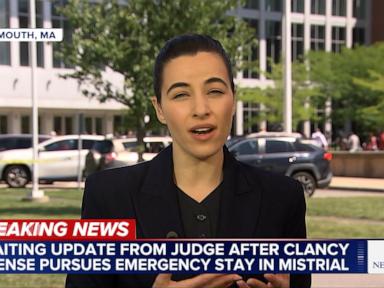
Dozens of supporters standing outside a Plymouth courtroom waiting for a verdict on Lindsay Clancy missed the point entirely. When Judge William Sullivan officially declared a mistrial after a deadlocked jury spent nearly forty agonizing hours parsing whether a mother was criminally responsible for strangling her three children, the media framed it as a tragedy of polarization. They argued over whether the supporters outside were sympathizers or protestors. They obsessed over the thirteen psychiatric medications, the execution-style timing, and the tragic window of January 2023.
They are all fighting the wrong war. You might also find this related article useful: The Golden Eye of Big Bear And What We Owe the Wild.
The mistrial is not a failure of twelve jurors to reach a consensus. It is a catastrophic failure of a legal system that attempts to apply medieval definitions of sanity to the chemical wreckage of postpartum psychosis. We treat severe psychiatric deterioration as if it is a standard corporate fraud case or a calculated gangland hit, expecting juries to measure the precise ounces of free will remaining inside a brain melting under the weight of acute neuroendocrine collapse.
Let us dispense with the lazy consensus immediately. The prosecution argued that Clancy executed her children—Cora, Dawson, and Callan—with cold efficiency because she managed to send her husband out for takeout and medicine first. The defense countered that auditory hallucinations and an over-medicated fog robbed her of criminal capacity. Both narratives buy into a comforting fiction: that a human mind experiencing total psychotic fracture operates according to logical, predictable steps. As reported in detailed articles by TIME, the effects are notable.
I have spent years analyzing high-stakes legal proceedings where medical malpractice collides with criminal liability, and I have watched institutions repeatedly fail to comprehend biochemical reality. When a patient is deep inside postpartum psychosis, the brain is not making rational choices; it is experiencing a catastrophic misfire of basic survival circuitry. Expecting a jury of laypeople to look at a mother who was prescribed a revolving door of psychiatric drugs and decide whether she "retained the substantial capacity to appreciate the wrongfulness" of her conduct is judicial malpractice disguised as due process.
Imagine a scenario where a pilot suffers a sudden, violent mid-air seizure, misinterprets the instrument panel, and flies directly into a mountain. We do not put the pilot on trial for first-degree murder based on the premise that they successfully manipulated the yoke prior to the crash. We recognize that the physiological engine failed. Yet when postpartum psychosis turns inward, the state demands a courtroom theater complete with competing forensic psychiatrists arguing over whether a hallucination sounded real enough to justify infanticide.
The public outside the courthouse wants a clean narrative. They want a villain to lock away forever, or a saint to absolve completely. Reality refuses to cooperate. Clancy was a former neonatal nurse who sought help repeatedly, checking herself into a psychiatric facility weeks before the tragedy. The system she trusted failed to stabilize her, handing her chemical cocktails that molecularly battered her prefrontal cortex. Then, when the inevitable explosion occurred, the state stepped in to ask if she planned the logistics with too much clarity to qualify for an insanity defense.
This is the core contradiction of the insanity defense in modern American jurisprudence. The law demands that you be completely unmoored from reality to be legally insane, yet prosecutors will use any evidence of purposeful behavior—like sending a husband to the pharmacy—to prove you were entirely rational. It is a catch-22 designed to punish the sickest individuals while pretending to offer a safety valve for mental illness.
If the state chooses to retry this case, the second trial will descend into the same grotesque circus that characterized the first. Millions of taxpayer dollars will be burned, expert witnesses will collect exorbitant fees to contradict each other on the stand, and a new set of jurors will be tortured with the gruesome details of a household destroyed by medical negligence and biological collapse.
The upcoming civil suit filed by both Lindsay and Patrick Clancy against her healthcare providers is where the actual accountability belongs. The real defendants should have been sitting at the medical board tables years ago, answering for a psychiatric culture that treats postpartum distress as a minor nuisance to be medicated away with a dozen overlapping prescriptions.
Stop asking whether a psychotic mother calculated her movements too efficiently to escape a prison sentence. Start asking why our medical infrastructure treats maternal mental health as an afterthought until the morgue doors open.
The jury is gone. The mistrial is official. And the system remains entirely broken.