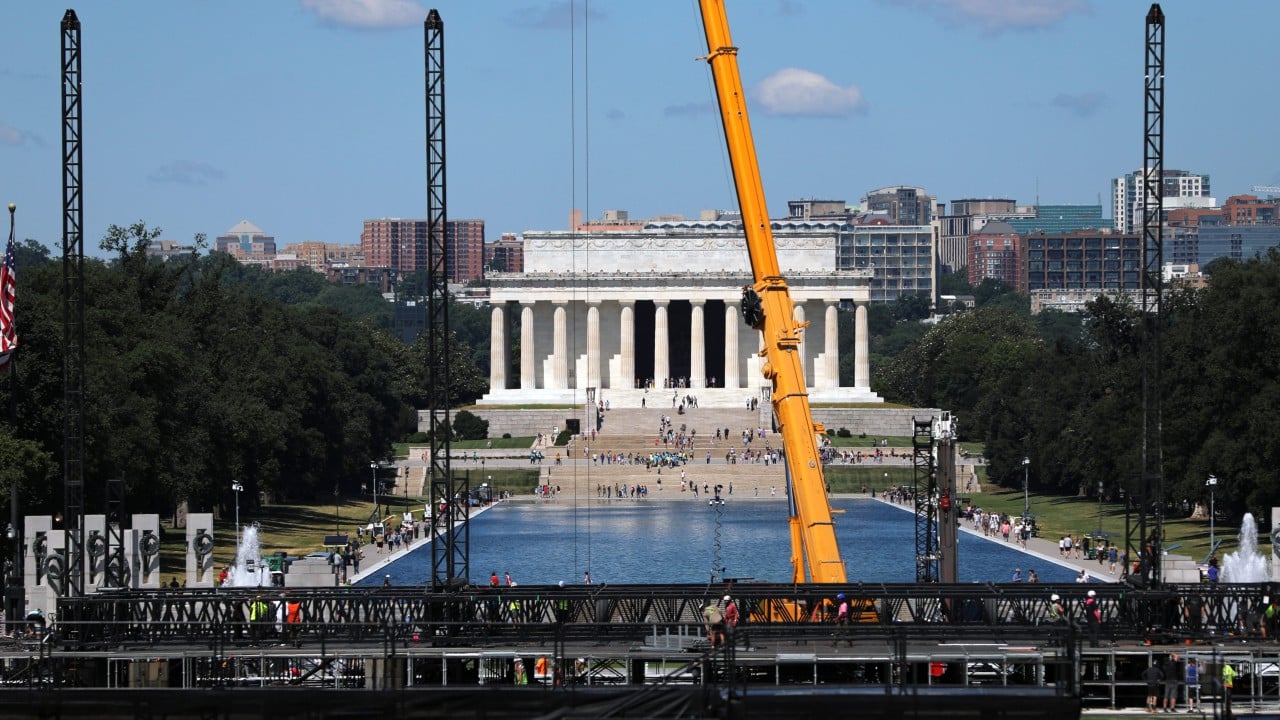
The mainstream media is treating the recent slashing of the Lincoln Memorial Reflecting Pool’s liner as a straightforward act of mindless vandalism. The National Park Service issues a sterile press release stating a sharp blade caused the damage, journalists type up their standard reports on the cost of civic repairs, and the public sighs at the decline of modern decency.
They are all missing the real story.
The obsession with protecting a fragile, synthetic membrane at the bottom of a historic monument exposes a deeper systemic failure. The problem is not that someone had a knife. The problem is that our most iconic public space relies on a design philosophy that treats citizens as passive consumers who must be walled off from the infrastructure they own. We built a giant, delicate aquarium in the middle of the National Mall and now we are shocked when it breaks.
The Lazy Consensus of Public Design
The standard response to civic vandalism follows a predictable, tired script: demand more security cameras, call for harsher penalties, and spend hundreds of thousands of tax dollars restoring the site to its exact previous state. This approach assumes the design itself is flawless and only human malice is at fault.
It is a fundamentally flawed premise.
When a piece of infrastructure on the National Mall can be compromised by a single person with a standard hardware store tool, the architecture itself is obsolete. The Lincoln Memorial Reflecting Pool holds roughly 6.75 million gallons of water. To contain that volume, engineers rely on a massive polyurethane or PVC liner laid over a gravel bed. It is essentially a glorified backyard pool scaled up to monumental proportions.
I have spent two decades analyzing urban infrastructure budgets and capital allocation. I have watched municipalities throw millions into "hardened" security measures for structures that were fundamentally misengineered for the realities of public usage. If a public asset requires constant surveillance and a zero-tolerance policy toward physical contact just to exist, it is not public infrastructure. It is a museum exhibit.
The Cost of Fragility
Let us look at the actual mechanics of how we maintain these spaces. The National Park Service routinely battles algae blooms, structural leaks, and equipment failures across its DC properties. When a liner tears, the repair process is a logistical nightmare:
- Complete Drainage: Millions of gallons of treated water are dumped directly into the Potomac watershed, creating a massive waste of resources.
- Localization Issues: Finding a sub-surface tear in a footprint spanning over 2,000 feet requires manual inspection, specialized pressure testing, or thermal imaging.
- Patch Instability: A vulcanized rubber or plastic patch applied to an aging liner under hydraulic pressure is a temporary fix, not a permanent solution.
Imagine a scenario where we designed our roads with the same fragility. If a single pothole threatened to collapse an entire highway system, we would fire the engineers. Yet, we accept this exact vulnerability in our civic landmarks because we have been conditioned to prioritize cosmetic perfection over resilience.
The heavy hitters in modern landscape architecture—firms that understand true urban integration—have abandoned this static model. They design spaces that embrace human interaction, wear, and even minor disruption without structural failure.
The Myth of the Passive Citizen
The People Also Ask columns are already filling up with questions like "How can we better protect the Reflecting Pool?" and "What is the penalty for damaging national monuments?"
These are the wrong questions. They stem from a flawed premise that the public's relationship with a monument should be entirely visual. You are allowed to look, you are allowed to take a photo, but you must not touch.
This artificial separation invites the very behavior it seeks to prevent. When you create a space that feels sterile and hyper-regulated, you alienate the community. The fence line becomes a challenge. The fragile liner becomes a target.
The downsides of my contrarian view are obvious to traditionalists. If you move away from synthetic liners and pristine, stagnant water, you lose the mirror-perfect reflection of the Washington Monument on a windless day. You get a space that looks more like a natural wetland or a heavy-duty stone plaza. It changes the aesthetic.
But the trade-off is a space that actually belongs to the city.
Disrupting the Architecture of Disconnection
We need to stop trying to fix the liner and start changing the material composition of our public commons. The status quo dictates that we patch the hole, hide the scars, and wait for the next blade to slice it open.
True resilience means replacing the fragile with the indestructible. If the basin of the reflecting pool were constructed using high-density, low-porosity engineered stone panels with self-sealing crystalline waterproofing additives within the concrete slab itself, a knife would do nothing but dull its own edge. There would be no membrane to pierce. The maintenance cycle would drop from a continuous crisis of leak detection to a simple, periodic power-wash.
It costs more upfront. It requires a complete overhaul of how federal procurement contracts are awarded, shifting the metrics from "lowest initial bid" to "century-long life cycle durability." But it eliminates the vulnerability entirely.
Stop treating our national symbols like fine china that will shatter the moment someone steps out of line. Build spaces that can handle the full weight of a chaotic, unpredictable public. Anything less is just a temporary patch on a sinking ship.