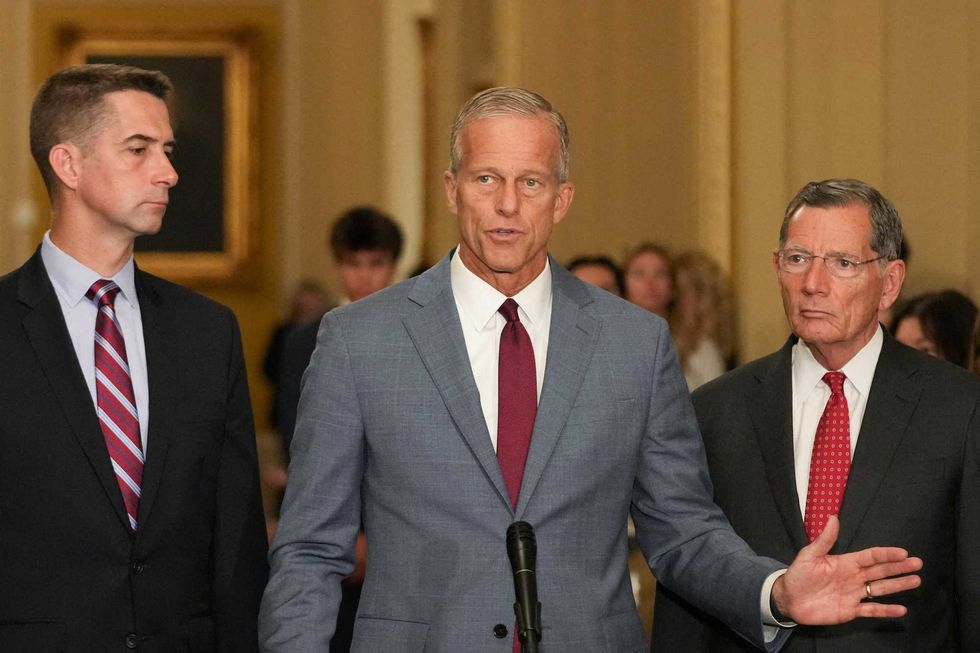
Political power within a dominant party coalition rarely flows in a unidirectional current from executive leader to legislative rank-and-file. When high-profile friction emerges between Donald Trump and Senate Republicans, observers frequently reduce the dynamic to personal animus or fleeting tactical disagreements. This analytical framework fails to account for the structural incentives, institutional self-preservation mechanisms, and divergent geographic constraints that govern legislative behavior in the United States Senate.
Evaluating these high-stakes legislative clashes requires examining the underlying mechanics of party discipline, the divergence between executive campaign objectives and senatorial electoral survival, and the structural design of the upper chamber. Behind closed-door confrontations and sharp public exchanges lie systematic conflicts over resource allocation, institutional prerogatives, and long-term electoral viability in swing jurisdictions.
The Structural Divergence of Incentives
The primary driver of friction between executive leadership and Senate Republicans stems from asymmetric incentives. An executive leader operating on a national mandate prioritizes broad-brush policy positioning, ideological purity tests, and rapid mobilization of base voters. Senators, by contrast, operate under distinct geographic constraints. A senator representing a purple or light-blue state must construct a winning coalition that routinely includes independent voters and moderate Democrats.
This structural divergence creates a persistent tension in legislative strategy. When an executive directive or nominee demands absolute ideological alignment, senators face a binary choice: comply and risk alienating the median voter in their specific state electorate, or dissent and trigger executive retaliation.
[Executive National Mandate] ---> Demands Uniform Alignment ---> Threatens State-Level Coalitions
[Senatorial State Mandate]   ---> Requires Median-Voter Appeal ---> Generates Institutional Pushback
This divergence manifests most clearly during high-stakes confirmations, budgetary negotiations, and legislative floor fights. The cost function of compliance for a senator in a competitive seat involves measurable electoral vulnerability. Consequently, institutional self-preservation regularly overrides party discipline, producing the rare public clashes that characterize modern inter-branch relations.
The Cost Function of Legislative Compliance
To understand why Republican senators occasionally break ranks, one must examine the tangible costs associated with absolute legislative subordination. Party unity yields collective goods, such as legislative majorities, committee chairmanships, and synchronized messaging. However, individual legislators bear localized costs when party directives conflict with regional economic or social baselines.
- Electoral Alienation: Voting for polarizing measures or controversial nominees forces vulnerable senators to defend records that may alienate critical suburban or independent blocs within their state borders.
- Institutional Prerogative: The Senate historically guards its constitutional authority regarding advice and consent, appropriations, and treaty ratification. Executive encroachment on these powers threatens the institutional standing of the chamber itself, prompting resistance from senior committee chairs regardless of partisan affiliation.
- Donor Base Fragmentation: Major financial contributors in state-level business and financial sectors often demand legislative predictability and moderation. Extreme friction or erratic policy shifts introduce market uncertainty, causing local donors to pressure their elected representatives to stabilize the legislative environment.
When these costs accumulate, the threshold for open defiance drops significantly. The resulting clashes are not random outbursts of frustration, but calculated tactical signals indicating that the boundary of acceptable legislative compromise has been breached.
The Mechanics of Private Confrontation Versus Public Posturing
Legislative negotiations within the Senate rely heavily on a bifurcated communication structure: private caucus deliberations and public media positioning. The friction between Trump and Senate Republicans often intensifies because these two domains operate on contradictory incentives.
In private caucus meetings, senators operate with relatively high candor. Institutional norms, seniority systems, and the imperative of maintaining working relationships enforce a degree of tactical discipline. However, when private disputes leak or are intentionally amplified, the dynamics shift instantly. Executive actors utilize external media channels and digital platforms to bypass traditional legislative bottlenecks, applying direct pressure on recalcitrant lawmakers through base mobilization.
This creates a feedback loop of escalation. When an executive figure publicly labels a dissenting senator as disloyal or weak, the senator's calculus shifts from a private legislative negotiation to an existential defense of independence. Capitulation under public duress signals weakness to both constituents and primary challengers, virtually guaranteeing that the targeted senator will dig in rather than fold. Thus, public pressure campaigns frequently produce the exact opposite of their intended legislative outcome, hardening opposition within the conference.
Managing Factional Fractures Within the Majority
Intra-party friction also exposes deep ideological fault lines within the Republican caucus itself. The contemporary senatorial landscape is populated by distinct factions: institutionalist traditionalists, populist nationalists, fiscal hawks, and defense-focused internationalists.
Maintaining cohesion across these competing factions requires delicate internal diplomacy. An executive strategy that favors one faction to the exclusion of others inevitably alienates the remainder. For instance, aggressive cuts to federal programs or sweeping executive overreach can alienate fiscal traditionalists who view such moves as violations of statutory norms and budgetary discipline.
The management of these internal fractures dictates the legislative output of the chamber. When leadership fails to bridge these gaps, individual senators step into the vacuum to assert their collective leverage. The resulting friction serves as an internal regulatory mechanism, preventing the party from overextending its legislative mandate beyond what the most vulnerable members can safely defend at the ballot box.
Strategic Outlook and Institutional Trajectory
The underlying dynamics governing relations between executive leadership and Senate Republicans indicate that friction will remain a permanent fixture of modern governance. As long as national polarization increases the pressure for ideological uniformity while state-level electorates demand pragmatic independence, institutional clashes are structurally guaranteed.
Future legislative outcomes will depend entirely on how effectively leadership accounts for the localized vulnerabilities of individual members. Strategies that respect the procedural autonomy of the upper chamber and accommodate the distinct political geography of swing-state senators will minimize public fractures. Conversely, attempts to enforce absolute behavioral compliance through external pressure will reliably provoke institutional resistance, reinforcing the structural checks and balances designed into the legislative branch.