Silence.
In the sterile, climate-controlled cleanrooms of Hsinchu and Santa Clara, where microscopic transistors are etched onto silicon wafers with ultraviolet light, silence is not merely the absence of noise; it is the foundational requirement for creating the modern world, a fragile vacuum where a single stray particle of dust or a single whispered rumor can shatter billions of dollars in value before the morning bell even rings on Wall Street.
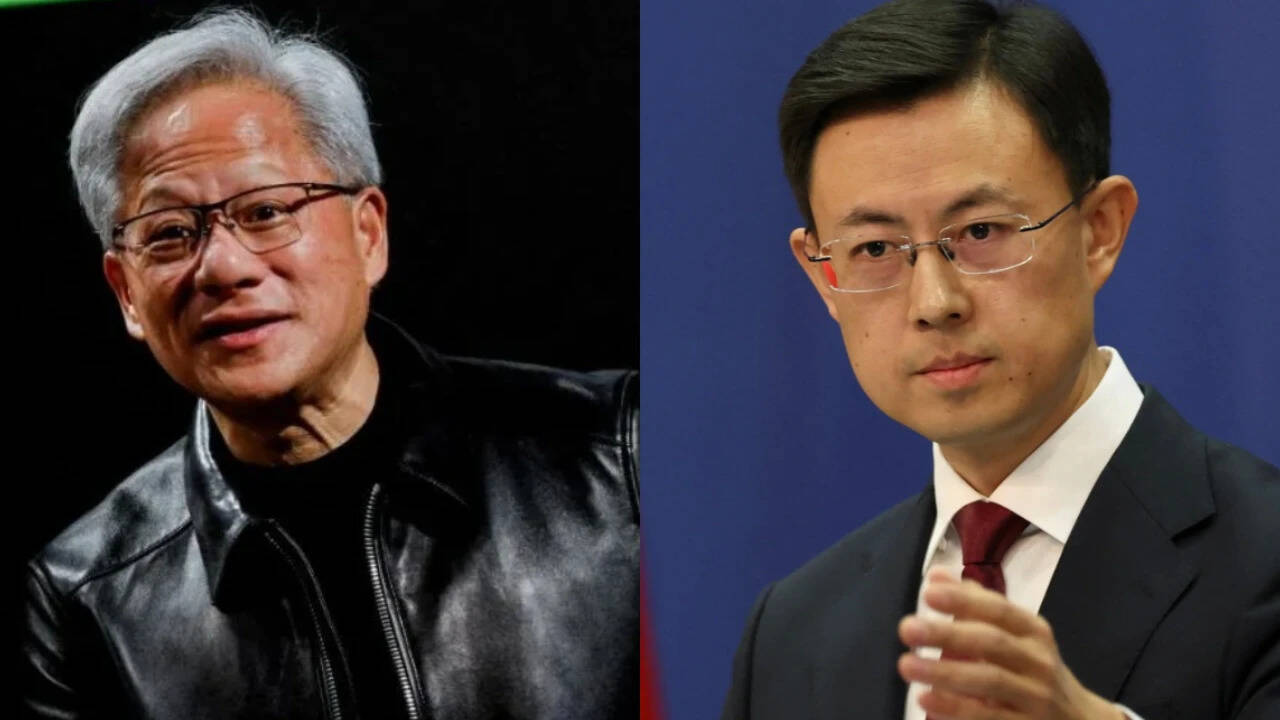
I remember the exact afternoon the first tremors of this particular rumor hit the trading floors and the policy corridors of Washington. A colleague of mine—let us call him Marcus, a veteran semiconductor analyst who has spent twenty years tracking supply chains from Taipei to Austin—called me from an airport lounge in San Jose, his voice tight with the kind of exhausted adrenaline you only hear when geopolitical reality collides head-on with market euphoria. He had just read a report circulating out of Washington, amplified by international outlets like NDTV, claiming that United States intelligence officials believed Jensen Huang, the leather-jacketed architect of Nvidia’s three-trillion-dollar empire, had once been involved in a romantic relationship with a suspected Chinese intelligence operative.
Pause.
Let that sink in for a second.
We are not talking about a mid-level defense contractor in Virginia or a sleepy academic lab in Massachusetts. We are talking about the man whose company designs the H100 and Blackwell graphics processing units—the literal neural tissue of the artificial intelligence revolution, the single most contested strategic asset on planet Earth right now. When a headline links the chief executive of Nvidia to alleged Chinese espionage, the shockwave does not stay neatly contained inside the gossip columns of Silicon Valley; it ripples outward into the Pentagon, the Zhongnanhai leadership compound in Beijing, and the retirement portfolios of millions of ordinary people who have never even heard the word "lithography."
The Anatomy of a Modern Intelligence Nightmare
To understand why a story like this carries the weight of a diplomatic crisis, you first have to strip away the Hollywood melodrama and look at how modern counterintelligence actually operates in the twenty-first century. Forget the trench coats, the poisoned umbrellas, and the clandestine handoffs on foggy bridges in Vienna. Today, espionage looks like a polite conversation over oolong tea at a tech conference in Taipei, a shared research grant between two universities, or a quiet romance that begins years before anyone realizes the person at the center of it will one day hold the keys to global technological supremacy.
Think of the global semiconductor supply chain as a single, impossibly intricate suspension bridge spanning the Pacific Ocean. On one side, American engineers design the architectural blueprints—the software ecosystems like CUDA and the chip designs that make large language models think. On the other side, specialized foundries in East Asia fabricate those designs at atomic scale, using machines built in the Netherlands and raw materials refined in China. Every single cable on that bridge relies on trust, predictability, and the assumption that the people standing at the center of the span are loyal to the rules of the system.
Now, imagine what happens when intelligence agencies begin whispering that one of the chief architects of that bridge may have had an intimate personal entanglement with an asset linked to a rival superpower.
The reports that surfaced out of Washington—citing anonymous national security officials and intelligence assessments—did not accuse Jensen Huang of treason, nor did they claim that proprietary Nvidia source code had been handed over on a silver platter. Intelligence assessments rarely deal in cinematic absolutes. Instead, they deal in vulnerabilities, historical timelines, and the cold, mathematical calculus of human leverage. According to the accounts circulating in policy circles, U.S. intelligence agencies had flagged a past romantic relationship between Huang and a woman believed by American counterintelligence to have ties to Chinese state security apparatus.
Does a past relationship prove wrongdoing? No.
Does it immediately trigger alarms inside the Committee on Foreign Investment in the United States, the Department of Commerce, and the National Security Council? Every single time.
The Human Variable in a World of Silicon
I have spent enough years watching founders, engineers, and intelligence officers cross paths in Silicon Valley to know a truth that rarely makes it into quarterly earnings calls: technology is built by machines, but it is governed by human frailty, ambition, and memory.
Consider a hypothetical scenario, grounded entirely in the standard playbook of modern intelligence services. Imagine a brilliant, charismatic engineer in the late 1990s or early 2000s—long before artificial intelligence was a household phrase, back when graphics cards were mostly bought by teenagers playing Quake in suburban basements. In those early decades, the boundary between American tech hubs and East Asian manufacturing centers was porous, optimistic, and almost entirely unpoliced by national security hawks. Cross-border relationships, joint ventures, and personal friendships were not viewed as potential vectors for state-sponsored espionage; they were celebrated as the glorious engine of globalization.
If a foreign intelligence service wanted to cultivate influence in Silicon Valley twenty or thirty years ago, they did not target the CEO of a trillion-dollar behemoth—because that company did not exist yet. They cast a wide net across promising immigrants, ambitious founders, and rising engineers, building relationships slowly, patiently, over decades, waiting to see which seeds would grow into towering redwoods.
By the time those seeds mature, the geopolitical climate has changed entirely. What looked like an innocent personal chapter in a freer, more naive era suddenly looks, under the harsh fluorescent lights of a 2026 counterintelligence briefing, like a potential point of exposure. Even if no secrets were ever shared, even if the relationship ended years before export controls were ever drafted, the mere existence of the connection becomes a weapon in the hands of rival factions in Washington and Beijing.
And that is where the real danger lives. Not necessarily in what happened in the past, but in how that past can be weaponized right now.
Why Washington and Beijing Are Locked in a Chip War
To grasp why a rumor about Jensen Huang’s personal life can rattle global markets, you have to understand the existential stakes of the current technological standoff between the United States and China.
For the past several years, Washington has erected an increasingly tight wall of export controls designed to prevent China from acquiring advanced AI chips and the equipment needed to manufacture them. The logic inside the Pentagon is straightforward: whoever leads in artificial intelligence will eventually lead in autonomous weapons systems, cyber warfare, cryptography, and economic productivity. In this view, Nvidia is not merely a publicly traded company in Santa Clara; it is a strategic national asset, roughly equivalent to the Manhattan Project or the Apollo space program, except that its products are sold on the open market.
Yet Jensen Huang himself has walked a razor-thin tightrope between Washington’s national security demands and the brutal commercial reality of the global market. Before the tightest restrictions took effect, China accounted for roughly a fifth to a quarter of Nvidia’s data center revenue. Huang has repeatedly warned policymakers—publicly, candidly, and sometimes to the visible annoyance of Washington hawks—that cutting Nvidia off entirely from the Chinese market will not stop China from developing AI; it will simply hand that massive market to domestic Chinese competitors like Huawei, starving American companies of the revenue they need to fund the next generation of research and development.
Imagine standing in Huang’s boots for a moment.
You have spent thirty years building a company from a booth at a Denny’s restaurant in San Jose into the most valuable hardware enterprise in human history. You are celebrated like a rock star in Taipei, courted by heads of state in Europe and the Middle East, and summoned to closed-door briefings in Washington. And then, right at the moment when your company sits at the epicenter of global power, a report leaks from the intelligence community suggesting you had a romantic relationship with a suspected Chinese spy.
Who benefits from that leak? Ask yourself that question slowly.
If you are a hardliner inside the U.S. government who believes Nvidia is too cozy with Beijing and needs to be brought under tighter federal oversight, a story linking the CEO to a Chinese intelligence operative instantly weakens his political leverage on Capitol Hill. Suddenly, his warnings about export controls sound less like objective market analysis and more like compromised sympathy. Conversely, if you are an adversary looking to sow distrust between Silicon Valley’s most important leader and the American national security establishment, planting or amplifying doubts about his personal loyalties achieves the exact same paralysis without firing a single shot.
The Invisible Cost of Doubt
We like to believe that modern markets and governments run on hard data—on benchmark tests, teraflops, balance sheets, and verified intelligence intercepts. They do not. At the highest levels of power, everything runs on confidence, and confidence is extraordinarily fragile.
I felt this firsthand during a briefing a few years ago with a former counterintelligence official who had spent his career investigating economic espionage in California. Over lukewarm coffee in a nondescript hotel lobby near the Dulles Toll Road, he told me something I have never forgotten. "When we investigate a potential compromise at the top of a major tech firm," he said, leaning forward so his voice wouldn't carry to the next table, "the worst-case scenario isn't that the executive is actively spying for Beijing. That's rare, and honestly, it's easier to prosecute. The nightmare scenario is ambiguity. It's the lingering doubt that makes board members hesitate, makes generals second-guess a supplier, and forces a brilliant leader to spend half his energy proving his loyalty instead of innovating."
Look closely at the mechanics of that ambiguity, because it explains everything about why the NDTV report and the underlying U.S. intelligence whispers hit such a raw nerve.
When an intelligence agency forms a "belief" about a past romantic relationship, they are rarely working with a signed confession. They are assembling fragments: travel records, financial metadata, communications intercepts from a third party, social connections at academic conferences, and behavioral patterns tracked over decades. Sometimes those fragments point to a genuine, coordinated intelligence operation—the classic "honey trap" or long-term cultivation strategy that intelligence services have used since the days of Sun Tzu. Other times, those fragments are circumstantial echoes distorted by hindsight and geopolitical paranoia.
Think back to the cautionary tales etched into the history of American science and intelligence. In 1999, Wen Ho Lee, a Taiwanese-born scientist at Los Alamos National Laboratory, was accused of stealing nuclear secrets for China in a media firestorm fueled by anonymous intelligence leaks, only for the federal case to collapse into an apology from a federal judge after Lee spent nine months in solitary confinement. On the other side of the ledger, there are verified, devastating cases—like the decades-long penetration of American defense contractors and tech firms by MSS operatives who used genuine personal relationships, academic fellowships, and romantic attachments to extract trade secrets worth billions.
Both realities exist simultaneously. That is what makes this terrain so treacherous, and honestly, so unsettling to navigate as an observer. If you dismiss every intelligence warning as McCarthyite paranoia, you leave the crown jewels of American innovation unguarded in an era of intense great-power competition. If you treat every rumor of a personal connection as proof of guilt, you destroy innocent lives and tear apart the very immigrant-driven talent ecosystem that made Silicon Valley great in the first place.
Behind the Curtain of Corporate Governance
For Nvidia’s board of directors, institutional investors, and partners across the defense and cloud computing industries, a report like this creates an immediate, unspoken governance dilemma.
Nvidia is no longer just a vendor selling chips to gamers; it is deeply embedded in sovereign AI initiatives, national laboratory supercomputers, and defense-adjacent cloud infrastructure across the Western alliance. When the chief executive of such a company is named in intelligence-related reporting involving a foreign operative, compliance officers in Washington, London, and Tokyo immediately start asking quiet, pointed questions behind closed doors.
Did the CEO disclose the relationship during any relevant security vetting or board governance reviews? When did the relationship occur, and what was the nature of the woman’s alleged ties to Chinese intelligence? Was she an active intelligence officer when they met, or did she become affiliated with state entities years later? Were any devices, travel itineraries, or corporate communications ever exposed during that period?
Notice how none of those questions require a dramatic courtroom trial to have real-world consequences. In the world of national security clearances and sovereign procurement contracts, perception and risk mitigation govern everything. Even a fiercely loyal, entirely innocent executive can find themselves walled off from certain classified briefings or forced to delegate sensitive government contracts to cleared subordinates simply to insulate the company from the appearance of conflict.
And meanwhile, the public is left staring at a headline that sounds like a Netflix thriller, trying to figure out whether the man who built the engine of the AI age is a visionary patriot, a naive target, or a pawn in an intelligence shadow war they can barely see.
What the Headlines Leave Out
If you read standard wire reports on stories like this, you get the bare bones: an unnamed source, a sensational allegation about a romantic link, a brief summary of Nvidia’s market dominance, and a boilerplate request for comment. It reads like a police blotter from another planet.
What those dry summaries miss is the profound human isolation that comes with standing at the top of the technological pyramid right now.
For decades, the mythology of Silicon Valley was built on radical openness. Founders wore jeans and leather jackets, spoke at conferences in Beijing and Shanghai with the same enthusiasm they brought to Las Vegas and Munich, and believed—genuinely, passionately—that connecting the world through faster silicon would naturally dissolve old geopolitical rivalries. Jensen Huang embodied that ethos more visibly than almost anyone else in the industry. Born in Taiwan, raised in Thailand and the American Pacific Northwest, educated at Oregon State and Stanford, he built a company that thrived precisely because it bridged East and West seamlessly.
Now, that bridge is being dismantled from both ends while he is still standing in the middle of it.
In Washington, any lingering personal or commercial tie to China is viewed through the lens of national security vulnerability. In Beijing, American tech executives are greeted with polite smiles in public while domestic state champions are quietly ordered to replace their hardware as quickly as possible. And in the shadows between the two capitals, intelligence services collect every detail of a leader’s private history—every dinner, every phone call, every past romance—turning a human life into a dossier of potential leverage.
I find myself thinking back to my friend Marcus in that San Jose airport lounge, staring at his phone as Nvidia’s stock ticker flickered in after-hours trading. What rattled him wasn't the fear that Nvidia’s chips would suddenly stop working tomorrow morning. It was the realization that the golden age of pure, apolitical engineering is dead and buried. Every line of code, every silicon wafer, and every personal relationship in the upper echelons of technology now carries a geopolitical price tag.
In the quiet cleanrooms of Hsinchu, the ultraviolet lasers keep firing, etching billions of microscopic pathways onto mirrors of polished silicon, oblivious to the whispers echoing through the corridors of Washington and Beijing. Yet out here in the noisy, imperfect world of human beings, one truth has become impossible to ignore: when a single company holds the keys to the future, no secret stays private forever, and even a memory from decades ago can cast a shadow across a trillion-dollar empire.