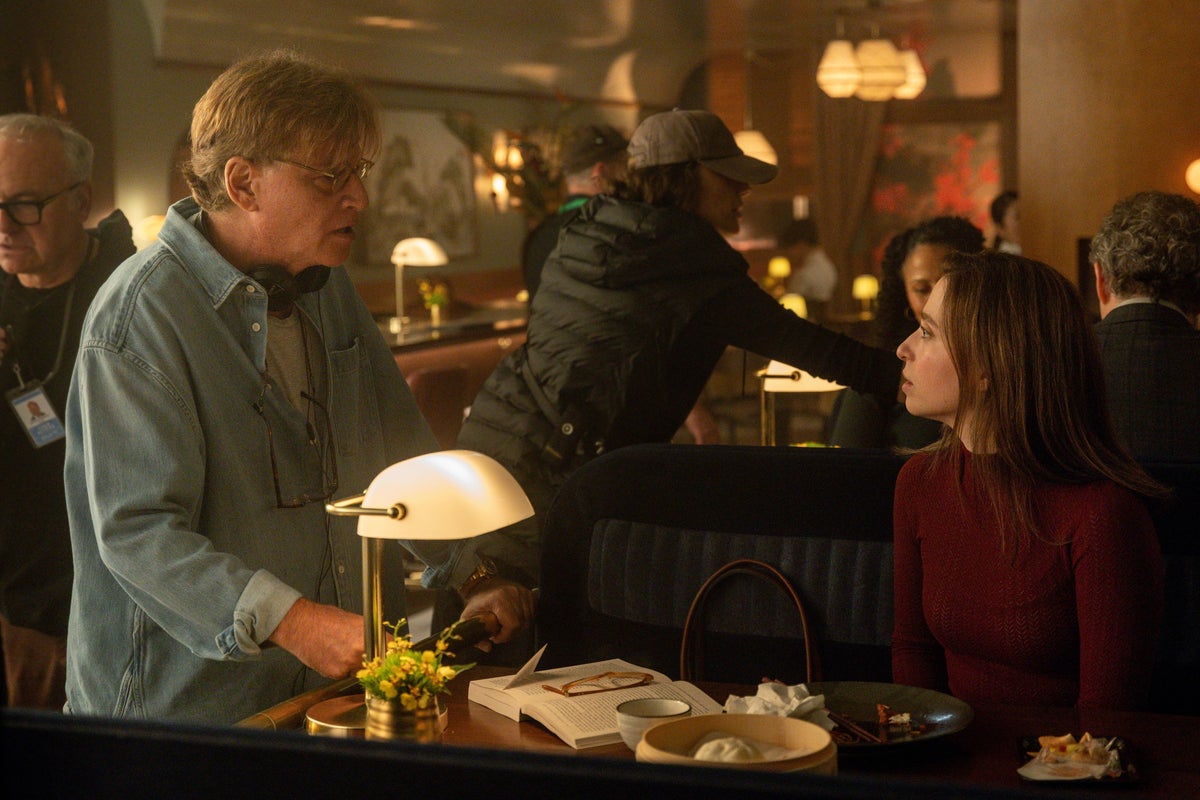
The sound stage in late autumn carries a distinct chill, the kind that forces actors to hug their heavy wardrobe close between takes. It was November 2025. Rob Reiner sat in a makeup chair, patiently letting a stylist adjust the starch-white wig of George Washington. He was seventy-eight years old, his face lined with decades of Hollywood history—from the loudmouth youth of All in the Family to the master architect behind The Princess Bride and When Harry Met Sally.
He was tired, but he was there. His old friend Larry David had called him for a secret cameo in a new HBO sketch series, Life, Larry, and the Pursuit of Unhappiness. Learn more on a connected topic: this related article.
Nobody in that room knew they were filming a piece of history. Nobody knew that just one month later, a horrific tragedy would take Rob and his wife, Michele, away forever.
They just thought they were making comedy. More reporting by Rolling Stone highlights related perspectives on the subject.
When a public figure dies under devastating circumstances, the world tends to freeze them in that final, tragic posture. We look at the headlines, the horrific details of the Los Angeles County medical examiner’s report from December, and we feel a profound, hollow weight. But creativity has a strange way of defying the timeline. Seven months after his death, as America celebrated its 250th anniversary in July 2026, Rob Reiner walked back onto our screens.
Clean-shaven, costumed in the formal regalia of the nation’s first president, he stepped up to a podium.
"Ladies and gentlemen," Reiner’s Washington began, his voice carrying that familiar, warm gravity. "I stand before you today as your president to announce that I shall not be seeking a third term."
In the crowd of historical extras, Larry David did what Larry David does best. He interrupted. He threw a wrench into the idealized machinery of American mythology.
"What if some future president doesn't follow your lead and runs for a third term?" David shouted from the crowd.
Reiner’s Washington countered calmly, noting that Congress would surely pass a constitutional amendment to stop it.
But David pressed harder, mapping out a dark, modern anxiety using the language of the 18th century. "What if there's some narcissistic prick who doesn't follow the Constitution?" He spun a hypothetical nightmare of a leader who uses the highest office to enrich his family, relies on a protective wall of yes-men, and incites an insurrection to overturn a fair election.
The studio audience watching at home didn't need a map to find the target. The sketch never once utters the name Donald Trump. It didn't have to.
Consider the mechanics of great political satire. It doesn't rely on a scalpel; sometimes it uses a sledgehammer. As the bit rolled on, Jimmy Kimmel joined the fray, mocking the idea of a commander-in-chief who spends his days aggressively lashing out at anyone who dares to poke fun at him.
Reiner’s Washington held the line, arguing with a straight face that a man of such profoundly poor character could never be elected in the first place. Surely, the guardrails would hold. Surely, the Supreme Court wouldn't be filled with partisans, and Congress wouldn't surrender its conscience to party loyalty.
Then, the illusion shattered. The crowd of colonists broke into a chaotic, screaming brawl. Reiner's Washington stood entirely powerless, watching the grand experiment dissolve into tribal warfare.
He looked directly ahead, sighed, and muttered a final line. "We're fucked."
It is a jarring, hilarious, and deeply sad moment of television. It serves as an unintended, posthumous mic drop.
For years, Trump and Reiner locked horns in a very public, very bitter ideological feud. Reiner had long classified the former president as mentally unfit for office. Trump, true to form, didn't let Reiner’s passing slow his vitriol. Following the filmmaker's death, Trump took to Truth Social to mock him, attributing his passing to "Trump Derangement Syndrome"—a post so venomous it drew quiet rebukes from within his own party.
Trump likely believed he had the definitive, unanswerable word. He was wrong.
Art has a funny way of escaping the grave. Because Reiner stepped onto that quiet set in November, he managed to throw a counterpunch from the great beyond. It bypassed the algorithms, the political rallies, and the daily news cycle to land directly on premium cable during Independence Day weekend.
Executive producer Ethan Lewis later admitted he was stunned the secret cameo stayed quiet for so long. At the Los Angeles premiere, they purposefully cut the sketch from the screening, hiding it like a hidden fuse until the July 3 broadcast. They wanted the public to experience it raw.
Some political commentators have argued the sketch lays it on too thick, that it serves merely to flatter the outrage of a specific Hollywood demographic while the actual machinery of Washington continues to tilt toward authoritarian fiat. They might be right. A television sketch cannot change a Supreme Court ruling or mend a broken electorate.
But watching Reiner play Washington isn't about policy. It's about the human refusal to be silenced.
We are left with an indelible image that refuses to fade: an old storyteller, dressed as the father of a country he spent his life trying to understand, looking past the camera, past the noise, and right into our eyes to tell us exactly what he thinks. He got the last word. And somewhere, one suspects, Rob Reiner is enjoying the silence that followed.