The coffee in the mug was cold before Karl realized he had stopped drinking it. Outside his kitchen window, the skyline of the Ruhr Valley did what it had done for a century: it breathed gray. It coughed low, rhythmic grunts of steam into an indifferent autumn sky. This was the landscape of Karl’s childhood, the architecture of his grandfather’s lungs, the monument of a nation built on crushed black stone.
Coal had a smell. It was heavy, sulfurous, and stubbornly alive. It smelled like employment. It smelled like hot radiators in drafty classrooms and Sunday roasts cooked on iron stoves. When you grow up in a country powered by what lies beneath your feet, the earth feels solid, dependable, almost patriotic.
Then came the law.
In the dry, air-conditioned rooms of Berlin, politicians signed a piece of paper that promised to rewrite the physics of the republic. They set a date: 2045. By then, the chimneys must go dark. For the first time in modern history, Germany bound itself to a legal absolute—the complete phase-out of fossil fuels. No more coal. No more oil. No more burning the ancient sunlight trapped in the shale to keep the lights on in Frankfurt or warm the apartments in Munich.
To a man who spent forty years maintaining turbine blades in a coal-fired plant outside Duisburg, 2045 sounds less like a target and more like science fiction.
"They talk about it like changing a lightbulb," Karl told me, wiping grease from his calloused thumb with a rag that had seen better decades. "They sit behind desks with clean fingernails and decide that our entire history was a mistake. But what happens when the wind doesn't blow? What happens to the bakery down the street that needs steam twenty-four hours a day?"
His skepticism is not born of malice. It is born of friction. Change on a continental scale is never clean; it arrives with the sound of grinding gears and the quiet panic of workers wondering if their skills have an expiration date.
Yet, beneath the skepticism lies an undeniable reality. The climate is not negotiating. Across southern Germany, alpine glaciers are bleeding into muddy trickles that elders say they have never seen before. In the North Sea, storm surges bite deeper into the dykes each winter, chewing away at land that generations fought the water to reclaim. The math of carbon is unforgiving, and the ledger is out of balance.
Germany’s commitment to reach climate neutrality by 2045—accelerated from previous timid timelines—is an attempt to force the future before the future forces them. It is an industrial nation trying to perform open-heart surgery on itself while running a marathon.
Consider the scale of the machinery involved. This is not a country of sun-drenched rooftops where solar panels are a casual weekend DIY project. This is a damp, cloudy northern European powerhouse that spent a century mastering the art of combustion. Transitioning means dismantling the very engine of its economic miracle and building a new one out of thin air.
The engineering challenge is staggering, but the human challenge is heavier.
In a hypothetical village in Lusatia, where open-pit coal mines look like brutalist amphitheaters carved into the crust of the earth, the mood is heavy. Maria, a thirty-two-year-old geologist whose father and grandfather both worked the draglines, watches the dust settle over the pit. Her job is to map the soil stability for future reclamation projects—turning moonscapes into artificial lakes and wind parks.
"Everyone thinks closing a mine is just turning a key," Maria explains, her boots caked in gray marl. "It is not. It is tearing out the central nervous system of a community. The pub closes. The sports club loses its sponsors. The young people leave because code and wind turbines don't require the same muscle as iron and coal."
She isn't wrong. The transition demands a reinvention of identity. For generations, to be German—especially in the industrial heartlands—meant to make things that were heavy, durable, and fueled by fire. Shifting to electrons captured from sea breezes and photons trapped by silicon changes the emotional texture of labor. It moves the source of power from the earth to the sky, from something you can shovel into a furnace to something you can only watch register on a distant digital meter.
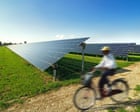
Yet, the transition is already altering the horizon. Drive down the autobahn today, and the gray smokestacks are increasingly flanked by white giants. Modern wind turbines spin in slow, hypnotic circles across the agricultural plains of Brandenburg and Schleswig-Holstein. Offshore parks in the North Sea hum with invisible current, sending invisible energy down invisible corridors to power distant factories.
The numbers tell a story of stubborn acceleration. Despite political squabbles, bureaucratic inertia, and the sudden, violent energy shocks triggered by conflicts in the east, renewable sources have surged to supply over half of the nation's electricity. The trajectory bends upward, even when the path gets steep.
The year 2045 is not just a policy document. It is a psychological horizon. It marks the boundary between the epoch of extraction and the epoch of stewardship.
Back in the Ruhr Valley, Karl walks me to the edge of his property. He points toward the horizon, where the cooling tower of his old power plant cuts a pale silhouette against the gathering dusk. It is scheduled for decommissioning. The massive boilers that once roared with the energy of a million ancient ferns will soon go cold forever.
He is quiet for a long moment. The wind stirs the dry leaves along the fence line.
"My grandfather told me that men who dig coal owe a debt to the future," Karl says softly, his eyes fixed on the distant concrete cylinder. "I always thought he meant we had to keep digging so the future would have light. Maybe he meant we had to stop, so the future would have a chance to breathe."
The chimney stands tall against the violet sky, silent, monumental, and living on borrowed time. The fire inside is dying down, but the light is just beginning to change.