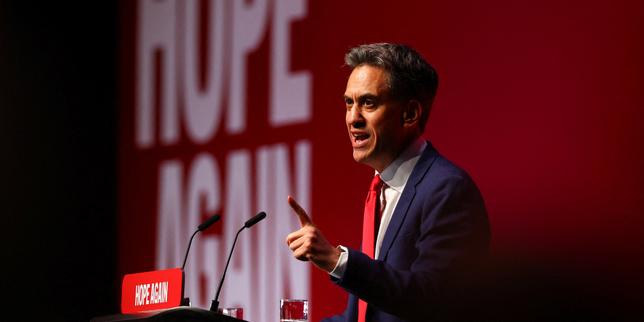
According to reporting on recent UK Labour Party dynamics, senior figures including Ed Miliband and Andy Burnham have signaled a desire to recalibrate the party’s foreign policy approach toward Israel, positioning this adjustment as a break from Keir Starmer’s leadership era. Political commentary surrounding these remarks largely frames the development through a familiar binary: a battle between a centrist, disciplined frontbench and a progressive grassroots demanding moral clarity on the Middle East.
That framing misses the structural reality of British electoral politics. What looks like an ideological rupture inside Labour is primarily an exercise in coalition management, electoral arithmetic, and institutional risk mitigation. You might also find this similar story insightful: Why Legal Aid Denials For Policy Challenges Are Setting Records.
To understand why Ed Miliband, Andy Burnham, and the broader Labour leadership apparatus are shifting their rhetoric, you have to look past the conference hall applause and examine the mechanics of party survival in the United Kingdom.
The Myth of the Clean Break
Political journalism thrives on narratives of succession and rebellion. When a cabinet minister or a prominent regional mayor speaks to party activists about reviewing policy on Israel, the immediate interpretation is that a leadership challenger is planting a flag, or that the party is finally "turning the page" on Keir Starmer's tight discipline. As reported in detailed articles by BBC News, the effects are significant.
In practice, senior figures within a governing or prospective governing party rarely freelanced on high-stakes foreign policy without either tacit clearance from the center or a shared understanding of electoral necessity.
Consider the roles these men occupy. Ed Miliband is a veteran cabinet figure and former party leader who understands the cost of internal party warfare better than almost anyone in Westminster. Andy Burnham, as Mayor of Greater Manchester, governs a diverse metropolitan electorate where the fallout from Gaza and British arms export policy had direct, measurable consequences at the ballot box during the 2024 general election and subsequent local contests.
When they speak of reviewing the party's approach, they are not launching a coup against the leadership's worldview. They are responding to a concrete political vulnerability that cost Labour parliamentary seats and tens of thousands of votes in historically safe constituencies.
Electoral Math Over Ideological Purity
In the 2024 UK general election, Labour won a massive parliamentary majority, yet its vote share dropped sharply in areas with large Muslim populations and among younger, urban progressive voters. Independent candidates campaigning explicitly on Gaza unseated Labour incumbents in constituencies like Blackburn, Dewsbury and Batley, Leicester South, and Birmingham Perry Barr.
A political party does not need a sudden philosophical conversion to recognize an existential threat to its urban base. If Labour fails to rebuild trust in those seats before the next election cycle, its parliamentary majority becomes structurally fragile, regardless of how well it performs in swing towns.
Therefore, when Miliband and Burnham tell activists that the party has reviewed its approach, they are performing a specific political function: signaling to alienated voters and party members that the leadership has heard the criticism, without actually dismantling the core diplomatic framework of the British state.
What "Reviewing the Approach" Actually Means in Whitehall
There is a vast difference between what is said at a fringe meeting of party activists and what happens inside the Foreign, Commonwealth and Development Office (FCDO).
Standard political commentary often treats a change in tone as a change in policy. In British governance, however, foreign policy toward Israel is anchored by three institutional pillars that survive changes in party rhetoric:
- Intelligence and Security Architecture: The UK’s defense and intelligence cooperation with Israel is deeply integrated into broader Western security frameworks, including intelligence-sharing agreements and defense procurement supply chains. No Labour cabinet—whether led by Starmer, Burnham, or Miliband—is going to unilaterally sever security ties that Whitehall officials view as vital to UK national interests.
- Alignment with Washington: British foreign policy remains structurally tethered to the United States. While London can diverge on specific legal interpretations—such as suspending certain arms export licenses based on assessments of international humanitarian law, or restoring funding to UNRWA—it does not execute sweeping diplomatic reversals that would isolate it from Washington.
- Legalistic Calibration: When the Labour government adjusted its stance on arms export licenses in 2024, suspending roughly 30 out of 350 licenses, ministers were careful to frame the decision not as a political rebuke, but as a narrow, quasi-judicial compliance exercise under the UK’s Strategic Export Licensing Criteria.
Framing policy adjustments around legal reviews and humanitarian conditions allows Labour figures to tell activists they are "changing course" while reassuring diplomatic allies in Washington and Tel Aviv that Britain remains a predictable partner.
The Misunderstood Role of Andy Burnham and Ed Miliband
To treat Miliband and Burnham simply as standard-bearers of the party's left wing is to misread their political careers. Both men are pragmatic institutionalists who operate within the mainstream of the Labour tradition.
- Ed Miliband's Trajectory: During his own tenure as Labour leader from 2010 to 2015, Miliband navigated intense internal debates over the Middle East, including the 2014 parliamentary vote on recognizing a Palestinian state. His approach has consistently been to find consensus positions that hold the Labour coalition together—supporting a two-state solution, criticizing specific actions of the Israeli government, and maintaining support for Israel's security.
- Andy Burnham's Positioning: As a regional mayor, Burnham is insulated from the day-to-day constraints of collective cabinet responsibility, giving him the latitude to speak more candidly to grassroots sentiment. Yet his political brand is built on competence, regional economic devolution, and broad-church pragmatism, not ideological insurgency.
By placing themselves at the forefront of a "reviewed approach," Miliband and Burnham act as pressure valves for the party. They absorb the frustration of the activist base, validate their concerns in empathetic language, and channel that energy back into the party structure rather than letting it bleed out to independent rivals or the Green Party.
The Risk of the Dual-Audience Strategy
While recalibrating rhetoric to soothe activists and win back lost urban voters makes short-term electoral sense, it carries a serious strategic downside that political analysts frequently overlook.
Speaking differently to party activists than to diplomatic counterparts creates a credibility gap.
If grassroots members and alienated voters are told that Labour is "turning the page" on the Starmer era, their expectations for concrete policy shifts will rise accordingly. They will expect sweeping arms embargoes, immediate bilateral recognition of Palestine without preconditions, and tougher sanctions.
When the realities of Whitehall governance, international treaties, and coalition diplomacy inevitably limit how far the government goes, that initial wave of relief among activists quickly turns into deeper cynicism. Voters who feel misled twice are far harder to win back than voters who simply disagree with a policy.
At the same time, signaling an internal rupture on foreign policy invites scrutiny from political opponents and international partners, who will question whether the UK government speaks with one voice or is retreating under domestic pressure.
What Observers Should Actually Watch
If you want to know whether Labour's approach to Israel is genuinely changing or merely undergoing a communications facelift, ignore the speeches delivered to party faithful and track three concrete indicators:
- Export Licensing Scope: Watch whether the criteria used by the Department for Business and Trade expand beyond direct-use offensive weapons in Gaza to include components for global defense programs like the F-35 fighter jet. That is the line between symbolic adjustment and structural disruption.
- Diplomatic Recognition Timing: Pay attention to whether the UK moves toward unilateral recognition of a Palestinian state as a diplomatic lever now, or keeps it strictly tied to the end-state of a negotiated peace process.
- Trade and Sanctions Policy: Monitor whether rhetoric about Israeli settlements translates into tangible economic measures, such as banning goods from occupied territories or sanctioning sitting Israeli cabinet ministers, rather than limiting sanctions to individual extremist settlers.
Until those levers move in Whitehall, talk of turning the page is not a foreign policy revolution. It is the standard operating procedure of a political party trying to hold an incompatible coalition together.