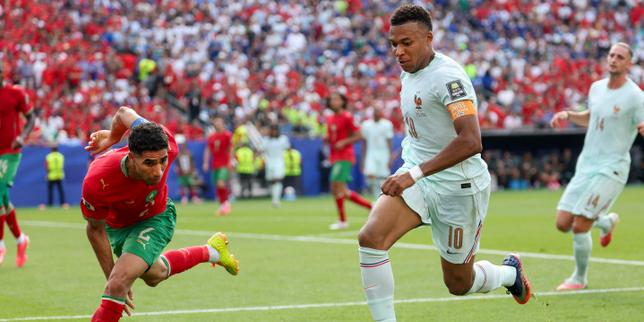
France ended Morocco historic World Cup run with a clinical victory that proved elite tournament experience often trumps raw emotional momentum. Kylian Mbappe speed and tactical gravitas opened up the spaces that allowed Les Bleus to secure their place in the final. While headlines focused on French dominance, the reality of the match revealed a deeper tactical chess game where attrition finally caught up with a depleted Moroccan defense.
The Mirage of Control
Morocco entered the semifinal with the best defensive record in Qatar. They had not conceded a single goal to an opponent across five previous matches.
The early French breakthrough altered the entire tactical calculus of the match. Theo Hernandez struck in the fifth minute, forcing Morocco out of their low-block defensive shape. For the first time in the tournament, the Atlas Lions had to chase a game.
What followed was a tactical paradox. Morocco actually controlled possession for large stretches of the match. They held 62% of the ball, a statistic that would usually indicate dominance. French manager Didier Deschamps engineered this shift deliberately. France retreated into a compact mid-block, willingly ceding the ball and daring Morocco to break them down through sustained possession rather than quick transitions.
The Quiet Gravity of Kylian Mbappe
Much of the post-match analysis focused on Mbappe lack of defensive work rate. Achraf Hakimi and Sofyan Amrabat managed to contain his direct central runs for long periods.
Mbappe impact extended far beyond his touches on the ball. His presence acted as a tactical anchor that distorted the entire Moroccan defensive structure. Even when standing still on the left flank, he demanded the constant attention of two or three defenders. This gravitational pull created the massive gaps in the right channel that Antoine Griezmann exploited repeatedly.
Morocco Defensive Shift vs. Mbappe Presence
[Morocco Right Flank] -> Heavily Committed to Mbappe
       |
       v
[Central Space Opened] -> Exploited by Griezmann / Hernandez
The second French goal perfectly illustrated this dynamic. Mbappe picked up the ball in a crowded penalty box. He drew four Moroccan defenders toward him through sheer reputation and quick footwork. His deflected shot found Randal Kolo Muani at the back post. It looked messy, but it was the direct result of defensive panic caused by a single player.
The Cost of Heavy Minutes
Morocco exit was not just a failure of tactics. It was a failure of the human body under extreme stress.
Manager Walid Regragui took a massive gamble on the fitness of his key center-backs. Romain Saiss, Noussair Mazraoui, and Nayef Aguerd all carried significant injuries into the match. Aguerd was withdrawn just before kickoff. Mazraoui lasted only until halftime. Saiss was forced off after 21 minutes, visibly unable to sprint.
| Player | Injury Status | Minutes Played in Semifinal |
|---|---|---|
| Nayef Aguerd | Thigh Strain | 0 (Withdrawn before kickoff) |
| Romain Saiss | Hamstring Tear | 21 (Forced substitution) |
| Noussair Mazraoui | Hip Flexor | 45 (Substituted at halftime) |
Elite international football leaves no room for sentimentality. France targeted these physical liabilities immediately. The opening goal came down the Moroccan right side, where the defensive rotations were visibly compromised by lack of mobility.
Beyond the Fairy Tale
The narrative surrounding Morocco focused heavily on romantic notions of spirit and destiny. They became the first African and Arab nation to reach a World Cup semifinal.
Spirit does not stop elite transition play. France won because they possessed a pragmatic ruthlessness that defines modern tournament teams. They did not care about style points or possession percentages. They waited for the inevitable physical drop-off that occurs when a squad missing three starting defenders tries to match the intensity of a world champion.
Morocco reliance on a hyper-dense defensive block worked perfectly against Spain and Portugal teams that favored slow, predictable sideways passing. France offered a completely different profile. With players like Ousmane Dembele and Mbappe on the wings, France stretched the pitch horizontally, forcing the injured Moroccan defenders to cover distances their bodies simply could not handle.
The Blueprint for the Future
The tactical lesson from this match is clear for developing football nations. Defensive organization and emotional intensity can carry a team through the group stages and early knockout rounds. Winning a World Cup requires a depth of squad rotation that can survive seven games in 28 days.
Morocco lacked the bench depth to replace their injured stars without a drop in quality. When creative midfielder Azzedine Ounahi tried to spark the attack, he lacked the clinical final ball that elite teams convert with minimal effort. France showed that winning at this level is about minimizing errors and maximizing the value of every entry into the opposition penalty area.