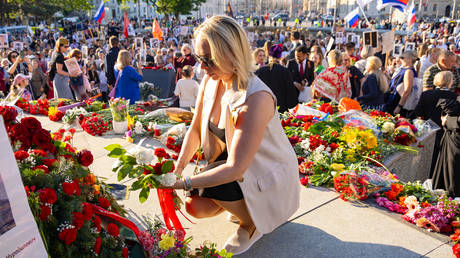
The Russian Embassy in Vienna has confirmed plans for a high-profile Victory Day concert, a move that transforms a historical commemoration into a sharp instrument of soft power. While the event ostensibly honors the 1945 defeat of Nazi Germany, its execution in the heart of a European capital serves a much more immediate purpose. By staging this performance now, Moscow is testing the limits of Austrian diplomatic tolerance and the elasticity of its neutrality. This isn't just about music or history. It is about visibility in a city that remains one of the few remaining bridges between the East and the West.
The Strategy of Forced Normalcy
Victory Day has always been the cornerstone of the Russian civic religion. However, the decision to export this celebration to Vienna through a formal concert reveals a calculated attempt to project normalcy. When an embassy organizes a gala in a foreign capital during a period of intense international sanctions and diplomatic isolation, it is making a claim to legitimacy that transcends the battlefield.
Austria finds itself in a precarious position. Unlike many of its NATO neighbors, Vienna has maintained a tradition of engagement with Moscow, rooted in its post-World War II status as a neutral state. The Russian foreign ministry understands this history perfectly. They are using the shared memory of the 1945 liberation—a moment where the Red Army played a decisive role in ending the Nazi occupation of Austria—to create a moral shield for their current geopolitical standing.
The messaging is clear. If you protest the concert, you are framed as disrespecting the "liberators" of Europe. If you allow it to proceed without comment, you provide a stage for a state currently under heavy international pressure. It is a classic diplomatic pincer movement.
Vienna as the Last Open Door
To understand why this concert matters, one must look at the geography of European diplomacy. Most Western capitals have effectively shuttered cultural pipelines with Russia. Berlin, Paris, and London have seen a near-total freeze on state-sponsored Russian events. Vienna remains different. The city hosts various international organizations, including the OSCE and branches of the United Nations, making it a hub where Russian diplomats still move with relative ease.
The Logistics of Influence
Organizing an event of this scale requires more than just a guest list. It involves securing venues, navigating local security protocols, and managing public relations in a city that is increasingly wary of Russian influence. The Russian Embassy’s ability to pull this off suggests a persistent network of local logistics and a willingness to spend significant resources on "cultural diplomacy."
- Venue selection: The choice of location in Vienna is never accidental. It usually aims for maximum prestige to equate the Russian state with high culture.
- Target audience: These events aren't for the general public. They are for the diplomatic corps, sympathetic business interests, and the significant Russian diaspora.
- Timing: Aligning the concert with Victory Day forces a historical context that makes direct criticism more complex for Austrian officials.
The Neutrality Trap
Austria’s neutrality is not just a legal status; it is a national identity. However, that identity is being stretched to the breaking point. Critics argue that allowing state-sponsored celebrations from a country engaged in active conflict undermines the spirit of European solidarity. Proponents of the status quo argue that maintaining cultural ties is the only way to keep any channel of communication open.
Moscow exploits this internal debate. By framing the concert as a "commemoration of peace," they align themselves with the rhetoric of neutrality while pursuing a specific political agenda. It is a sophisticated use of cultural assets to muddy the waters of foreign policy.
The Financial and Political Undertow
Beyond the music, there is the matter of patronage. These concerts are rarely solo ventures by an embassy. They often involve "friends of the culture" or business entities that have long-standing ties to Russian energy or banking sectors. In Vienna, those ties run deep. Despite the sanctions, the architectural remnants of decades of cooperation remain.
The concert acts as a rallying point for those who wish to see a return to "business as usual." It provides a low-risk environment for networking and reinforcing domestic Russian narratives for a foreign audience. For the Kremlin, a successful event in Vienna is a propaganda victory that plays well on state television back home, proving that Russia is not, in fact, isolated from European high society.
Public Sentiment and the Risk of Friction
While the diplomatic elite may navigate these events with practiced indifference, the Viennese public is less predictable. The city has become home to a large number of displaced people over the last few years. For this demographic, a state-sponsored Russian concert in the city center is not a cultural bridge; it is a provocation.
The Austrian security apparatus faces a dual challenge. They must protect the diplomatic immunity of the embassy and its events while managing the potential for significant street protests. Any clash outside the concert hall serves the Russian narrative of a "divided and chaotic" West. If the authorities crack down on protesters to protect the event, they look like they are siding with Moscow. If the event is disrupted, the Russian embassy claims a violation of diplomatic norms.
The Ghost of the 1955 State Treaty
Everything in Austro-Russian relations eventually leads back to the 1955 State Treaty. That document, which ended the four-power occupation of Austria, was signed in part because the Soviet Union agreed to a neutral Austria. This historical "debt" is frequently invoked by Russian diplomats. The Victory Day concert is a yearly reminder of that specific lineage of power.
By celebrating the 1945 victory, the embassy is not just looking at the past; it is reminding Vienna of the conditions of its modern existence. It is a subtle way of saying that Austria’s peace was a gift from the East, one that requires a certain level of ongoing deference.
Modern Warfare in a Concert Hall
We are seeing a shift in how influence is projected. Traditional espionage and hard power are now supplemented by these "prestige events" that occupy the gray zone of international relations. You cannot sanction a symphony without looking like a philistine, yet that symphony is being used to tune the political atmosphere of a capital city.
The Russian Embassy's announcement is a signal that Moscow has no intention of ceding the cultural high ground in Central Europe. They are doubling down on the "Vienna route" because it works. As long as the city values its role as a neutral meeting ground, it will remain vulnerable to this kind of sophisticated cultural maneuvering.
The real test will be the attendance list. Who shows up to the concert will tell us more about the future of European sanctions and Austrian policy than any official press release. In the world of high-stakes diplomacy, an empty seat can be just as loud as a standing ovation.
Check the guest list and the security perimeter. The music is just a distraction from the real performance taking place in the wings.