The humidity in the Democratic Republic of Congo doesn't just sit on you; it breathes with you. In the dense, emerald shadows of the Congo Basin, the air is thick with the scent of damp earth and the distant, rhythmic calls of a world that predates human memory. This is the only place on Earth where bonobos exist. They are our closest cousins, sharing 98.7% of our DNA, yet they are being erased from the map by the very people who share their bloodline.
Deep in the heart of this green expanse, far from the chaotic sprawl of Kinshasa, a tragedy unfolds daily. It begins with a gunshot. Poachers, driven by a desperate need for meat or the lucrative black market for exotic pets, target adult bonobos. The elders are killed for food. But the infants—tiny, wide-eyed creatures with grasping fingers—are kept alive. They are the collateral damage of a war they cannot understand.
The Weight of a Broken Bond
Imagine a child who has witnessed the unthinkable. A bonobo infant clings to its mother for years, learning the complex social graces of their matriarchal society. When that bond is severed by a machete or a bullet, the trauma is more than psychological; it is physiological. They stop eating. They stop moving. They simply give up.
Lola ya Bonobo, a sanctuary founded on the outskirts of the capital, acts as the only line of defense against this spiritual and biological extinction. The name translates to "Paradise for Bonobos," but for the staff who work there, it is a site of constant, exhausting triage. When a crate arrives at the gates, often after days of the infant being tied up in a village or shoved into a sack, the first thing the rescuers look for isn't a wound. It is the eyes. If the eyes are vacant, the battle is already half-lost.
The stakes are invisible to most of the world, but they are monumental. Bonobos are the "gardeners of the forest." They eat seeds that are too large for other animals to process, and as they move across their territory, they plant the future of the Congo Basin through their waste. Without them, the second-largest rainforest on the planet begins to thin. The lungs of Africa start to fail.
The Surrogates
The sanctuary doesn't rely on high-tech interventions or sterile laboratories. It relies on the most basic human instinct: touch.
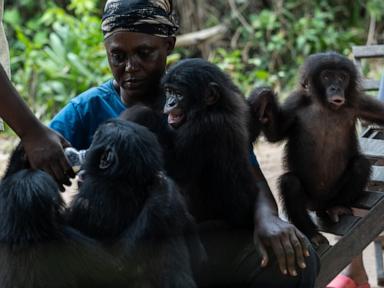
Every orphaned bonobo that enters the sanctuary is assigned a "surrogate mother." These are local Congolese women who have often experienced their own share of hardship and loss in a country scarred by conflict. For twenty-four hours a day, these women carry the infants. They eat with them, sleep with them, and bathe them.
It is a grueling, visceral form of labor. The infants scream in the night, haunted by the memories of the forest. The surrogates must provide the warmth and the heartbeat that the forest took away. This isn't just about survival; it is about re-teaching a sentient being how to trust a species that has only ever brought it pain.
The recovery process is slow. It begins with a single hand reaching out to touch a human cheek. Then comes the first interest in fruit. Eventually, there is the play—the tumbling, laughing, and tickling that makes bonobos so unnervingly like us. But the goal isn't to make them pets. The goal is to make them wild again.
The Economics of Extinction
To understand why poaching happens, you have to look at the dinner plate of a family in a remote Congolese village. This isn't a story of villains in black masks; it’s a story of systemic poverty. When there is no infrastructure, no industry, and no stable food source, the forest becomes a supermarket. Bushmeat is a traditional protein source, and a single bonobo can provide enough meat to feed a family for weeks or fetch a price at a market that equals a month's wages.
The sanctuary knows that you cannot save the animals if you do not save the people. Conservation in the Congo is as much about building schools and clinics as it is about patrolling the woods. By hiring locals, buying produce from nearby farmers, and educating the next generation, the sanctuary creates a new economy. They turn the "protectors" of the forest into the primary breadwinners.
Consider the shift in perspective required. For decades, the bonobo was just meat. Now, for the communities surrounding the sanctuary and the reintroduction sites, the bonobo is a job. It is a textbook for a child. It is a future.
The Long Walk Back
The ultimate test of the sanctuary’s mission happens hundreds of miles away from Kinshasa, in the Ekolo ya Bonobo community reserve. This is the finish line. After years of rehabilitation, groups of bonobos are released back into protected wild spaces.
The transition is fraught with danger. Will they remember how to find water? Will they be able to defend themselves against predators? Most importantly, will they be able to form a cohesive society without the guidance of the elders they lost?
Early data suggests that the answer is yes. Released bonobos have been observed forming stable groups, mating, and raising their own young in the wild. They are reclaiming their heritage, one acre at a time. But the pressure from the outside world never truly relents. Logging interests and the expansion of agriculture continue to nibble at the edges of their world.
The Mirror in the Trees
We often speak of conservation as a charity, something we do for "them"—the animals, the environment, the future. But standing at the edge of the enclosure at Lola ya Bonobo, watching a juvenile bonobo figure out how to use a stick to fish for termites, that distinction vanishes.
You see the way they comfort one another with an embrace. You see the way the females lead the group with a quiet, firm authority that prevents the kind of violent outbursts seen in chimpanzee societies. They are the peaceful alternative to our own more aggressive tendencies. They are a living reminder that evolution didn't have to lead only to war and competition.
The tragedy of the bonobo is not just that a species is dying. It is that we are losing a mirror. Every time a poacher’s gun fires, a piece of our own history is silenced.
The air in the Congo remains heavy. The rains still come, washing the red dust from the leaves and turning the tracks of the sanctuary into muddy rivers. Inside the nursery, a woman sits on a wooden stool, a small, dark bundle pressed against her chest. The infant’s breathing is steady now, synchronized with her own.
This is the frontline. It isn't a boardroom or a political summit. It is a quiet room filled with the scent of milk and rain, where the gap between two species is bridged by nothing more than a heartbeat and the refusal to let go.
The forest is waiting. It is deep, it is ancient, and for the first time in a long time, it is not quite as empty as it was yesterday.


