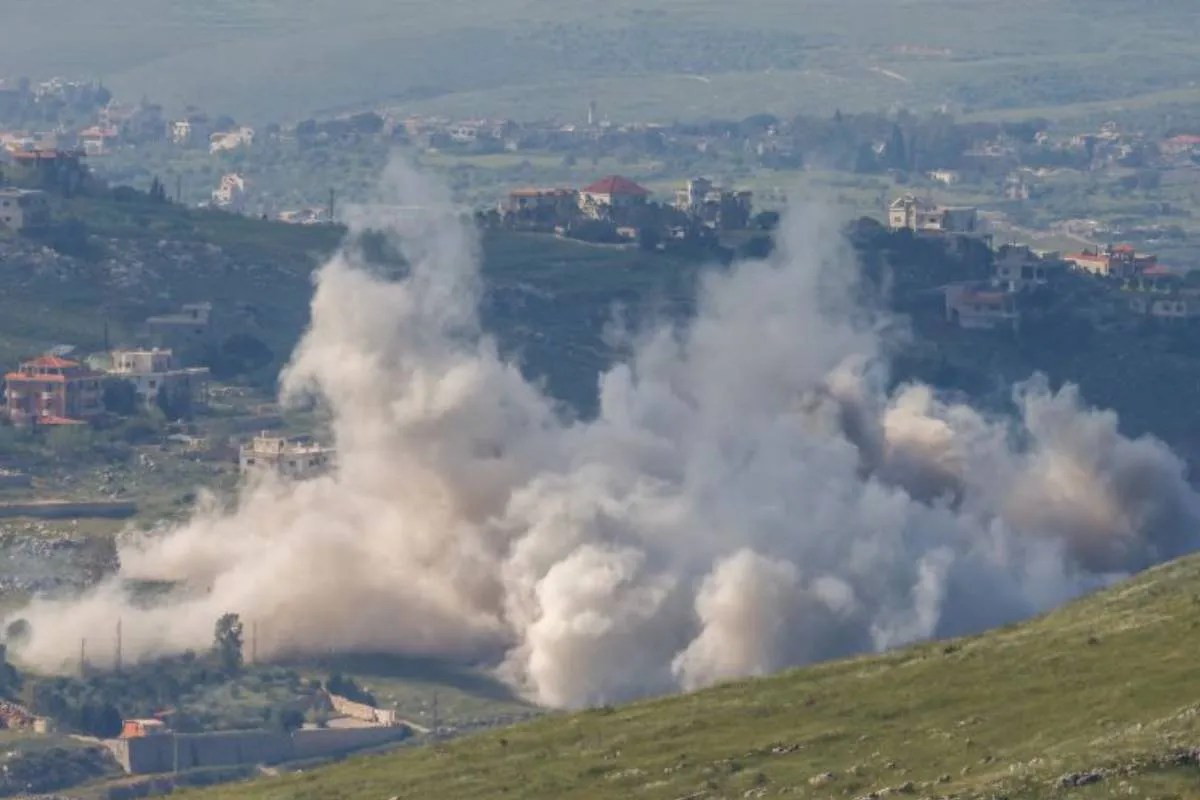
The current surge in kinetic activity across the Lebanese-Israeli border and the corresponding hardening of Iranian rhetoric toward the United States represent more than a localized flare-up; they are the manifestation of a deliberate shift from covert gray-zone operations to high-intensity attrition. To understand why nine casualties in Lebanon trigger an immediate and credible threat from Tehran against Washington, one must analyze the three structural pillars of this conflict: the depletion of strategic depth, the collapse of de-escalatory signaling, and the Iranian "forward defense" cost-benefit analysis.
The Lebanon Front as a Strategic Pressure Valve
The recent engagement resulting in nine fatalities in Lebanon serves as a data point in a broader pattern of tactical recalibration. Israel's operational objective is the restoration of territorial integrity in the north, which requires the physical displacement of Hezbollah forces north of the Litani River. This is not a matter of choice but a demographic necessity for the Israeli state to return 80,000 displaced citizens to their homes.
Hezbollah’s response functions under a different logic. Their calculus is built on The Principle of Proportionality and Punishment. For every Israeli strike on high-value logistical nodes, Hezbollah must respond with a strike that maintains the "balance of terror." When the death toll rises, the political cost for Hezbollah of remaining restrained increases, forcing them to climb the escalation ladder. This creates a feedback loop where tactical successes (killing enemy combatants) lead to strategic instability.
The Iranian Threat Framework and the American Variable
Tehran’s explicit warning to the United States regarding its support for Israel is a calculated move to broaden the theater of risk. This is not emotional rhetoric; it is an application of Asymmetric Deterrence. Iran views the U.S. military presence in the Middle East—specifically in Iraq, Syria, and the Red Sea—as a liability that can be leveraged to restrain Israeli decision-making.
The logic follows a three-step chain of causation:
- Israeli Offensive Action: Targeted strikes in Lebanon or Syria degrade Iranian assets or proxy capabilities.
- U.S. Facilitation: Tehran argues that Israeli intelligence and kinetic capabilities are inextricably linked to U.S. satellite data, munitions supply, and diplomatic cover.
- Target Substitution: If hitting Israel directly carries too high a risk of total war, Iran pivots to targeting U.S. peripheral assets or global shipping lanes, effectively raising the global "cost of participation" for the United States.
By threatening the U.S. directly, Iran seeks to force Washington to act as a governor on Israeli Prime Minister Benjamin Netanyahu’s war cabinet. The Iranian leadership understands that the U.S. is currently in a state of high domestic sensitivity, making it more susceptible to threats of regional entanglement.
Structural Bottlenecks in Diplomacy
The reason traditional diplomacy is failing to arrest this slide into regional conflict lies in the Misalignment of Time Horizons.
- Israel’s Horizon: Immediate and existential. The presence of hostile forces on the border is an intolerable status quo that must be resolved through force if diplomacy fails to move Hezbollah.
- Iran’s Horizon: Long-term and ideological. Iran is willing to trade proxy lives and regional stability for the gradual exhaustion of Israeli military resources and international legitimacy.
- The U.S. Horizon: Cyclical and electoral. The primary driver for U.S. policy is the avoidance of a large-scale regional war that could spike oil prices or necessitate a troop surge during an election cycle.
These diverging timelines ensure that every "ceasefire" proposal is merely a temporary pause rather than a resolution. The core dispute—the sovereignty of the border regions and the disarmament of non-state actors—remains untouched.
The Cost Function of Regional Attrition
In a protracted conflict, the side that manages its resource depletion more effectively wins. We can quantify this through the Attrition Ratio. Israel utilizes high-cost precision munitions (e.g., JDAMs, Iron Dome interceptors) to counter low-cost, high-volume saturation threats (unguided rockets, kamikaze drones).
The economic burden of this defense is lopsided. While Israel receives significant aid, the sheer volume of interceptions required over a prolonged period creates a massive drain on the national treasury and military readiness. Iran, conversely, operates a decentralized supply chain. By providing its proxies with the means to manufacture or assemble weaponry locally, Tehran maintains a low-cost "offensive" position while forcing its adversaries into a high-cost "defensive" posture.
The Role of Miscalculation in Modern Warfare
The greatest risk currently is not a planned invasion, but a Calibration Error. In a highly kinetic environment, a single strike that results in unexpected mass civilian casualties or the destruction of a high-profile religious site can trigger an emotional and political response that bypasses rational strategic planning.
The "nine lives" lost in Lebanon represent a threshold. Every time a new threshold is crossed, the baseline for "normal" violence rises. This is the normalization of escalation. What would have been considered a declaration of war two years ago is now categorized as a "routine exchange of fire." This erosion of red lines makes it increasingly difficult for any actor to back down without appearing defeated.
Strategic Forecast and Deployment of Force
The situation is trending toward a definitive inflection point. The Israeli military cannot sustain a state of partial mobilization indefinitely without crippling its domestic economy. Therefore, the probability of a multi-brigade ground maneuver into Southern Lebanon increases with every week the diplomatic channels remain stagnant.
For Iran, the strategy remains the preservation of the "Ring of Fire" around Israel. If Hezbollah’s core infrastructure is threatened with total destruction, Iran will likely activate its broader network—including militias in Iraq and Yemen—to create a multi-theater distraction. The threat to the United States serves as the final deterrent against a total decapitation strike on Hezbollah’s leadership.
The strategic play for external observers is to ignore the rhetoric of "total victory" and focus on the Resupply Dynamics. The actor that runs low on interceptors or long-range strike capabilities first will be the one forced to the negotiating table. Until that point of exhaustion is reached, the kinetic exchanges will continue to expand in both geography and intensity.
Expect a tactical shift toward the targeting of energy infrastructure and maritime chokepoints if the land-based attrition remains a stalemate. This would move the conflict from a regional military dispute to a global economic crisis, which remains Iran’s most potent leverage against the West.