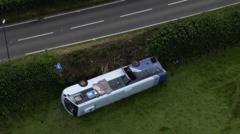
A peaceful afternoon in Carmarthenshire shattered instantly when an X11 service bus overturned near the Kidwelly roundabout. Emergency services rushed to the scene on the A484, immediately declaring a major incident. Nineteen people suffered injuries in the collision, which occurred at roughly 12:20 PM on Tuesday.
The response required local police, fire, and ambulance services to converge quickly on the stretch of road between Parc y Bocs and Llandyfaelog. First responders faced a chaotic scene, working frantically to extract passengers safely from the vehicle. While thirteen people were evaluated and discharged at the scene, six individuals required hospitalization. Fortunately, authorities confirmed none of the injuries appeared life-threatening, but the crash raises massive questions about regional infrastructure and safety on these crucial transit corridors.
The Reality of Rural Bus Infrastructure
Rural routes present unique hazards that urban transit systems rarely encounter. High-speed limits on single-carriageway roads combined with tight, complex roundabouts require total driver focus. The X11 service, operated under First Bus Franchising, connects communities through these exact environments every single day.
When a multi-ton transit vehicle loses control near a junction like Old Forge Lane, the physics are unforgiving. Roundabouts demand sudden decelerations and shifting weight balances. If a vehicle leaves the tarmac or collides with an obstruction here, the risk of a rollover multiplies drastically. Local commuters know this specific stretch of the A484 well, often citing the tight angles and fast-approaching traffic as constant pain points.
Local representatives were quick to respond to the unfolding crisis. Dame Nia Griffith, MP for Llanelli, expressed immediate concern for those caught up in the crash and praised the rapid deployment of emergency workers. Her public plea for drivers to avoid the area highlighted how quickly a singular accident can paralyze the local road network.
Managing Major Incidents in Outlying Communities
Declaring a major incident is not a decision emergency services take lightly. It triggers a synchronized, multi-agency protocol designed to flood a scene with resources. For a rural area like Kidwelly, this means drawing ambulances and fire crews from multiple surrounding stations, which naturally strains local healthcare networks.
Hywel Dda University Health Board felt the pressure immediately. Their emergency departments experienced a surge in demand, forcing hospital administrators to warn the public about significantly longer waiting times. The health board had to prioritize treating the bus casualties with the greatest medical need first, demonstrating how a single transit failure creates a massive ripple effect across regional medical infrastructure.
The rescue operation extended far beyond medical triage. Community resilience took center stage at the John Burns Centre in Kidwelly, which quickly transformed into a dedicated rest and welfare hub. Displaced passengers and uninjured survivors sought comfort, shelter, and basic care there while police secured the crash site. This rapid community activation provided a safe haven during those tense initial hours before the major incident status was officially stood down later in the afternoon.
Investigation Protocol for Transport Rollovers
While the road remains closed between the Parc y Bocs roundabout and Llandyfaelog, collision investigators face meticulous work. Determining exactly why an X11 bus overturned involves a rigid investigative process. Forensic teams must piece together data from multiple sources to understand the mechanics of the failure.
First Bus Franchising dispatched a team from their Ammanford depot to support the driver and assist investigators. Managing Director Zoe Hand confirmed the company is actively cooperating with the police to discover the underlying cause. Investigators will scrutinize the vehicle's maintenance records, tachograph data for speed analysis, and the physical evidence left on the road surface.
The investigation will primarily focus on three critical pillars.
- Vehicle Dynamics and Mechanical Integrity: Checking for sudden mechanical failures, braking imbalances, or steering defects that could cause a rollover at a roundabout.
- Environmental Factors and Road Conditions: Assessing the impact of summer heat on the tarmac surface, visibility limits around the Old Forge Lane junction, and any sudden obstacles.
- Driver Inputs and Telematics: Analyzing steering angles, speed profiles leading up to the roundabout, and tracking operational data to build a second-by-second recreation of the crash.
Immediate Steps for Commuters and Drivers
If you regularly use the A484 or rely on the X11 transit line, expect prolonged disruption. Major collision investigations take time, and structural clearance of an overturned bus requires heavy specialized equipment. Drivers must adjust their travel habits immediately to minimize regional gridlock.
Utilize alternative routes via the B4308 or the main A48 trunk road to bypass the Kidwelly area entirely. If you find yourself caught in residual traffic jams near the closures, Dyfed-Powys Police emphasize staying calm and managing vehicle temperatures to avoid heat exhaustion. Check real-time traffic updates before starting your journey, and allow an extra thirty to forty-five minutes of travel time for any essential trips through Carmarthenshire.


