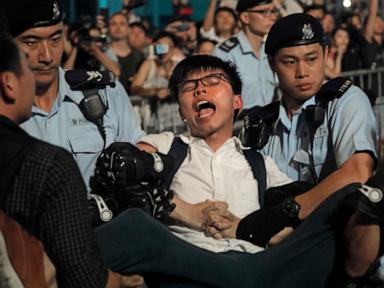
Everyone in Western media wants to sell you a tidy tragedy about Joshua Wong.
They frame him as a teenage David flattened by the Beijing Goliath, rotting away in a Hong Kong prison cell while the world watches in solemn, helpless sympathy. That narrative is comforting. It lets columnists in London and Washington feel righteous without doing a single ounce of hard geopolitical math. It is also dangerously wrong. In related updates, take a look at: Inside the Massive Underground Expansion at Iran Missile Bases Nobody Is Talking About.
Joshua Wong is behind bars today not merely because the Chinese Communist Party crushed dissent, but because an entire generation of young activists was fed a fatal delusion by Western onlookers: the idea that moral clarity and street theater could substitute for actual leverage.
If you want to understand why Hong Kong’s pro-democracy movement collapsed into the 2020 National Security Law and why Wong is serving years of his adult life in Stanley Prison, stop looking at him as a saintly symbol. Look at the strategic malpractice that put him there. USA Today has also covered this important issue in extensive detail.
The Myth of the Inevitable Moral Victory
Western coverage treats Hong Kong’s political trajectory from 2012 to 2020 as a Greek tragedy—noble heroes fighting an unstoppable tyrant. That framing erases agency. It pretends politics is a morality play rather than a brutal contest of power, institutions, and deterrence.
In 2012, Wong was fifteen when Scholarism forced the Hong Kong government to shelve its Moral and National Education curriculum. That early win poisoned the well. It taught Wong, his peers, and their international cheerleaders that mass mobilization in the streets could force Beijing to blink.
It could not. In 2012, Beijing blinked because the issue was local, administrative, and beneath Xi Jinping’s consolidated grip on the party apparatus. By 2014, during the Umbrella Movement, the structural reality had shifted completely. Yet the playbook stayed identical: occupy public space, capture international headlines, wait for the authorities to fold.
They never folded. Instead, the authorities took notes.
I have watched political movements across Asia and Eastern Europe burn through their best people using this exact flawed template. When activists mistake international media sympathy for hard political power, they escalate into brick walls. Every Western op-ed calling Wong the "face of a generation" acted like gasoline on a fire he had no way to control. Nobel Peace Prize nominations from American lawmakers did not buy him a single inch of protection inside Hong Kong’s court system; they handed Beijing’s propaganda machine the exact ammunition it needed to paint him as a foreign agent.
What the Lazy Consensus Misses About Leverage
To see why the mainstream narrative fails, examine the mechanics of asymmetric political struggle. Political scientist Gene Sharp, whose work on nonviolent action was widely cited by Hong Kong protesters, emphasized that nonviolence is not passive moral posturing—it requires stripping a regime of its pillars of support: the police, the civil service, the business elite, and the bureaucracy.
Hong Kong’s opposition never cracked a single one of those pillars.
- The Tycoon Class: Hong Kong’s property conglomerates and banking elites remained firmly tethered to mainland capital. Street protests disrupted retail, not Beijing’s balance sheet.
- The Civil Service and Police: Far from defecting, the Hong Kong Police Force hardened into an instrument of pure enforcement, backed by mainland logistical support and unyielding political cover.
- International Deterrence: Western governments offered speeches, visa schemes, and targeted sanctions against officials who didn't hold Western assets anyway. Not a single major financial institution pulled out of Hong Kong to save Joshua Wong.
When you have zero institutional leverage and zero credible external deterrence, maximalist demands are political suicide.
In 2019, Carrie Lam withdrew the extradition bill. That was a tactical victory. A disciplined political movement banks the win, regroups, and builds institutional power through district councils and labor unions. Instead, the decentralized "be water" ethos—praised endlessly by tech-obsessed Western commentators—meant nobody had the authority to call off the escalation. Demands expanded to universal suffrage and an independent inquiry into police brutality, backed by tactics that gave Beijing the pretext it had waited years to exploit.
The 2020 Primary Election Trap
Joshua Wong’s current prison sentence stems largely from the "Hong Kong 47" subversion case—the unofficial pro-democracy primary held in July 2020 to select candidates for the Legislative Council.
Mainstream articles describe this as punishing people simply for organizing an election. That misses the legal and political trap Beijing set, and into which the opposition walked with eyes wide open.
By July 2020, the National Security Law had already been imposed. The rules of the game were no longer British common law norms; they were mainland national security statutes dressed in Hong Kong judicial robes. Legal scholar Benny Tai’s "35-plus" strategy—winning a legislative majority to veto the government budget twice, forcing the Chief Executive to resign—was explicitly designed to paralyze the administration.
Under the old rules, that was hardball constitutional politics. Under the new National Security Law, Beijing classified it as conspiracy to subvert state power.
Why did Wong and forty-six others proceed as if the old rules still applied? Because for eight years, they had operated inside an echo chamber where Western norms were treated as universal laws of physics. They believed the international spotlight would act as a shield. They believed Hong Kong’s status as a global financial hub made a total crackdown too expensive for Beijing.
They miscalculated Beijing’s hierarchy of values. When forced to choose between Hong Kong’s laissez-faire autonomy and absolute political control, the Chinese Communist Party will choose control ten times out of ten.
Dismantling the Questions Nobody Wants to Answer
Did international support help Joshua Wong?
No. Performative Western solidarity accelerated his imprisonment. Congressional photo-ops in Washington, high-profile meetings with European diplomats, and glossy magazine covers turned Wong into a high-value target for Beijing. While Western politicians collected domestic clout for standing with Hong Kong’s youth, Wong stayed behind in a jurisdiction where Beijing controlled the courts, the prisons, and the legislature. Sanctions on Carrie Lam did not shorten Wong’s sentence by a single day.
Was the 2019 protest movement a failure?
Strategically, yes. Emotionally and culturally, it forged a distinct Hong Kong identity, which is why millions fled to the UK, Canada, and Taiwan. But in political science, you measure outcomes by power retained, not feelings generated. Before 2019, Hong Kong had a vocal opposition press, independent trade unions, opposition lawmakers in the Legislative Council, and an active civil society. By 2021, every single one of those institutions was dismantled. Trading functional civic space for symbolic defiance is a catastrophic loss.
Could Joshua Wong have avoided prison?
Yes, by leaving Hong Kong before the National Security Law took effect, as Nathan Law and others did. Wong chose to stay. That choice deserves respect for its sheer personal courage—staying when you know the cell door is closing takes guts most commentators will never possess. However, admiring his courage does not require endorsing the strategy that made imprisonment the only remaining option.
The Uncomfortable Downside of Realism
There is an obvious flaw in arguing for strategic restraint against an authoritarian state: restraint can easily decay into quiet surrender. Had Hong Kong’s youth stayed home in 2012, 2014, and 2019, Beijing would still have eroded the "One Country, Two Systems" framework, just on a slower, quieter timetable. Appeasement does not stop an empire; it merely lets the empire digest its gains without indigestion.
Acknowledge that truth, and you still reach the same conclusion: if you are going to fight an asymmetric war, you cannot fight it on the enemy’s strongest terrain using tactics that maximize your own vulnerability.
Dissident movements that survive long-term repression—from Solidarity in 1980s Poland to underground networks in Latin America—do not put their brightest leaders on the front lines of street clashes where facial recognition and mass arrests can wipe out an entire generation in eighteen months. They build resilient, low-profile institutional networks. They protect their human capital. They understand that a movement whose leaders are all in prison or exile has ceased to exist as a domestic political force.
Stop Canonizing Defeat
Turning Joshua Wong into a passive martyr strips his story of its most urgent lesson. He is not a tragic figurine on a shelf. He is a brilliant, relentless organizer who was chewed up by a strategy that confused visibility with power.
As long as Western media and political observers keep romanticizing doomed street uprisings while offering zero real-world backing when the crackdown arrives, young activists from Minsk to Yangon to Hong Kong will keep paying the price with their twenties and thirties behind bars.
Sympathy is cheap. Leverage is everything. Until movements learn the difference, the prison cells will keep filling up.