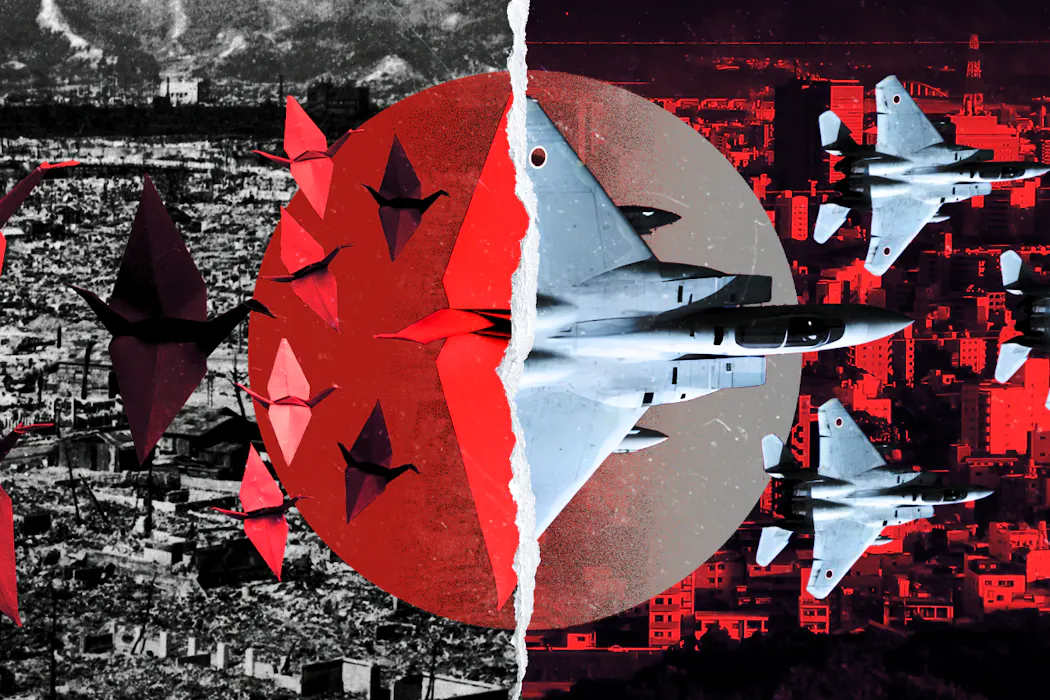
Japan is quietly rewriting its national identity. For decades, Tokyo hid behind Article Nine of its post-war constitution, a self-imposed straightjacket that explicitly renounced war as a sovereign right. That pacifist architecture is crumbling. Beijing's naval expansion, a nuclear-armed North Korea, and a shifting American security umbrella have forced Japanese leadership to drop the diplomatic theater. Tokyo is transforming into an active military power, acquiring counterstrike capabilities and boosting defense spending toward NATO-standard benchmarks. This is not a sudden pivot. It is the culmination of a decade-long, methodical strategy to redefine what a normal country looks like in an increasingly hostile Asia-Pacific theater.
The Cost of Staying Quiet
The global press often frames Japan's remilitarization as a reluctant reaction to external aggression. That narrative is too neat. It ignores the domestic political engineering required to drag a pacifist electorate into the reality of modern defense economics. For seventy years, Japanese citizens traded military ambition for economic recovery and constitutional protection under the American nuclear umbrella.
That bargain expired the moment China built a blue-water navy capable of contesting the First Island Chain.
When you stand on the docks of Yokosuka or watch the heavy refitting of the Izumo-class destroyers into de facto aircraft carriers, the change is palpable. These are not defensive patrol craft. These are power-projection tools. The Ministry of Defense under successive administrations has systematically normalized defense spending increases that would have triggered massive student protests in the nineteen-seventies. Now, the public shrugs. Citizens understand that Article Nine cannot intercept a hypersonic missile.
Breaking the Taboo
Bureaucrats in Kasumigaseki excel at semantic gymnastics. They do not amend the constitution directly because doing so requires a bruising national referendum with an uncertain outcome. Instead, they reinterpret it.
Government lawyers ruled that a direct attack on an ally constitutes an existential threat to Japan itself, thereby unlocking the legal mechanism for collective self-defense.
This doctrine of reinterpretation allowed Tokyo to sign sweeping acquisition deals for American Tomahawk cruise missiles. Think about the strategic weight of that purchase. Japan is acquiring weapons designed to strike adversary missile bases before they launch. That is an offensive capability, pure and simple. The pacifist label is a ghost story used to comfort neighboring capitals, but the hardware rolling off Mitsubishi Heavy Industries assembly lines tells a very different story.
The Industrial Complex Awakens
You cannot build a regional deterrent on imported hardware alone. Japan's domestic defense industry, long throttled by self-imposed bans on arms exports, is waking up from a multi-decade slumber.
- Export Restrictions Eased: Tokyo relaxed its strict three principles on defense equipment transfers, allowing joint development projects like the Global Combat Air Programme with the United Kingdom and Italy.
- Dual-Use Technology: Commercial robotics and semiconductor manufacturing are being quietly tethered to military supply chains.
- Budget Realities: Defense outlays are surging past the traditional one-percent-of-GDP ceiling, pushing toward two percent.
This industrial mobilization changes the economic calculus for Tokyo. Defense manufacturing is no longer a corporate afterthought or a domestic welfare program for aging heavy industries. It is an export engine and a geopolitical currency. When Japanese firms co-develop next-generation fighter jets, they bind their security architecture directly to European and American partners, creating an unbreakable web of mutual obligation.
The Demographic Trap
Here is the brutal truth about Japan's military renaissance. The nation is running out of soldiers.
While politicians debate missile ranges and command structures, the Self-Defense Forces face a catastrophic recruitment crisis driven by a collapsing birth rate and a rapidly graying population. You can buy all the Aegis-equipped destroyers money can buy, but hulls do not crew themselves.
The Ground Self-Defense Force consistently misses its annual recruitment targets by thousands of personnel. Young Japanese workers have zero appetite for military service when the civilian labor market offers endless options and zero risk of dying in the East China Sea.
To compensate, the Ministry of Defense is turning to automation, unmanned surveillance drones, and artificial intelligence integration. Yet technology only bridges the gap temporarily. A modernized military still requires human expertise to maintain, command, and deploy. If Tokyo cannot solve its demographic math, its shiny new military hardware will become expensive museum pieces parked in pristine concrete hangars.
Living in the Gray Zone
Washington expects Tokyo to carry a heavier load. Beijing watches every budget line with hawk-like suspicion. Seoul remains perpetually triggered by historical grievances that complicate trilateral intelligence-sharing agreements.
Japan is navigating a minefield of regional distrust while trying to build a credible deterrent without provoking the very conflict it seeks to prevent.
The traditional definition of a normal country meant economic might decoupled from military responsibility. That era is dead. Japan is entering an era where its sovereignty will be measured not by how well it avoids conflict, but by how effectively it can deter one through sheer, unyielding readiness. The debate is no longer about whether Tokyo should defend itself. The debate is how fast it can adapt before the window closes permanently.