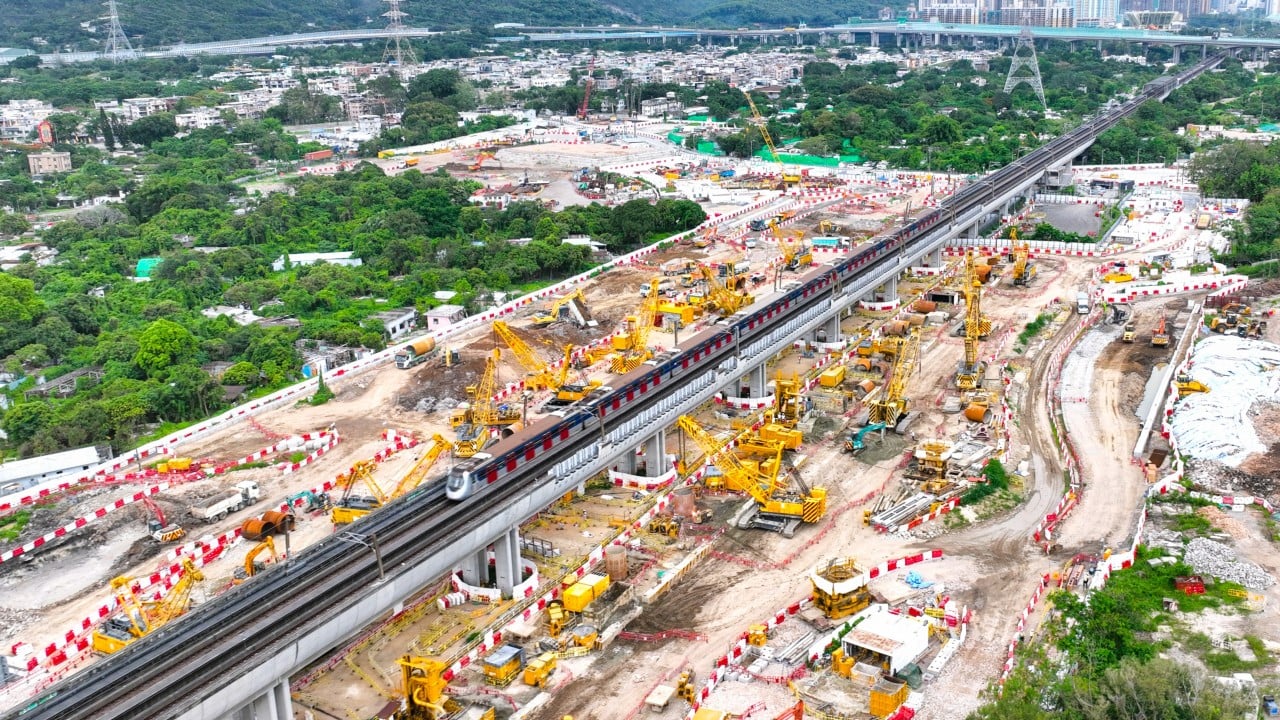
Midnight in the New Territories smells of wet concrete, diesel fumes, and the sharp, metallic tang of an approaching future.
If you stood on the edge of Hung Shui Kiu right now, past the corrugated metal fences and the harsh arc-lights humming against the Hong Kong humidity, you would hear the steady, rhythmic breathing of a city that never stops rearranging its own bones. Trains roar past on existing arteries overhead, shaking the loose gravel underfoot. Commuters sleep against glass windows miles away, dreaming of shorter commutes, oblivious to the sheer audacity required to carve a brand-new station into the middle of a living, hyper-dense transit network. Meanwhile, you can read similar developments here: Structural Mechanics of Lignocellulosic Foams Replacing Expanded Polymers.
For decades, building a railway station meant stopping the world to fix it. You closed the tracks. You rerouted millions of tired workers. You carved open the earth with brute force, turning daily life upside down while giant cranes swung overhead. It was a messy, loud, grinding compromise. Progress demanded disruption.
Until now. To see the complete picture, check out the excellent report by ZDNet.
The Problem Beneath Our Feet
Imagine standing in the control room of an engineer who has lost sleep for three hundred nights straight.
Her name is Carmen, and she is staring at a monitor tracing the exact heartbeat of the Tuen Ma line. Every single day, hundreds of thousands of passengers surge through these tracks. A fraction of a millimeter of track displacement means delayed trains, angry crowds spilling onto platforms in Tuen Mun and Yuen Long, and a cascading failure of the clockwork precision that defines this city.
Carmen and her team are tasked with building a brand-new transit hub—the Hung Shui Kiu station—right against the operational spine of an existing line. They cannot shut it down. They cannot afford a single miscalculation. The margins for error are thinner than a sheet of tracing paper.
Traditional construction methods would require massive temporary structures, deep excavations directly beneath live electrical catenary wires, and months of night-shift windows so narrow that work would have to stop almost as soon as it started. It would take years. It would bleed millions of dollars. Worst of all, it would test the patience of a public already stretched to its limits.
Engineering, at its core, is the art of solving impossible geometry with limited time. When you cannot stop the trains, you have to invent a way to build around them while they are moving at full speed.
The Skidding Revolution
This is where the MTR Corporation steps away from the playbook of the twentieth century and does something entirely unprecedented.
Instead of building the station structure piece by piece in situ—welding, pouring, and lifting heavy steel above live tracks—they built a massive concrete and steel station structure entirely off to the side, safely away from the danger zone. They assembled it in a protected staging area, like a ship being built in dry dock.
Then came the moment of truth.
To deploy this world-first skidding method, engineers constructed a series of heavily reinforced sliding tracks equipped with specialized hydraulic pushing jacks and low-friction polythene-coated sliding pads. Think of it as moving a massive, multi-thousand-tonne multi-story building not by lifting it into the air, but by making it glide across a film of specialized lubricant with absolute, calculated smoothness.
It sounds deceptively simple, like sliding a heavy chest of drawers across a polished hardwood floor. But scale that chest of drawers up to the size of a multi-level transit concourse, weigh it down with thousands of tonnes of reinforced concrete and structural steel, and place it mere meters away from live railway wires carrying high-voltage electricity.
Consider what happens next: the hydraulics engage. The pressure builds in the lines, hissing softly against the night air. The massive structure doesn't lurch; it creeps. Sensors placed every millimeter track the movement in real-time, feeding data back to engineers who watch the load distribution shift with bated breath.
For the first time in railway history on this scale, a colossal station module is being pushed sideways into its permanent resting place over a microscopic window of overnight engineering hours.
Why This Changes Everything
Why does this matter to the commuter half asleep on the 7:15 AM train from Tin Shui Wai?
Because you will never know it happened.
That is the quiet triumph of modern infrastructure. The true brilliance of the skidding method isn't just the mechanical ingenuity of hydraulic pushers and sliding shoes; it is the invisibility of the friction. By moving the heavy lifting away from the active rail corridor, MTR has effectively eliminated the thousands of hours of track-possession time that usually plague major transit expansions.
There are no endless weeks of single-track operations. There are no frantic emergency repairs at 4:00 AM because a crane slipped. The work was done where it was safe, precise, and controlled, and then slid into alignment with the surgical accuracy of a watchmaker adjusting a gear.
This is what happens when necessity meets imagination. Civil engineering is often viewed as a conservative, heavy-footed discipline—bound by concrete, gravity, and ancient safety codes. Yet here, in the damp night air of the New Territories, engineers have treated a multi-tonne concrete structure with the fluid grace of a dancer.
The Morning After
Dawn breaks over Hung Shui Kiu with a pale, bruised light cutting through the smog.
The hydraulic jacks are silent now, locked off and secured. The temporary staging tracks are already being dismantled. Overhead, the first morning train streaks past on the Tuen Ma line, its wheels clicking rhythmically against the rails, carrying workers toward Kowloon, toward financial towers, toward ordinary lives.
Passengers look out the window as they flash past the new station footprint. They see the clean lines of concrete, the nascent skeleton of a concourse that will soon teem with thousands of hurried footsteps, glowing ticket gates, and the smell of fresh coffee kiosks.
They do not see the invisible tracks underneath. They do not know about the hydraulic pressure gauges, the sleepless nights, or the audacious gamble of sliding a building sideways over a live railway.
They just move forward. And the iron beneath them holds fast.