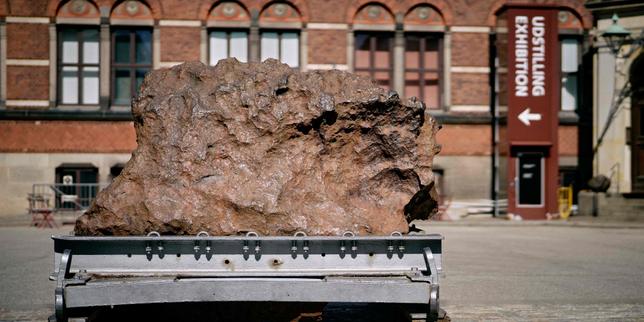
Heavy metal does not belong in a glass cage.
For decades, thousands of miles away from the jagged fjords and freezing winds that birthed it, a massive chunk of the cosmos sat quietly in a European museum. It weighed twenty tons. It was forged in the furnace of an ancient collision before Earth had names or borders. To the scientists who cataloged it, it was simply the Agpalilik meteorite. To the people of Greenland, it was an exiled piece of their landscape, a silent witness to history torn from the soil.
Picture an elder standing on the shore of Cape York. Wind tears at the heavy fur trim of a parka. The salt stings the eyes. This is not just geography; this is memory written in stone and ice. When foreign expeditions carried away objects of immense cultural and geological weight, they did not just take rocks. They took anchors.
Diplomacy moves at the speed of glaciers. For generations, the relationship between Denmark and Greenland has been a complex web of shared history, political transition, and the slow, necessary unravelling of colonial ties. Treaties are signed in quiet rooms with expensive pens. Laws are debated by men in suits who have never felt the bite of Arctic frost. But reconciliation is rarely achieved through parchment alone. Sometimes, it demands a grand gesture of physical restoration.
The announcement that Denmark would facilitate the return of the Agpalilik meteorite is more than a diplomatic footnote. It is a tectonic shift in how nations reckon with the trophies of their past.
Consider what happens next. A multi-ton mass of iron and nickel cannot simply be packed into a cardboard box and shipped via standard post. It requires engineering, patience, and a profound respect for gravity. More than that, it requires an acknowledgement that history is dynamic. Objects do not stay where they are put forever, especially when they belong to the soul of a community.
To understand why this matters, one must look past the chemistry. Meteors fall from the sky at random, indifferent to human ownership. Yet the moment a fragment lands, it acquires meaning. For the Inuit hunters who once used pieces of the Cape York meteorites to forge tools, iron was survival. It was the difference between enduring the long dark and succumbing to it. The metal was literally heaven-sent, harvested from the ice long before industrial smelters existed.
When the largest fragments were shipped to Copenhagen, a piece of that raw capability went with them.
Now, the pendulum swings back.
This return is not merely about ceding control of a museum artifact. It represents a broader realignment of power and respect. Autonomy is not handed over in a single afternoon; it is built through thousands of small corrections, punctuated by profound moments of restitution. When a sovereign nation agrees to send back a piece of stolen heritage, it whispers an admission that possession without consent is a fragile thing.
Listen to the silence of the Arctic night when the meteorite finally comes home. The wind howls across the snow, indifferent to politics, yet cradling a piece of the stars that fell to earth long before humanity began keeping score.
Restitution is rarely clean. It stirs up questions about what else was taken, who else is waiting, and how many other museum basements hold the beating hearts of distant cultures. But every journey home begins with a single, heavy step.
The iron is coming back to the north. The ice welcomes its child. The story is far from over.