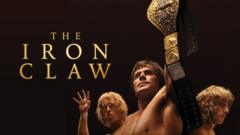
Biopics usually lie to you. They smooth down the jagged edges of a human life to fit a clean, comfortable three-act structure. But Sean Durkin's film The Iron Claw faces the opposite problem. The real story of the Von Erich wrestling family is so relentlessly tragic, so weighed down by loss, that the filmmakers actually had to leave out an entire brother just to make the movie believable for an audience.
That's not a creative failure. It's a testament to the unimaginable reality of Texas wrestling royalty.
If you watched the film expecting a standard sports drama about triumphs in the ring, you probably walked away devastated. You also walked away with a piece of cinema that redefines how movies handle sports culture, family trauma, and the toxic myth of absolute masculine strength. The Iron Claw isn't just about wrestling. It's an indictment of a specific kind of American obsession.
The Haunting Reality Behind the Von Erich Curse
To understand why this movie hits so hard, you have to look at the factual timeline of the Von Erich family. Fritz Von Erich, played with terrifying rigidity by Holt McCallany, was a dominant wrestling promoter and performer who built an empire in World Class Championship Wrestling (WCCW) out of Dallas, Texas. He didn't just raise sons. He bred soldiers for his ring.
The movie focuses on four brothers: Kevin (Zac Efron), David (Harris Dickinson), Kerry (Jeremy Allen White), and Mike (Stanley Simons).
The tragedy started long before the 1980s wrestling boom. Fritz’s firstborn son, Jack Jr., died in a freak accidental drowning at just six years old in 1959.
Then came the domino effect of the 1980s and 90s. David died in 1984 while touring Japan, officially from acute enteritis. Kerry, who achieved the highest heights by winning the NWA World Heavyweight Championship, died by suicide in 1993, years after losing his foot in a motorcycle accident. Mike took his own life in 1987 after suffering severe brain damage from toxic shock syndrome following shoulder surgery.
Chris Von Erich, the youngest brother who struggled with severe health issues and never found the wrestling success of his siblings, shot himself in 1991. Durkin completely omitted Chris from the script.
"There was a repetition to the tragedy," Durkin explained during the film's press tour. "It was hard to take dramatically. It just felt like it couldn't be sustained in a two-hour film."
Kevin Von Erich, the sole surviving brother, approved of this massive omission. Think about that for a second. A man's life was so packed with grief that removing a dead sibling from his story actually made it feel more honest to a moviegoing audience.
Zac Efron and the Physicality of Grief
We need to talk about Zac Efron. For years, he was the musical theater kid or the handsome comedic relief. Here, he transforms into something unrecognizable. His physique is jarring. It looks less like a healthy athlete and more like a walking anatomical drawing, a literal armor of muscle built to withstand an abusive environment.
Efron captures Kevin’s profound isolation perfectly. Kevin is the brother who does everything right according to his father's playbook. He works the hardest. He stays loyal. He protects his brothers. Yet, he watches his family evaporate around him.
The acting shines brightest in the quiet moments. Look at the scene where Kevin discovers Kerry has died. Efron doesn't give you a loud, theatrical Hollywood cry. He gives you the raw, choking panic of a man who realized his armor couldn't save anyone. He carries the weight of a ghost story on his shoulders.
The cinematography by Mátyás Erdély complements this heavy atmosphere. The camera stays low, capturing the sweat, the dusty locker rooms of the Dallas Sportatorium, and the brutal impact of bodies hitting the canvas. Wrestling in The Iron Claw isn't glamorous. It looks painful, exhausting, and ultimately unrewarding.
Dismantling the Myth of the Patriarch
Holt McCallany’s portrayal of Fritz Von Erich avoids the easy trap of a cartoon villain. Fritz loves his sons. That's what makes him so dangerous. He genuinely believes that pushing them past their breaking points is the only way to shield them from a cruel world.
He ranks his sons at the breakfast table. He pits them against each other for opportunities. When David dies, Fritz immediately pivots to pushing Kerry into the spotlight. There is no time for mourning in the Von Erich house. There is only the next match, the next belt, the next payday.
This isn't just a Texas story. It's a critique of the classic American obsession with legacy and achievement at all costs. Fritz views his sons as extensions of his own ego, tools to conquer the wrestling world that he felt cheated him during his own career.
The mother, Doris (Maura Tierney), offers no salvation. She retreats into religion and painting, refusing to intervene when her sons are clearly cracking under the pressure. When Kevin asks her to help separate the brothers' conflicts, she tells him that's between them and their father. The systemic failure of parental protection in that household is staggering.
How The Iron Claw Fixed the Sports Movie Formula
Most sports movies rely on the big game or the title match to provide catharsis. The Iron Claw flips that entirely. The title wins feel like funerals.
When Kerry wins the NWA World Heavyweight Championship from Ric Flair—a moment that should be the pinnacle of his life—the mood is somber, frantic, and empty. The belt doesn't bring peace. It just increases the weight of expectations.
The film understands that professional wrestling is a unique beast. It is scripted, yes, but the physical toll and the emotional manipulation are entirely real. The performers live in a gray zone where their stage personas swallow their actual identities. Kerry couldn't stop being the "Modern Day Warrior" even after his body failed him.
Durkin handles the wrestling sequences with massive respect for the business. He doesn't look down on the sport. He shows the intricate choreography, the backstage camaraderie, and the genuine athletic skill required to make the magic work. By treating the industry seriously, the film makes the exploitation of the performers look even worse.
Finding Hope in Survival
If the movie ended with pure despair, it would be unwatchable. Instead, it becomes a story about breaking cycles.
Kevin’s salvation comes through his relationship with Pam (Lily James) and the birth of his own children. He chooses to step away from his father's shadow. He refuses to pass the curse down.
The final sequence of the film provides the emotional release the rest of the movie denies you. Kevin watches his sons play football in the yard. He starts crying. When his boys ask him why, he says it's because he used to be a brother, and now he isn't a brother anymore.
It is a devastating line, but his sons hug him and tell him they will be his brothers. In that moment, Kevin redefines what family means. It doesn't have to be a blood-soaked competition. It can just be a safe place to weep.
To get the most out of The Iron Claw, stop looking at it as a historical document. Don't obsess over the missing timeline details or the exclusion of Chris. Look at it as a exploration of how we survive our families. Watch Efron's performance not for the physical transformation, but for the emotional regression of a boy trying desperately to please a father who cannot be satisfied.
Skip the standard behind-the-scenes fluff pieces. Go watch the actual 1980s WCCW matches on YouTube. See the real charisma of David, Kerry, and Kevin. Watch the crowd reactions in the Sportatorium. Once you see how much those fans loved that family, go back and watch the movie again. The contrast between the public adoration and the private isolation will completely change how you view cinema tragedy.