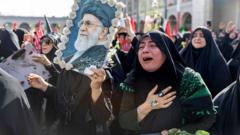
Hundreds of thousands of mourners are filling the streets of Tehran right now, weeping and beating their chests in what officials call the "funeral of the century." The body of Ayatollah Ali Khamenei—the man who ruled Iran for nearly four decades—is lying in state under a glass casket at the Imam Khomeini Grand Mosalla.
But if you look closely at the front lines of the massive prayer service, the most important man in Iran is completely missing.
Mojtaba Khamenei, the newly appointed Supreme Leader, skipped his own father’s funeral. While his three brothers—Masoud, Mostafa, and Meysam—stood publicly in tears behind the caskets, Mojtaba was nowhere to be seen. Instead, a 97-year-old cleric led the state funeral prayers next to President Masoud Pezeshkian and Revolutionary Guard commanders.
It is an unprecedented, glaring absence that tells you everything you need to know about the fragile, terrifying reality of Iran’s new leadership.
The Ghost in the Machine
You don't just miss your father's state funeral in the Middle East unless your life depends on it. For Mojtaba, it literally does.
Ever since the February 28 US-Israeli airstrikes killed his father, his wife, and several family members at their residence, Mojtaba has been a ghost. He was appointed Supreme Leader just 10 days after the strike, yet he hasn’t appeared on camera, given a speech, or recorded a single audio message in over three months.
The regime claims he's staying underground due to extreme security concerns. They aren't exaggerating. Israeli Defense Minister Israel Katz openly declared that Mojtaba is "marked for death."
There's also the physical reality. Regime insiders whisper that Mojtaba isn't just hiding; he's healing. Reports suggest he suffered severe facial injuries and shrapnel wounds to his legs during the same February airstrike that took out his father. Appearing in public in a wheelchair or visibly disfigured would smash the image of absolute power the Islamic Republic desperately tries to project right now.
A Public Display of Fractured Unity
The funeral was supposed to show a seamless transition of power. Instead, it highlights a regime standing on a knife-edge.
While Mojtaba stays in the shadows, the rest of the upper echelon made a highly coordinated appearance to signal they aren't afraid. Look at who actually showed up to pray
- President Masoud Pezeshkian, trying to maintain a grip on the civilian government.
- Mohammad Bagher Ghalibaf, parliament speaker and Tehran’s chief negotiator with Washington.
- Major General Ahmad Vahidi, the IRGC commander who just resurfaced after his own four-month disappearance.
The metro system logged seven million trips in less than 24 hours as people poured into the capital. The regime is pulling out all the stops, offering 50% discounts on hotels and turning schools and sports halls into free housing for mourners.
But a crowd of millions can't mask the operational paralysis. Mojtaba is reportedly directing the state entirely through written memos. He even had to approve a critical memorandum of understanding between Iran and the US via a written statement because he couldn't meet his own cabinet. You can't run a regional proxy war or manage a nuclear program through sticky notes forever.
Trump and the Fragile Ceasefire
The backdrop to this massive funeral is a temporary, highly volatile truce. US President Donald Trump noted that peace talks are paused for a week out of respect for the funeral processions.
In typical fashion, Trump couldn't help but stir the pot, telling reporters that Washington could have taken out the entire Iranian leadership with "one shot" at the funeral but chose not to because "then we would have nobody to negotiate with." He also publicly questioned the tears of the mourners, calling them "fake."
That rhetoric explains exactly why Mojtaba didn't show up. The regime knows that the moment the six days of funeral processions end—moving from Tehran to Qom, then to Najaf and Karbala in Iraq, before final burial in Mashhad—the ceasefire expires.
What Happens Next
Iran is attempting to project strength through sheer numbers, but a leadership operating from a bunker is inherently unstable. If you are watching Iran, stop looking at the crowds in the streets and start looking for the first sign of the new Supreme Leader’s voice.
The next move for regional stability depends entirely on whether Mojtaba can actually step out of the shadows and govern, or if the IRGC commanders who stood by the casket on Sunday are the ones really calling the shots. Watch the state media channels closely after the burial in Mashhad on Thursday. If Mojtaba remains silent after the mourning period ends, expect the internal power struggle in Tehran to break out into the open.