Dr. Aris Thorne stared at a glowing monitor in a basement laboratory in Hsinchu, his eyes burning from twelve consecutive hours under flickering fluorescent tubes. Outside, the tropical night was quiet, but inside, the air hummed with the high-pitched whine of cooling fans and the quiet desperation of a dying physics problem.
For a decade, the semiconductor industry had been running headfirst into a brick wall. Silicon, the reliable workhorse of the digital revolution, was getting too hot. It was leaking electricity. It was running out of space. Every smartphone in a teenager's pocket, every server farm powering global networks, and every medical scanner saving lives depended on squeezing more power into vanishingly small spaces. And silicon was hitting its absolute limit.
Aris rubbed his thumb against a small ceramic coffee mug, now stone cold. He was looking at a microscopic catastrophe.
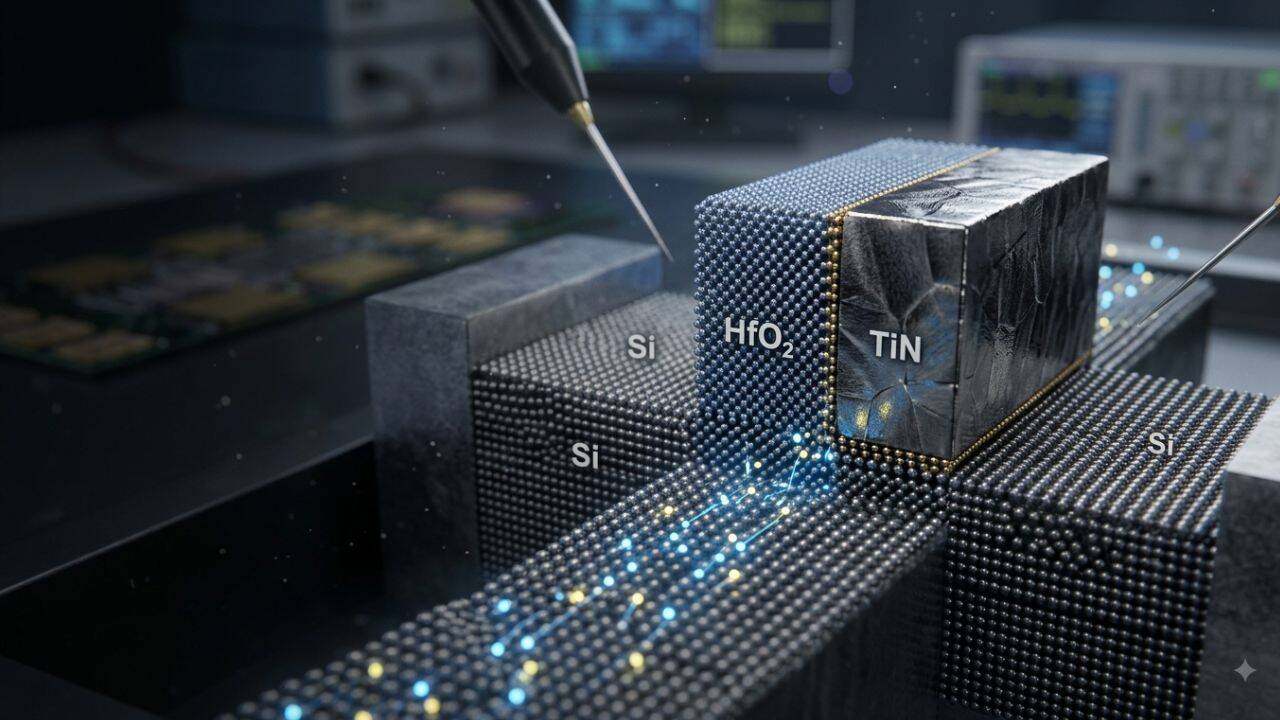
To build faster, cooler, and more energy-efficient computer chips, engineers had spent years eyeing a miracle material called molybdenum disulfide, known simply in labs as MoS2. Think of it like a sheet of molecular chicken wire, just a few atoms thick. Electrons could race across it at breathtaking speeds without slamming into obstacles. It promised transistors so tiny and efficient they could transform electronics entirely.
There was just one catch. Whenever you tried to glue this wonder material to a traditional electrical contact, a messy chemical barrier formed. Electrons refused to cross smoothly. They stuttered, piled up, and generated frustrating heat. It was like trying to pour water through a funnel choked with gravel. The material was extraordinary, but the handshake between the wire and the semiconductor was broken.
The industry was stuck. Progress felt impossible.
Consider what happens when an electron hits a roadblock inside a modern computer chip. It loses energy. It generates heat. Multiply that by billions of transistors firing simultaneously inside your phone while you stream a video, and the device gets warm in your hands. That heat is wasted energy. It is the sound of computing hitting the ceiling of our current material sciences.
Aris remembered the exact Tuesday morning the breakthrough happened.
His graduate student, a tireless researcher named Maya, walked into the lab carrying a petri dish that looked like it held nothing at all. Inside was a sliver of material treated with a radically different approach. Instead of forcing standard metals onto the MoS2 surface, the team engineered an interface so impossibly thin it defied conventional manufacturing wisdom.
It measured exactly 0.42 nanometers.
To put that into perspective, a human DNA strand is roughly 2.5 nanometers wide. This interface was fractions of that scale. It was a molecular bridge built with terrifying precision.
When they hooked it up to the testing rig, Aris held his breath. The needle on the oscilloscope jumped. The electrical resistance that had plagued their prototypes for years vanished. Electrons flowed from the metal contact into the MoS2 channel almost as if the barrier wasn't even there at all.
It was a quiet moment. No flashing lights. No dramatic alarms. Just a digital graph ticking upward into territory no human had ever seen before.
The implications ripple outward far beyond clean lab benches and academic journals.
Imagine a smartphone that holds a charge for an entire week, even with heavy gaming and constant video streaming. Imagine artificial intelligence models running locally on a wristwatch, consuming a fraction of the power currently required by massive, energy-hungry data centers that drain municipal power grids. This single 0.42-nanometer interface is the key that unlocks that reality.
Physics does not care about our deadlines. It does not negotiate. When silicon finally stops shrinking, the entire architecture of human technology has to pivot or stall. Breakthroughs like the one forged in Taiwan prove that the pivot is happening right now, happening in the quietest corners of cleanrooms, driven by people willing to stare at glowing screens until dawn.
Aris powered down his monitor, the laboratory plunging into a sudden, deep shadow. Outside, the first faint pink of dawn was breaking over the horizon, casting long, sharp lines across the pavement. The wall had not fallen all at once. It had been breached, one fraction of a nanometer at a time.