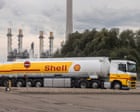
Midnight at a coastal refinery looks less like an industrial plant and more like an oil-stained cathedral.
Towering distillation columns hiss in the dark, venting superheated steam into a damp marine breeze. Below them, a maze of carbon-steel pipes carries thousands of barrels of crude oil every hour, a churning soup of hydrocarbons waiting to be violently separated, cracked, and transformed into the liquid that moves the modern world. Inside the control room, illuminated by the cold blue glow of hundred-million-dollar monitors, operators watch numbers pulse. A decimal point shifts. A profit margin ticks upward by fractions of a cent. Across a billion gallons of refined fuel, those fractions compound into fortunes.
Right now, that machinery is gearing up for a staggering financial transformation.
Shell, one of the titan energy conglomerates steering the global economy, is quietly projecting that its refining operations will almost double the profit extracted from every single barrel of fuel it manufactures. Think about that for a moment. Not a modest uptick. Not an inflationary adjustment. An effective doubling of the margin squeezed out of the roaring furnace of production.
To understand why this is happening, we have to look past the corporate press releases and step away from the abstract ledgers of Wall Street. We have to look at the ground.
The Anatomy of a Barrel
Let us demystify the crude barrel. When a supertanker docks at a terminal, it unloads Brent or West Texas Intermediate—thick, dark, sulfurous sludge that smells faintly of rotten eggs and raw ambition. Left alone, it is useless. You cannot pour crude into the fuel tank of a commuter sedan or a Boeing 777.
It must be cooked.
Refining is an exercise in extreme chemistry. In massive atmospheric distillation units, crude is heated to over 750 degrees Fahrenheit, turning liquid into vapor inside giant steel columns. As the vapor rises and cools, different fractions condense at different heights. Heavy gas oils drop to the bottom. Diesel condenses in the middle. Gasoline and jet fuel rise near the top like ghost-whispers before being captured and hauled away by tanker trucks and pipeline networks.
For years, this entire process was a low-margin, high-volume grind. Refiners bought crude at market price, processed it through multi-billion-dollar complexes that cost a fortune to maintain, and sold the resulting gasoline and diesel on razor-thin margins. Sometimes, when global markets were oversupplied, they lost money on every gallon that cleared the plant gates. It was an industrial utility business operating at the mercy of global commodity swings.
Then, the world changed.
Geopolitical fractures, sanctions on major energy exporters, and a wave of refinery closures across North America and Europe over the last decade created an unexpected bottleneck. The world stopped building new refineries. Environmental pressures mounted. Capital expenditure shifted away from fossil infrastructure.
And suddenly, demand for finished fuels outpaced the world's capacity to crack them.
The Economics of Scarcity
Imagine you own the only bakery in a growing city of one million people. For years, flour was cheap, bread was abundant, and competition kept your profits low. You made your living strictly on the sheer volume of loaves pushed across the counter.
Then, half the bakeries in the region are forced to shut down due to rising municipal taxes and stricter zoning laws. The demand for bread doesn't drop. In fact, more people move to the city. Suddenly, you are one of the few places left with a roaring oven.
What happens to the price of your loaf? What happens to your profit margin?
This is precisely the position major energy refiners find themselves in today. Global refining capacity has tightened to a razor-sharp edge. When operational capacity shrinks while global mobility rebounds, the crack spread—the financial difference between the cost of crude oil and the market value of the refined petroleum products derived from it—widens into a canyon.
Shell’s internal projections of doubling per-barrel profits are not born from magic. They are born from this structural structural tightness. The company has spent years trimming the fat from its downstream portfolio, shedding inefficient, older refineries in places where environmental compliance and operating costs eat away at the bottom line. What remains is a leaner, more technologically advanced fleet of mega-refineries—facilities in strategic hubs along the US Gulf Coast, Europe, and Asia that can process heavy, cheaper crude oils and convert them into high-specification clean fuels with surgical precision.
When you control fewer plants, but those plants are hyper-efficient juggernauts operating in a supply-constrained market, your pricing power shifts dramatically. Every barrel that rolls off the line carries a heavier financial weight.
The Ripple Effect at the Pump
For the average driver sitting at a traffic light, watching the digital numbers spin upward on a gas station sign, this corporate math feels deeply personal.
You feel it when you commute to work. You feel it when the cost of delivering groceries spikes because the logistics network running on diesel fuel has become more expensive to operate. When a major energy producer doubles its per-barrel refining margin, that money does not materialize out of thin air. It is absorbed by the supply chain, shared among traders, distributors, and retailers, and ultimately paid for by the end consumer.
Yet, there is a profound paradox at play here.
Even as companies like Shell position themselves to extract massive cash flows from traditional fossil fuels, they are simultaneously pouring billions of dollars into the energy transition—building electric vehicle charging networks, investing in low-carbon hydrogen, and developing biofuels.
How do you fund the future? You milk the cash cow of the present.
The traditional refining business, once viewed as a dying sunset industry destined for slow, painful margin erosion, is instead experiencing a golden twilight. It is throwing off immense amounts of free cash flow precisely because the world is pivoting away from long-term fossil investments. By refusing to build new refineries, the industry has accidentally engineered a supply shortage that guarantees high profitability for the assets that remain standing.
The Long Shadow of the Barrel
Stand near a modern refinery at twilight and watch the flare stack burn—a bright, dancing tongue of orange fire licking the evening sky. That flame represents excess gases being safely burned off, but it also feels like a monument to an era of high-stakes industrial energy.
The doubling of refining profits is a symptom of a transition period in human history. We are halfway out of the old world of hydrocarbons, but we are not yet safely inside the new world of renewables. In that dangerous, high-demand middle ground, the infrastructure of the twentieth century is proving extraordinarily lucrative for the few corporations robust enough to hold the keys.
The next time you fill your tank, remember the invisible math playing out across the globe. Behind every gallon of fuel is a complex web of geopolitics, steel towers, chemical reactions, and corporate strategy designed to extract maximum value from every drop of ancient sunlight trapped beneath the earth.
The machinery is humming louder than ever. And the margins have never looked sharper.


