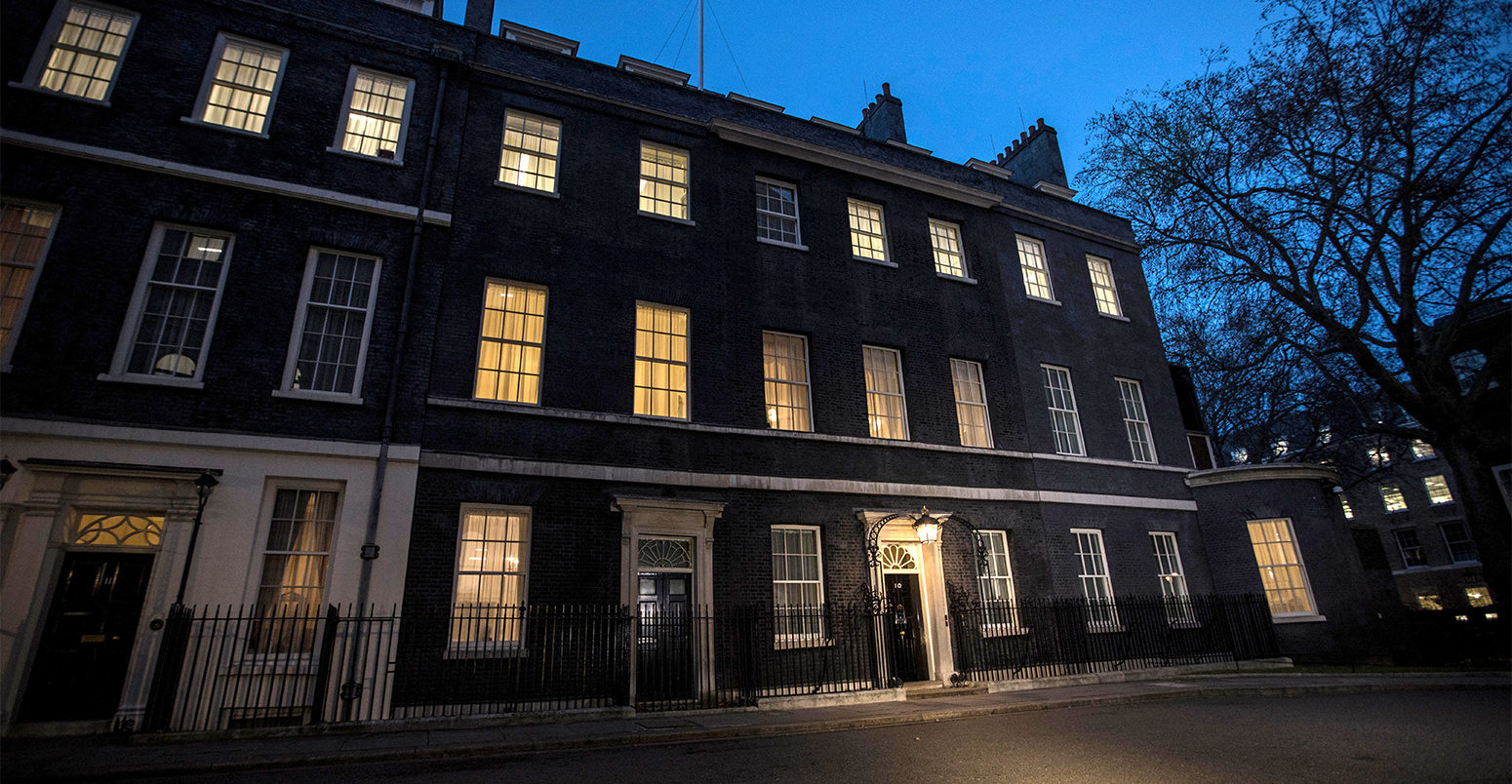
The rain in London does not care about fiscal policy. It slicks the pavement outside Downing Street, reflecting the harsh glare of television broadcast lights, just as it did decades ago. Inside those thick, historic walls, a newly elected Prime Minister sits with a pen balanced between his fingers. Keir Starmer faces a spreadsheet that isn't just a collection of numbers. It is a map of human choices.
Every digit represents a school roof that might leak, a hospital bed that might go unfunded, or a family whose mortgage payments might spike by hundreds of pounds a month.
Across the Atlantic, in a sterile, glass-fronted office in Washington D.C., the International Monetary Fund looks at the exact same spreadsheet. They do not see the leaky roofs. They see lines of systemic risk. They see a nation flirting with the edge of a financial breakdown. When the IMF recently issued its stern warning to the UK, urging the government to "stay the course" on borrowing and fiscal discipline, it sounded like a bureaucratic drone.
It wasn't. It was an alarm bell muffled by diplomatic politeness.
The Ghost of Chancellors Past
To understand why a warning from Washington can make a British Prime Minister pause mid-breath, we have to look at how fragile this system truly is. Think of a nation’s economy not as a monolithic machine, but as a massive, communal tightrope.
Imagine a family—let's call them the Taylors, a hypothetical household living just outside Manchester. Over the last few years, the Taylors have watched their grocery bills climb. They deferred fixing their car's rattling exhaust pipe. They opted for a cheaper internet plan. They did this because they knew that running up their credit card to maintain their old lifestyle would eventually lead to a catastrophic phone call from the bank.
A government is not exactly like a household; it can print money and issue bonds. But the fundamental physics of debt do not change. If the global markets lose faith that the UK can pay back what it borrows, those markets retaliate.
We saw this play out in real time during the disastrous mini-budget of 2022. It took only forty-eight hours of reckless fiscal signaling to send pension funds into a tailspin and spike mortgage rates for millions of real-world people like the Taylors. That wound is healed, but the scar tissue remains. The IMF's recent intervention is a reminder that the global financial community has a long memory. They are watching Starmer's government with a magnifying glass, looking for any sign of a wobble.
The Illusion of Free Money
There is a quiet, seductive argument that surfaces whenever a new government takes power. It suggests that if we just borrow a little more today, we can spark the growth that pays for tomorrow. It sounds reasonable. It sounds compassionate.
But borrowing money on the international stage is never free, and the terms are dictated by predators who do not care about British social welfare. When the IMF tells the UK to stick to its strict fiscal rules, they are acting as the cold, rational friend holding your coat while you eye a fight you cannot win.
Consider the mechanics of a government bond. When the UK Treasury needs cash, it auctions off these promises to pay. The buyers are sovereign wealth funds, massive insurance corporations, and billionaire investors. If these buyers sense uncertainty—if they look at Starmer's platform and see vague promises instead of hard arithmetic—they demand a higher price for their trust. That price is called the yield.
When yields rise, the cost of servicing the national debt skyrockets. Right now, the UK spends more on interest payments for its past borrowing than it does on many major public services. Every extra billion spent on interest is a billion snatched away from the National Health Service. That is the invisible stake. The less disciplined the government is today, the less sovereignty it has tomorrow.
The Uncertainty Principle
The real tension in Downing Street right now is not about a lack of will; it is about a lack of time. Keir Starmer walked into office on a wave of promises to rebuild a crumbling public infrastructure. The voters who put him there are tired. They are exhausted by years of austerity, by waiting lists that stretch into months, and by public transport systems that feel increasingly provisional.
The political pressure to break the fiscal rules and spend heavily is immense. It comes from backbench MPs, from trade unions, and from the raw reality of a country that needs repair.
But the IMF’s message is unyielding: there are no shortcuts. The global economy is currently navigating a treacherous strait. Inflation is a sleeping dragon that could wake at any moment. Central banks around the world are keeping interest rates high to keep that dragon contained. In this environment, a sudden surge in British government borrowing would be like throwing kindling onto a smoldering fire.
This creates a brutal paradox for the current administration. To secure the long-term stability that the IMF demands, they must risk the short-term anger of the people who elected them. They must stand before a public that wants immediate relief and explain that the foundation must be poured and cured before the house can be built.
The Ledger of Real Life
Let us step away from the abstract macroeconomic models for a moment and look at what this discipline actually looks like on the ground.
If the government heeds the IMF and maintains its strict borrowing limits, it means making choices that wound. It means telling a local council that the funding for a new community center is deferred. It means telling university vice-chancellors that there is no bailout coming for their deficits. It means telling public sector workers that their pay rises must be measured, not monumental.
It feels cruel. It looks like cold-hearted statistics winning out over human need.
But look at the alternative. If the government ignores the warning, if they decide to borrow heavily to fund immediate desires, the reaction from the market will not hit the politicians. It will hit the Taylors in Manchester. It will manifest as another jump in the cost of their fixed-rate mortgage when it comes up for renewal. It will look like a weaker pound, making imports of food and fuel more expensive. The poorest in society always pay the highest price for fiscal recklessness.
The IMF is not asking the UK to be heartless. They are asking the UK to be sustainable. True compassion in governance is not promising everything to everyone today; it is ensuring that the promises you make today can still be honored in a decade.
The Unwritten Chapters
The pen remains balanced in the Prime Minister's hand. The pressure to spend is a physical weight in the room, balanced against the data-driven warnings coming from international institutions.
This is the crucible of leadership. It is the moment where campaign rhetoric collides with the unyielding laws of global finance. The decisions made in these quiet rooms over the coming months will dictate the trajectory of the country for a generation.
There will be no grand announcement that the danger has passed. There will be no victory lap. Success in this arena is entirely silent. It is defined by what does not happen. It is a mortgage rate that remains steady. It is a currency that doesn't collapse on a Tuesday afternoon. It is the boring, beautiful predictability of a stable economy.
As the rain continues to fall outside the window, blurring the lights of London, the spreadsheet awaits its final entries. The numbers will be tallied, the bonds will be issued, and the country will move forward, balanced precariously on a line written in ink that cannot afford to run.