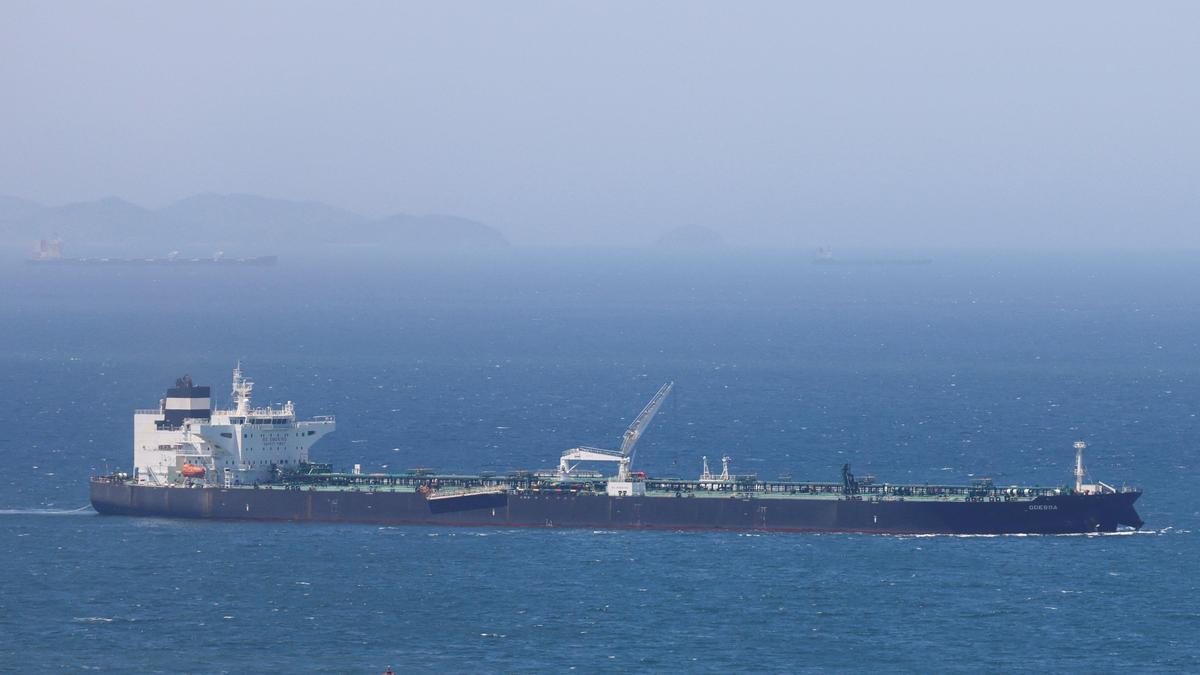
The sea is never as empty as it looks from a distance. If you stand on the deck of a VLCC—a Very Large Crude Carrier—as it enters the Strait of Hormuz, the horizon feels heavy. You aren't just looking at water. You are looking at 20 percent of the world’s petroleum consumption squeezed into a passage that, at its narrowest point, offers only two miles of navigable shipping lanes in either direction.
It is a claustrophobic reality for a global economy that likes to pretend it is borderless.
Project Freedom was supposed to be the definitive answer to this pressure cooker. It was pitched as a technological and diplomatic shield, a way to ensure that the "artery of the world" remained open regardless of the political fever dreams of regional powers. But the project didn't just stumble; it collapsed under the weight of a fundamental misunderstanding of how power works in the 21st century.
To understand why, you have to look past the spreadsheets and the satellite imagery. You have to look at the bridge of a merchant vessel.
The Two-Mile Trap
Imagine a captain named Elias. He isn't a soldier. He’s a veteran mariner responsible for a cargo worth three hundred million dollars. When Elias enters the Strait, he isn't thinking about grand strategy. He is thinking about the fact that his ship, longer than three football fields, takes miles to come to a full stop.
He is operating in a space where "international waters" is a legal term that provides very little physical protection.
The U.S. led Project Freedom on the premise that superior sensor arrays and a coordinated naval presence would deter interference. The idea was simple: if we can see everything, we can stop anything. But transparency is not the same as control. In the Strait, the threat isn't always a destroyer or a fleet of fighter jets. Often, it is a swarm of fast-attack boats—small, nimble, and inexpensive.
These boats don't need to win a war. They only need to create enough "friction" to make the insurance premiums for a ship like Elias's skyrocket.
The Math of Friction
Logistics is a game of margins. When the U.S. began rallying allies for Project Freedom, the pitch was centered on collective security. However, the cost-benefit analysis for participating nations was skewed from the start.
Consider the sheer overhead of maintaining a constant, high-readiness naval presence in a climate that eats hardware for breakfast. The salt, the heat, and the constant operational tempo wear down the most sophisticated Aegis systems. While the U.S. was spending millions of dollars per day to keep "the door open," the opposing forces were spending a fraction of that to occasionally kick the frame.
This is the "asymmetric trap."
Project Freedom relied on a traditional model of power projection. It assumed that a massive, visible show of force would stabilize the market. Instead, it often did the opposite. Every time a new destroyer arrived, the tension in the Strait ratcheted up. For the global oil market, tension is a commodity. It’s a price hike.
The project failed to secure the Strait because it tried to use a sledgehammer to protect a glass vase. The more force was applied, the more fragile the situation became.
The Ghost in the Machine
We often talk about "freedom of navigation" as if it’s a natural law, like gravity. It isn’t. It’s a fragile agreement maintained by a thousand quiet handshakes and a massive amount of technical infrastructure.
Project Freedom attempted to automate this trust. It pushed for advanced AI-driven monitoring and autonomous patrol vessels to reduce the human risk. On paper, it was brilliant. In the water, it was a disaster.
The sensors struggled with the chaotic environment of the Persian Gulf. Between the heavy humidity, the dust storms blowing off the Arabian Peninsula, and the sheer volume of legitimate small-craft traffic—fishermen, traders, smugglers—the "signal" was lost in the "noise."
Elias, our hypothetical captain, didn't want an autonomous drone telling him the path was clear. He wanted to know that if a boarding party climbed his rails, a human being with the authority to intervene was less than five minutes away. Project Freedom offered high-tech surveillance but hesitated on the high-stakes commitment of actual intervention.
This hesitation was the death knell.
The Sovereignty Standoff
You cannot secure a waterway if you do not respect the geography of the people living on the coast.
The Strait of Hormuz is not the mid-Atlantic. It is bordered by nations that view the presence of a foreign-led "security project" as a direct challenge to their territorial integrity. Project Freedom was marketed as a neutral effort to protect trade, but in the Middle East, nothing is neutral.
By framing the mission as a U.S.-led initiative, the project forced other nations to pick a side. Many of the very countries whose oil was being protected—nations in the Gulf Cooperation Council—were wary of being seen as too closely aligned with a provocative military footprint. They wanted security, but they didn't want the "Freedom" brand if it meant a permanent state of high-alert.
Then there was the European factor.
Major maritime powers in Europe looked at Project Freedom and saw a potential for escalation they couldn't control. They chose to launch their own, separate monitoring missions. Suddenly, the "unified front" was a fractured map of overlapping jurisdictions and competing radio frequencies.
Why the Navy Can't Fix a Market
There is a stubborn myth that military power can dictate economic stability.
The failure of Project Freedom proved that you could have the most powerful navy in human history parked in a waterway and still lose the battle for "free navigation." Secure navigation isn't just about the absence of sea mines; it’s about the presence of predictability.
When the project failed to gain the participation of key regional players and major Asian importers like China and India, it lost its mandate. Security in a chokepoint is a social contract. If the people using the road don't trust the toll collector, the road remains dangerous.
The invisible stakes of this failure are felt every time you fill up your car or buy a product shipped from overseas. We pay a "Hormuz Tax" that is baked into the price of modern life. We pay for the failure of Project Freedom not in blood, usually, but in the slow, steady drain of economic uncertainty.
Elias still sails through the Strait. He still watches the radar. He still sees the fast-attack boats shadowing his wake like wolves following a slow-moving elk.
He knows what the planners in Washington forgot: out here, the water is deep, but the politics are shallow and jagged. You don't secure freedom with a project name and a press release. You secure it through the grueling, unglamorous work of diplomacy and the physical presence of people who have something to lose.
The Strait remains a narrow, dangerous hallway. The lights are flickering, and the guard we sent to fix them realized he didn't have the right tools for the job.
The sea is never empty, and it never forgets a mistake.