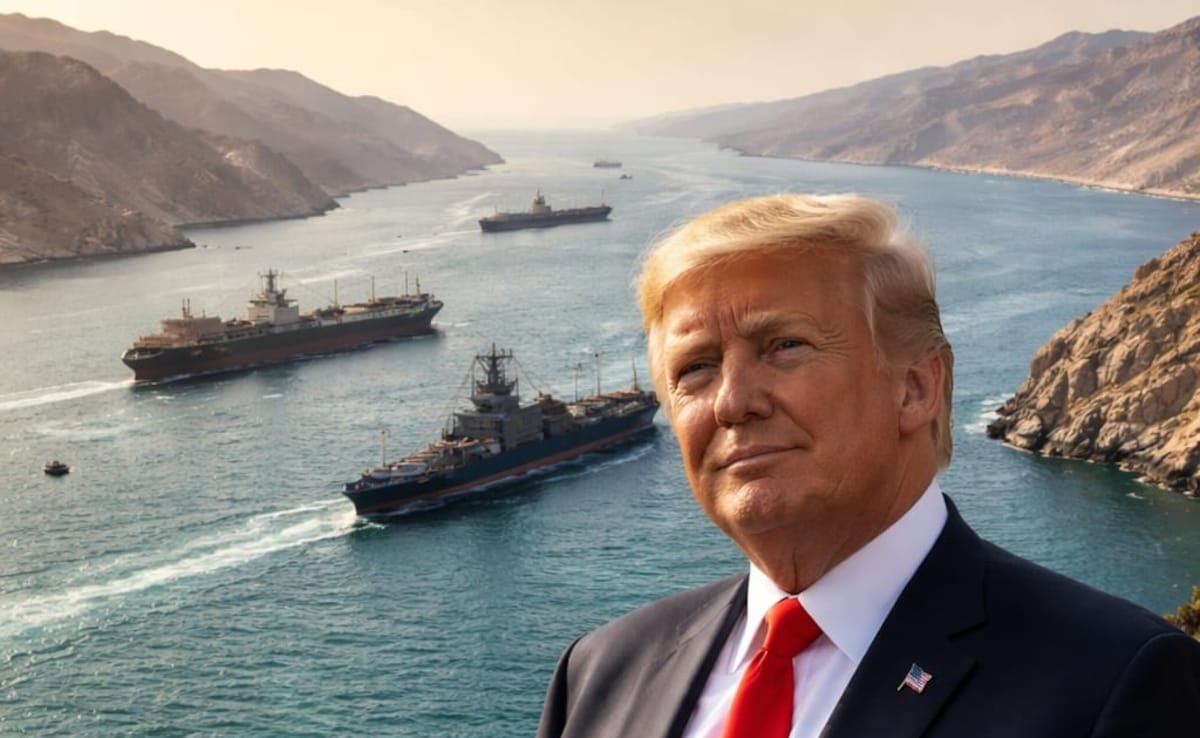
A single, jagged line on a map off the coast of Oman dictates the price of the plastic in your hand, the heat in your radiator, and whether the person sitting across from you at dinner has a job tomorrow. We call it the Strait of Hormuz. It is twenty-one miles wide at its narrowest point. That is roughly the distance an average person drives to get to a decent shopping mall.
Yet, within that sliver of saltwater, the global economy holds its breath.
Recent political rhetoric suggests we have outgrown this geographic bottleneck. The argument goes like this: the United States is now a net exporter of energy. We frack. We drill. We have more oil and gas than we know what to do with. Therefore, the old logic—the logic that sent carrier strike groups to patrol the Persian Gulf for decades—is obsolete. We are told we don't need Hormuz anymore.
It is a seductive idea. It tastes like independence. But it ignores the way the world actually works.
The Myth of the Isolated Island
Think of the global energy market not as a series of separate buckets, but as a single, massive swimming pool. If someone dumps a gallon of red dye into the pool in Dubai, the water in Dallas turns pink. It does not matter if the U.S. produces enough oil to fill its own bucket. If twenty percent of the world’s petroleum and a third of its liquefied natural gas stop moving through that twenty-one-mile gap, the price of every barrel on earth instantly doubles or triples.
Markets do not care about your domestic production when a global shortage strikes. They care about the panic.
Consider a hypothetical crane operator in a port city like Savannah or Rotterdam. We will call him Elias. Elias doesn't track geopolitical tensions in the Middle East. He tracks his mortgage and the cost of the diesel he puts in his truck to get to work. When a conflict closes the Strait, even for a week, the cost of shipping everything—grain, car parts, medical supplies—skyrockets. The "shale revolution" in the Permian Basin cannot shield Elias from the fact that his grocery bill just jumped forty percent because the global logistics chain is chained to the price of fuel.
A Pressure Cooker Under the Waves
The Strait of Hormuz is not just a shipping lane. It is a psychological barometer. To understand why it remains the most dangerous piece of water on the planet, you have to look at the sheer density of the traffic.
Imagine a highway where every vehicle is a three-hundred-meter-long steel beast carrying enough explosive energy to power a city. These tankers cannot swerve. They move in narrow, designated "Traffic Separation Schemes." If a single mine is spotted, or if a drone strike hits a deck, the insurance companies—the quiet, suit-wearing giants in London and Zurich—simply pull the plug. They stop insuring the ships.
Without insurance, the ships stop moving. When the ships stop moving, the pool starts to dry up.
The argument for walking away from Hormuz assumes that the U.S. interest in the region was always just about securing our own gas tanks. That was never the whole story. The real interest was stability. The U.S. Navy acted as the world’s most expensive security guard, ensuring that the gears of global capitalism kept turning. If the guard leaves the post, the vacuum isn't filled by "independence." It is filled by chaos, or worse, by competitors who understand that whoever controls the tap controls the world.
The Ghost of 1973
History is a persistent teacher, though we are often poor students. During the oil shocks of the 1970s, the world learned that energy isn't just a commodity; it’s a weapon. People stood in lines for hours to get a few gallons of gas. The economy buckled. Today, we think we are smarter, more "green," and more self-sufficient.
But our "green" transition is currently built on a foundation of fossil-fuel-powered logistics. The wind turbines and solar panels we crave are moved on ships that burn heavy fuel oil. The silicon chips that manage our smart grids are manufactured in factories that rely on the stability of global trade routes.
If we allow the Strait of Hormuz to become a no-man's-land, we aren't just risking higher prices at the pump. We are risking the very transition we claim to want. A global recession triggered by an energy spike doesn't lead to more investment in renewables. It leads to a desperate, soot-covered scramble for whatever fuel is left.
The Human Cost of "Not Needing It"
Let’s talk about the people we don’t see.
In a small village in India, a farmer relies on urea-based fertilizer to keep his crops alive. That fertilizer is a byproduct of natural gas. Much of that gas comes from Qatar, traveling right through the Strait. If that flow stops, the farmer’s yield drops. Food prices in his local market rise. He cannot feed his children.
In Japan, a country with almost no domestic energy resources, the lights stay on because of a constant, rhythmic pulse of tankers arriving from the Gulf. If that pulse flatlines, the third-largest economy in the world begins to go dark.
When we say "we don't need" to worry about this region, we are essentially saying we don't care about the collateral damage to the global structure that allows us to live our modern lives. The U.S. might be "energy independent" on paper, but our allies are not. Our trading partners are not. The people who buy our software, our airplanes, and our crops are not.
If their economies collapse, ours follows.
The fragility is the point. We have built a world of "just-in-time" delivery and hyper-efficient supply chains. These systems are marvels of engineering, but they have no margin for error. They are like a high-performance engine that seizes up if a single grain of sand gets into the oil. The Strait of Hormuz is where the sand is most likely to enter.
The Invisible Stakes
It is easy to look at a map and feel disconnected. The Persian Gulf is a long way from the American Midwest or the suburbs of London. But the geography of the modern world is not measured in miles. It is measured in connectivity.
The internet you are using to read this exists because of an undersea cable infrastructure and a power grid that are both tethered to the stability of global markets. The "invisible stakes" are everything you take for granted: the fact that your credit card works, that the pharmacy has your medication, and that the lights flicker on when you flip the switch.
Reopening and maintaining the security of the Strait isn't a favor we do for the Middle East. It isn't an act of charity. It is a fundamental necessity for a functioning civilization. To suggest otherwise is to ignore the physical reality of the planet we inhabit.
We can argue about who should pay for the security. We can debate the footprint of our military. Those are valid, necessary conversations. But the idea that the Strait of Hormuz is irrelevant because we found oil in North Dakota is a dangerous fantasy. It treats the world like a collection of isolated fortresses rather than a living, breathing, interconnected organism.
If you prick the finger, the whole body feels the pain. If you choke the Strait, the whole world gasps for air.
The tankers keep moving tonight, slipping through the dark waters of the Gulf, guided by GPS and the hope that the narrow path remains open. On board are crews from a dozen different nations, carrying the literal heat and light of the world. They are the frontline of a global system that is far more fragile than we care to admit. They move in silence, through a twenty-one-mile gap, while the rest of us sleep, convinced we no longer need the very thing that keeps us warm.
The line on the map remains. The stakes remain. And the water is deeper than it looks.