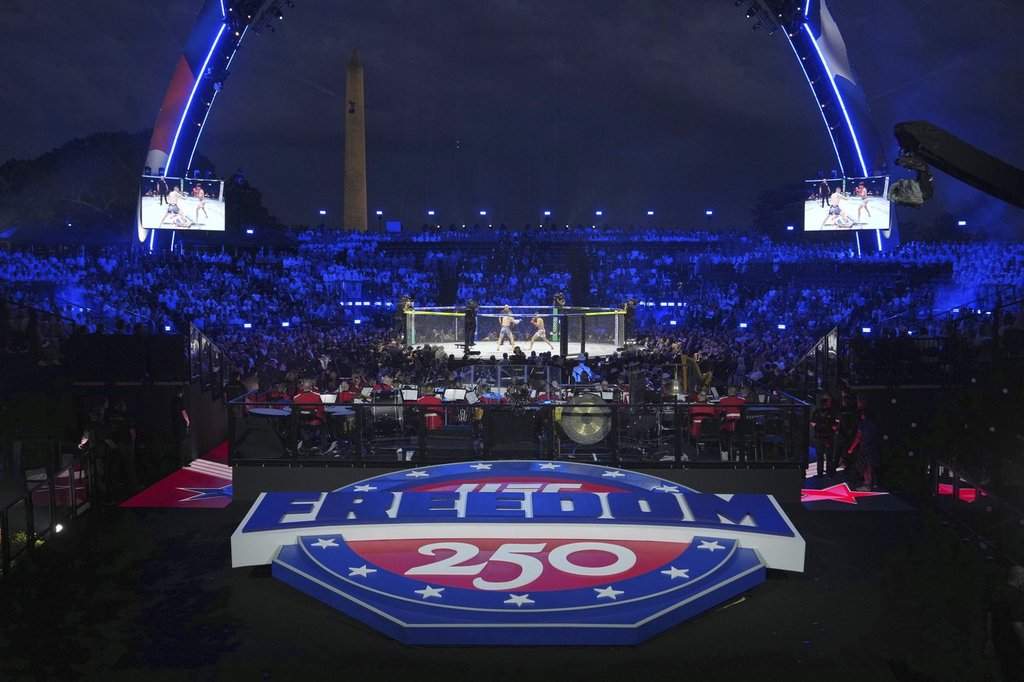
The federal tracking of the domestic terror cell calling itself "Vanguard of the Old" did not begin in Washington, but rather through a routine tip from an anxious mother in Ohio. When law enforcement unsealed criminal complaints following a sweeping multi-state sweep, the public learned how close the nation came to a mass-casualty event on the executive mansion grounds. The FBI disrupted an intricate, multi-staged plot targeting the historic UFC 250 card staged on the White House South Lawn, arresting five individuals across three states just days before the first bell rang.
The mechanics of the thwarted operation point toward a terrifying evolution in domestic extremist tactics. This was not a lone-wolf actor with a rifle, but a decentralized network operating over end-to-end encrypted Signal channels, aiming to combine commercial drone technology with traditional asymmetric warfare principles.
According to federal affidavits, the cell intended to detonate explosive-laden quadcopters over the north side of the White House complex. The objective was not necessarily to cause immediate mass deaths with the initial aerial blasts, but to trigger a blind, panicked evacuation. The plotters calculated that Secret Service details would rush high-profile attendees—including President Donald Trump, billionaire tech executives like Meta CEO Mark Zuckerberg, and senior cabinet officials—directly into pre-staged sniper lanes outside the secure perimeter.
The Digital Architecture of Modern Radicalization
For decades, domestic counterterrorism investigations relied heavily on monitoring physical compounds or known extremist meet-ups. Vanguard of the Old flipped this traditional investigative model on its head, constructing a sophisticated operational framework out of standard consumer digital tools.
The radicalization pipeline for the group began on TikTok. A public group served as the top-of-funnel recruitment mechanism, broadcasting generic grievance narratives regarding the direction of the country, vague references to the illicit networks of Jeffrey Epstein, and populistic anti-elite rhetoric. Once individuals demonstrated sufficient ideological alignment, they were systematically migrated to a primary Signal chat comprising approximately 23 active participants. Within these encrypted silos, the rhetoric quickly transformed into concrete operational logistics.
Federal investigators recovered high-resolution satellite maps of the National Mall, detailed floor plans of properties adjacent to Lafayette Square, and specific coordinate markers for sniper positions on the phones of those arrested. The cell also established secondary "side chats" to wall off specialized operational tasks, ensuring that if one member was compromised, the entire infrastructure might survive.
The profile of 19-year-old Tycen Proper, arrested in the Southern District of Ohio, highlights the speed with which these modern networks can mobilize. Within a matter of months, Proper went from participating in digital ideological echo chambers to actively purchasing firearms, body armor, and organizing a logistical transit plan to meet co-conspirators at a staging area in Fredericksburg, Virginia.
The Tactical Nightmare of Commercial Drone Interdiction
Staging a major sports broadcast featuring thousands of spectators on the South Lawn is already a security infrastructure challenge. Injecting a highly mobile, commercial drone threat into that equation exposes a massive vulnerability in urban counterterrorism defenses.
+-----------------------------------------------------------+
|               PHASE 1: THE AERIAL CATALYST                 |
|  Explosive-laden commercial quadcopters detonate over     |
|  the north perimeter to induce mass spectator panic.       |
+-----------------------------------------------------------+
                              |
                              v
+-----------------------------------------------------------+
|               PHASE 2: THE FUNNEL EFFECT                  |
|  Secret Service and security assets evacuate dignitaries  |
|  and crowds outward, away from perceived blast zones.     |
+-----------------------------------------------------------+
                              |
                              v
+-----------------------------------------------------------+
|              PHASE 3: THE KINETIC AMBUSH                  |
|  Pre-positioned sniper teams open fire on unshielded     |
|  targets funneling into the unsecured streets.            |
+-----------------------------------------------------------+
While the Secret Service maintains sophisticated electronic warfare suites capable of jamming signal frequencies around the White House, those systems are not infallible against automated or pre-programmed flight paths that do not rely on active radio frequencies. The Vanguard of the Old plot deliberately exploited the geographical realities of the District of Columbia. By launching small, low-altitude drones from public spaces outside the heavily guarded inner perimeter, attackers can bypass conventional physical barriers like gates, bollards, and biometric checkpoints within seconds.
The plan also featured a secondary assault element designed to storm the White House gates amidst the chaos of the sniper ambush. This indicates an operational philosophy aimed at total institutional decapitation rather than a symbolic statement.
The Blind Spots in Encrypted Counterterrorism
The FBI and the Department of Justice have praised the rapid execution of the multi-state sting that net suspects Michael Alan Thomas and Bryan Omar Roa in California, alongside co-conspirators in Missouri and Ohio. Yet, the celebratory tone from Bureau leadership masks an uncomfortable reality. Federal agencies did not infiltrate the encrypted Signal cell via advanced cyber capabilities; they got lucky because of a human intelligence tipoff from a suspect's family member.
This details the ongoing crisis facing modern intelligence agencies. When extremist groups migrate into end-to-end encrypted ecosystems, traditional signals intelligence signals go dark. The government cannot read the messages without physical access to an unlocked endpoint device. Had an alarmed parent not noticed rapid firearms accumulation and unusual behavioral shifts, the encrypted chats coordinating the UFC 250 attack would likely have remained invisible until the drones were already airborne over Washington.
Furthermore, the ideological profile of the cell reveals a volatile cocktail of conspiratorial beliefs that defies old-school classifications. The group combined intense anti-government sentiments with specific anti-Jewish rhetoric targeting organizations like the American Israel Public Affairs Committee (AIPAC), while simultaneously expressing a desire to execute "capitalist elites."
This eclectic ideological mix makes predictive threat modeling extraordinarily difficult for analysts. Modern domestic extremists no longer fit neatly into uniform, established paramilitary groups with recognizable hierarchies. Instead, they operate as fluid, ad-hoc coalitions of the aggrieved, assembling online around specific high-profile targets of opportunity.
The Privatization of High-Profile Event Security
The staging of UFC 250 at the executive mansion underscores the blurry lines between public governance and private enterprise. Funded entirely by corporate interests, the event required an extraordinary deployment of municipal and federal assets, costing local law enforcement an estimated $12 million in street closures and perimeter security alone.
While corporate leadership praised the seamless coordination between private security details and the Secret Service post-event, the incident raises deep systemic questions about the allocation of defensive resources. Staging an entertainment spectacle in the literal front yard of the executive branch created a high-value target environment that strained multiple regional field offices of the FBI, requiring coordinated intervention from at least 12 distinct bureaus to prevent a slaughter.
The tactical blueprints recovered by federal agents indicate that the cell viewed the intersection of celebrity culture, immense private wealth, and federal political power as the ultimate symbolic target to spark a broader domestic insurrection.
As the legal proceedings against Proper, Thomas, and Roa move forward in federal courts, the case will likely serve as a benchmark for how the Justice Department handles decentralized, digitally native terror cells. The charges filed—including conspiracy to commit murder and the attempted murder of federal officers—carry severe statutory penalties, but prosecuting individuals who were arrested days before arriving at their tactical launch points requires airtight digital forensics.
The reliance on endpoint device seizures to reconstruct the Signal logs will test the limits of digital chain-of-custody protocols in domestic terrorism trials. Investigators must now prove conclusively that the digital maps, sniper coordinates, and drone assembly discussions found on the encrypted applications constituted an active, immediate conspiracy rather than aspirational internet bravado.
The chilling truth remains that the security apparatus did not catch this plot through algorithmic surveillance or predictive AI monitoring of web traffic. The defense of the highest office in the country ultimately hinged on an old-fashioned phone call from a civilian who saw something real, felt the weight of reality, and chose to speak up before the digital world crossed over into the physical one.