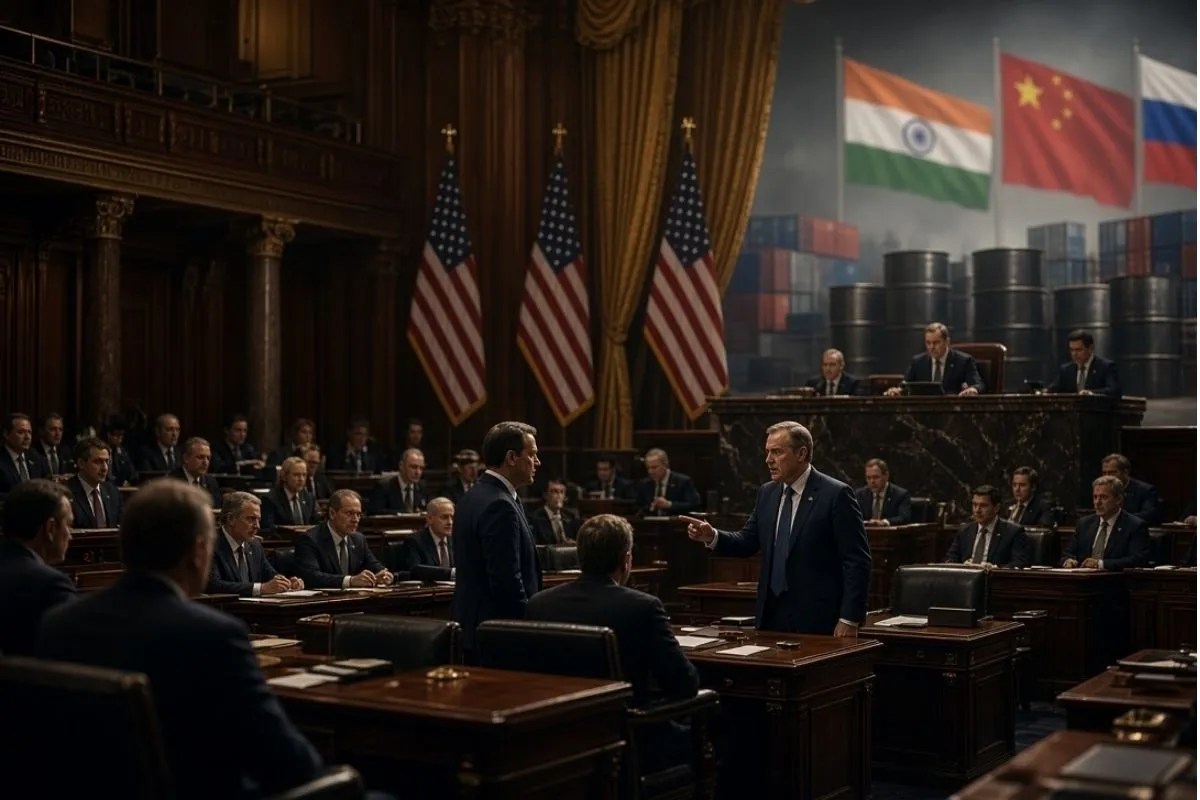
The legislative machinery on Capitol Hill rarely moves with pure alignment, and the recent stalling and procedural wrestling over presidential trade powers exposed deep fractures within the American political establishment. At the core of this standoff lies a contentious proposal granting the executive branch sweeping authority to impose punitive duties of up to one hundred percent on foreign nations maintaining energy trade with sanctioned economies. While headlines frequently focus on the sweeping rhetoric of protectionist policies, the actual legislative battleground involves a delicate calibration between congressional oversight, international energy markets, and executive overreach.
When the upper chamber overwhelmingly passed the measure targeting secondary energy trade, proponents framed it as an indispensable instrument of geopolitical pressure. Major developing economies that maintain robust petroleum and natural gas imports from Russia found themselves squarely in the crosshairs of this legislative text. Yet, the moment the text moved toward the House of Representatives, the political calculus shifted dramatically. Lawmakers representing industrial districts and export-heavy states began quietly sounding alarms about domestic market volatility, consumer price spikes at fuel pumps, and the broader inflationary fallout of sudden trade disruptions. Discover more on a similar topic: this related article.
This friction explains why the anticipated voting timeline hit unexpected roadblocks. House leadership faced an internal revolt not just from the opposing party, but from moderate members within their own caucus who feared the economic blowback of granting unchecked tariff mechanisms. For an administration that treats trade levies as its primary diplomatic and economic weapon, any attempt by Congress to restrict or condition these powers becomes an institutional turf war. Conversely, handing absolute discretion to the White House to penalize key global trade partners without stringent legislative guardrails creates profound anxiety among fiscal conservatives.
Consider a hypothetical scenario to understand the underlying economic mechanism. If a major industrial buyer of discounted crude oil suddenly faces a secondary tariff barrier equal to the full value of the imported commodity, the purchasing state has two immediate options. It can absorb the prohibitive cost, which destroys domestic industrial margins, or it can abruptly sever supply lines and scramble for alternative liquefied natural gas and crude sources in an already tight global market. The latter choice triggers an immediate shock to global commodity prices, driving up energy costs for ordinary citizens thousands of miles away from the diplomatic conflict zone. More analysis by NPR highlights similar views on this issue.
This reality forced congressional leaders to pump the brakes. While geopolitical hawks demanded immediate ratification to maximize pressure on foreign actors, pragmatists within the legislative branch pointed to domestic energy vulnerabilities. The debate is not merely about foreign policy compliance; it is a fundamental dispute over who controls the levers of international commerce. The Constitution grants Congress explicit authority over interstate and foreign trade, yet decades of delegated emergency powers have steadily shifted those powers toward the executive branch. Every time a high-stakes trade bill stalls in committee or faces floor resistance, it reflects a rare pushback by lawmakers attempting to reclaim constitutional prerogatives that were surrendered long ago.
As negotiations continue behind closed doors, the final shape of any trade enforcement mechanism remains uncertain. The delay demonstrates that even the most aggressive legislative agendas must contend with the messy reality of legislative arithmetic, regional economic interests, and the fear of voter backlash should energy prices surge before an election cycle. The pause is less a defeat and more a symptom of a fractured system trying to balance global ambitions against domestic economic survival.


