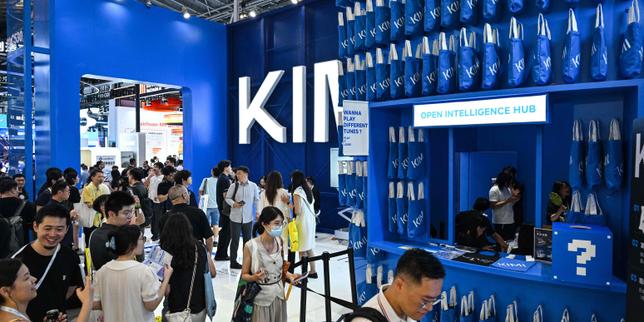
The White House has formally leveled accusations against Beijing-backed artificial intelligence startup Moonshot AI, alleging the firm systematically scraped, extracted, and duplicated intellectual property from American developer Anthropic. Federal officials claim Moonshot used automated distillation techniques to clone the reasoning architecture of Anthropic’s Claude models to train its own proprietary systems. This escalation marks a sharp transition in global tech trade friction. Washington is no longer merely restricting physical microchip exports; it is moving to police the silent, cross-border extraction of model weights and synthetic training outputs.
The mechanics of model distillation are straightforward, even if the policy response is complex. Distillation occurs when a smaller, newer AI system queries a superior target model millions of times, capturing the target’s output patterns to train itself at a fraction of the original research cost. Building a frontier foundation model requires hundreds of millions of dollars in compute, months of pre-training, and vast human feedback pipelines. Extracting that capability through API queries costs pennies on the dollar.
Moonshot AI rose rapidly in Beijing’s tech sector, fueled by massive capital injections and a reputation for building hyper-efficient long-context models. Its flagship offerings displayed surprising reasoning capabilities that rivaled top-tier Western benchmarks almost overnight. To industry insiders, that speed raised immediate red flags. Training a baseline model from scratch requires time, dataset curation, and massive compute infrastructure that usually leaves a clear digital and financial paper trail.
Anthropic discovered the alleged activity through anomalous usage patterns across its public endpoints and third-party API resellers. Investigators identified thousands of coordinated accounts executing systematic prompt suites designed to force Claude to reveal its chain-of-thought logic. Rather than asking standard user questions, these scripts systematically poked at the boundary conditions of Claude’s safety alignment and logical sequencing, recording every detailed step of the model's reasoning process.
The Synthetic Data Loophole Washington Is Desperately Trying to Plug
Western frontier labs face a structural vulnerability that current trade regulations never anticipated. While export controls effectively limit how many advanced graphics processing units China can import, they do nothing to stop data packet transfers over standard internet protocols. Anyone with a credit card and a VPN can access public APIs.
When a model generates an answer, that text becomes data. If a rival company collects millions of those generated answers, it creates a synthetic dataset packed with high-grade logical reasoning. Training a new architecture on this synthetic data effectively transfers the distilled intelligence of the original system into a completely new model.
Proving trade secret theft in synthetic data pipeline cases is notoriously difficult. Moonshot can plausibly argue its systems were trained on internet text, public open-source datasets, and independently generated internal data. In the digital software space, outputting similar text is not inherently proof of copyright infringement or trade secret violation, especially when models naturally converge toward optimal answers on logic and coding benchmarks.
Washington's intelligence community claims to have traced specific digital fingerprints embedded deep within the outputs. Model providers often embed faint behavioral signatures, specific stylistic quirks, and deterministic errors into their outputs to track downstream use. If Moonshot’s model replicates Anthropic's exact systemic errors and edge-case hallucinations, the defense of coincidental technical convergence falls apart.
The Compute Asymmetry Behind Rapid Distillation
- Capital Efficiency: Building a tier-one model from scratch costs upwards of $100 million in compute infrastructure alone.
- Extraction Cost: Extracting model behaviors via synthetic API queries can cost under $500,000 in API credits.
- Time to Market: Traditional pre-training takes six to twelve months; distillation fine-tuning takes weeks.
Beyond Chip Bans and Export Lists
The diplomatic fallout from this accusation will likely reshape how the United States treats foreign software access. Up to this point, foreign policy strategy focused heavily on hardware bottlenecks, such as restricting high-bandwidth memory chips and lithography machinery.
Hard hardware limits are necessary, but they are insufficient on their own. Physical hardware prevents foreign entities from running massive training runs efficiently, but distillation eliminates the need for massive initial training runs altogether. A foreign competitor does not need ten thousand high-end accelerators if it can skip the pre-training phase entirely by leeching off American research.
This reality puts American AI developers in an uncomfortable position. To commercialize their systems and recoup billions in research capital, they must expose their models via public APIs and web interfaces. Yet every open API endpoint operates as a potential leak where core capabilities can be extracted systematically by well-funded state competitors.
Anthropic, OpenAI, and Google have steadily tightened automated rate limits and implemented sophisticated counter-distillation telemetry. They monitor query velocity, semantic diversity, and account creation clusters to detect scraping operations early. But high-end operators use distributed proxy networks and residential IP rotation to mimic millions of distinct human users, making detection a constant game of cat and mouse.
The Structural Dilemma Facing American Commerce
If Washington decides to enforce strict controls on international API access to protect domestic research, it risks damaging the global footprint of its own tech sector. International startups, enterprise customers, and software developers across Europe and Asia rely on access to American foundation models to build their products.
Shutting off foreign access or requiring mandatory identity verification for API end-users would create massive friction, pushing international developers toward open-weight models produced in other jurisdictions.
Conversely, doing nothing guarantees that American frontier research will continue to function as an unfunded research and development department for foreign state-backed competitors. Distillation creates a free-rider problem where the innovator bears all the capital cost, technical risk, and safety alignment burden, while the copyist extracts the finished commercial utility for a tiny fraction of the investment.
The White House statement on Moonshot AI signals a transition toward active cyber-defense and diplomatic sanctions tied specifically to synthetic data extraction. The federal government is signalling that extracting synthetic reasoning traces from American servers will be treated with the same severity as industrial espionage or physical property theft.
Enforcing that stance across global networks remains an unsolved engineering and diplomatic challenge. As AI architectures become more efficient, the boundary between legitimate technological catch-up and systematic intellectual extraction will only grow harder to enforce.