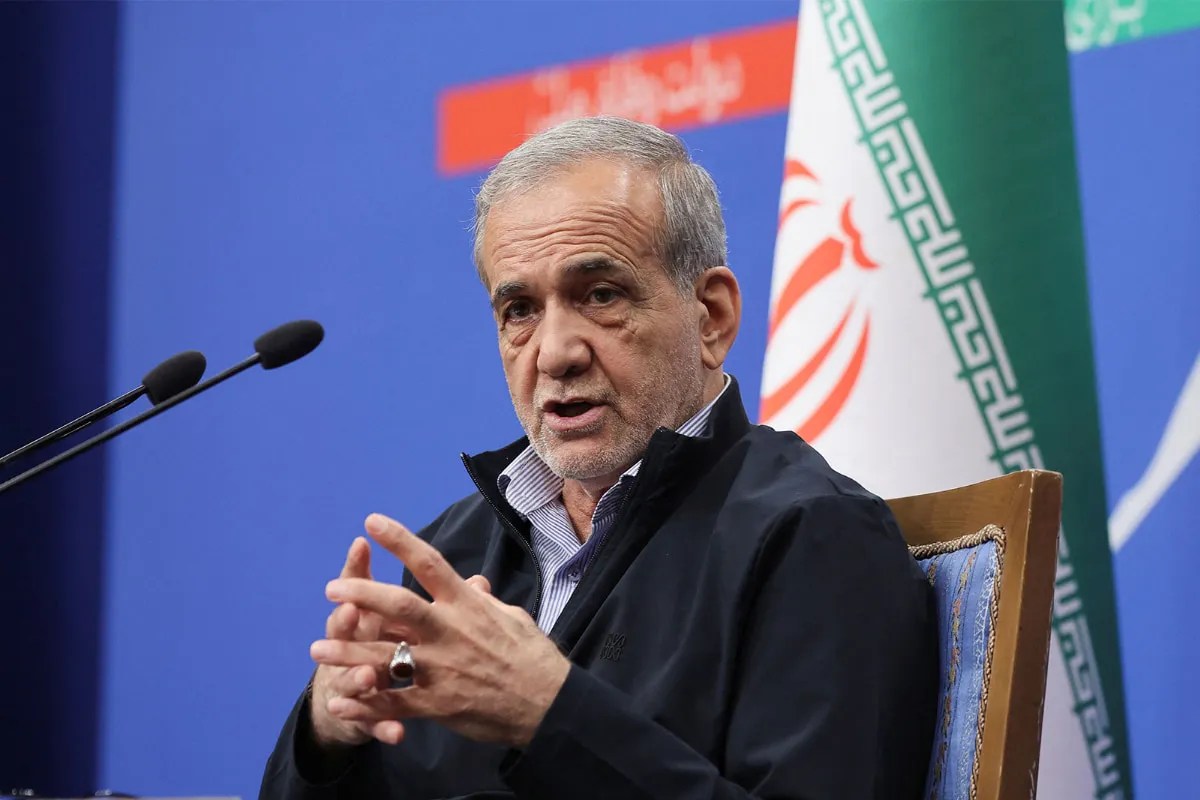
Iranian President Masoud Pezeshkian is urging Muslim states to close ranks against what Tehran calls United States and Israeli aggression. Strip away the diplomatic phrasing, though, and the call is less a sudden pan-Islamic awakening than a survival calculation born out of military pressure, contested negotiations, and deep regional distrust.
When Pezeshkian speaks about regional cooperation and shared security, he is operating inside a bruising reality. Conflict involving Iran, Israel, and the United States has tested air defenses, shipping lanes, and diplomatic channels across West Asia. Speaking on international stages—including the United Nations General Assembly—Pezeshkian has framed Washington and Jerusalem as violators of international law while arguing that external powers seek to divide Muslim capitals so they cannot check pressure together.
At the same time, Pezeshkian has publicly defended talks with Washington and European capitals while pushing back against domestic critics who accuse his administration of compromising. That dual track creates friction. Calling for a united front against the United States while keeping diplomatic backchannels open—or pointing to fragile understandings—leaves neighboring governments trying to read Tehran's real bottom line.
Why Tehran Wants a Regional Shield Right Now
Pressure concentrates minds. When a state faces military strikes, economic strain, and security friction along major maritime chokepoints, bilateral deterrence alone feels thin.
Pezeshkian has previously floated ideas such as regional security and economic coordination mechanisms—including proposals framed around an Islamic assembly for Middle Eastern coordination—arguing that regional neighbors do not need foreign military presence to settle disputes or manage stability. On paper, that argument appeals to capitals tired of outside intervention and sudden escalation.
In practice, it runs straight into an old contradiction. Many Gulf and Arab governments have spent years building their own security hedging strategies. Some maintain defense ties with Washington; others pursue quiet de-escalation with Tehran without signing on to confrontational blocs. Asking them to unite against the United States and Israel asks them to trade away room to maneuver.
A call for unity sounds noble in a speech. In foreign ministries, it looks like a request to share someone else's risk.
The Credibility Gap Inside Neighboring Capitals
You cannot build a security bloc on speeches alone. History in the region is littered with summits that produced strong communiques and weak follow-through.
Ask any seasoned diplomat who has covered Arab League or Organisation of Islamic Cooperation gatherings over the past three decades. Statements condemning aggression arrive reliably. Binding collective action rarely does.
Why? Because capitals weigh concrete threats differently. A government worried about missile spillover or shipping disruptions in the Gulf cares deeply about maritime security and airspace stability. Another government focused on domestic debt, border security, or trade corridors with Western markets looks at every anti-Western pledge through a financial lens.
Competing Priorities Across the Region
- Gulf states balance trade and de-escalation with Iran against long-standing security arrangements and commercial ties with the United States.
- Turkey guards its own regional autonomy, weighing economic pragmatism, border security, and diplomatic influence rather than subordinating its policy to another capital's bloc.
- Pakistan frequently steps into mediation and security dialogue, trying to lower temperatures without locking itself into a permanent frontline role.
- Domestic hardliners in Iran watch Pezeshkian's diplomacy closely, attacking any hint of negotiation with Washington even as the president argues that endless fighting serves Israel's interests.
That internal tug-of-war matters more than many outside commentators admit. If a foreign minister in Riyadh, Ankara, or Doha suspects that Tehran's outreach to neighbors is temporary—or that hardliners inside Iran could derail an understanding tomorrow—caution wins every time.
A Hypothetical Test of Collective Deterrence
Suppose, in a purely hypothetical scenario, three neighboring capitals agreed to a joint maritime and air-deconfliction pact aimed at keeping external strikes and proxy escalation out of regional waters. Even then, the hardest questions would start on day one.
Who pays when shipping insurance spikes? Who intercepts a drone or missile crossing shared airspace? What happens if one signatory continues quiet talks with Washington while another demands a public rupture?
Without clear rules of engagement, burden-sharing formulas, and trust in command-and-control, a pact becomes a headline rather than a shield. Regional states know that gap all too well.
What Pezeshkian Gets Right and Where the Pitch Falters
Give Pezeshkian credit for reading the mood of publics across the region. Anger over civilian casualties, regional escalation, and perceived double standards in international diplomacy is widespread and real. When he points out that regional instability hurts everyone's trade, infrastructure, and stability, he is stating an observable fact.
Yet the pitch falters whenever Tehran treats regional unity as synonymous with alignment against Washington and Jerusalem. Many regional leaders do not share Iran's ideological framing or its regional network strategy. They want calm borders, predictable trade routes, and credible off-ramps from crisis.
Even Pezeshkian's own rhetoric reflects that tension. He condemns what he calls US-Israeli aggression and foreign interference, yet he also insists Iran is open to negotiations and diplomacy rather than accepting endless confrontation. Bridging those two messages is a high-wire act.
| Dimension | Tehran's Pitch | Regional Reality |
|---|---|---|
| Core message | Muslim states must unite against US and Israeli aggression | Governments prioritize sovereign hedging and risk control |
| Security mechanism | Regional cooperation without foreign military presence | Overlapping security ties, bilateral channels, and uneven trust |
| Diplomacy vs. force | Reject submission while keeping doors to talks open | Partners worry mixed signals can trigger miscalculation |
| Main obstacle | External divide-and-rule pressure | Divergent threat perceptions and economic trade-offs |
What to Watch Next
Watch actions rather than podium rhetoric. Watch whether security meetings involving regional capitals produce concrete de-escalation rules, trade and transit commitments, or quiet diplomatic channels that keep crises from spiraling.
Watch also how Pezeshkian manages friction at home. A president who cannot hold his own domestic flank steady on diplomatic strategy will struggle to convince skeptical neighbors to stake their security on his regional vision.
Unity in West Asia has never failed for lack of slogans. It fails whenever individual capitals decide that going it alone—or hedging quietly—keeps them safer than marching behind someone else's banner.


