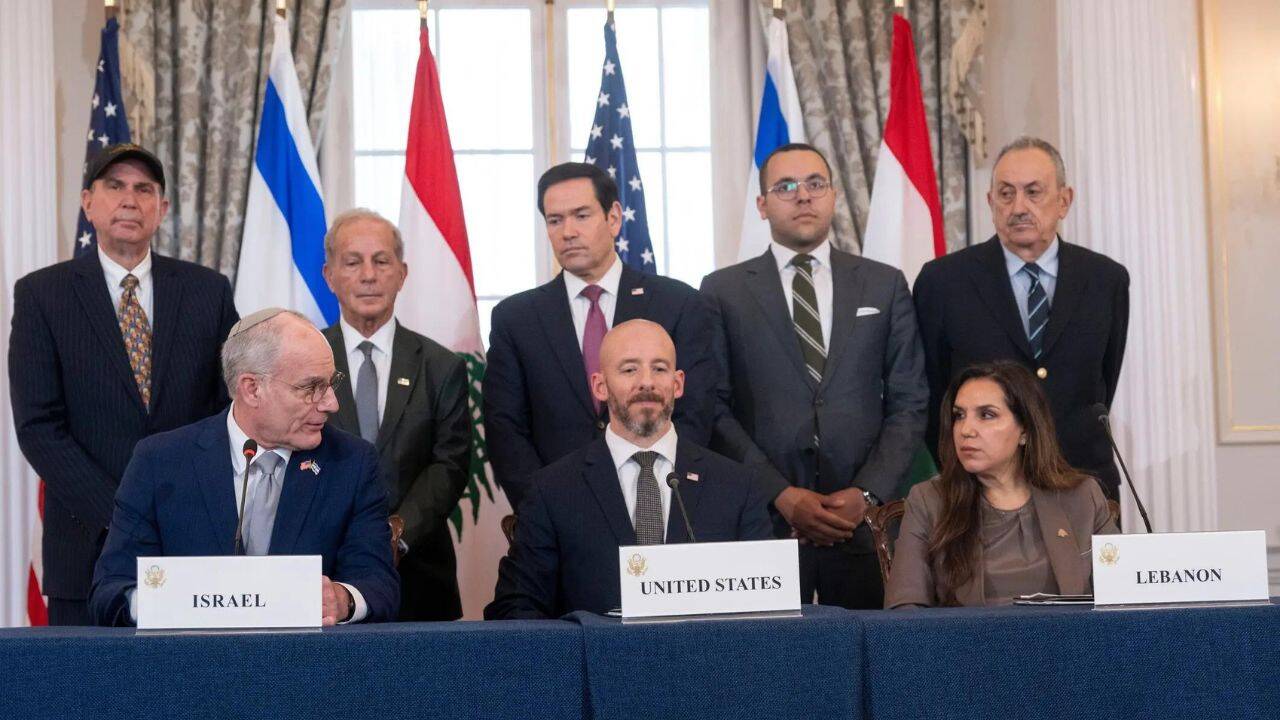
The trilateral framework agreement signed in Washington by the United States, Israel, and Lebanon is a diplomatic illusion that papers over unbridgeable security realities on the ground. While diplomats celebrate the conclusion of a grueling fifth round of talks, the deal’s core mechanism contains a fatal contradiction. It promises the restoration of Lebanese state sovereignty through the gradual introduction of its national army into southern pilot zones. Yet, it simultaneously permits the Israeli military to maintain an armed occupation of a six-mile-deep buffer zone until an impossible condition is met, namely the total disarmament of Hezbollah. This structurally flawed framework does not stop a war; it merely schedules the next phase of the conflict.
The public signing ceremony at the State Department featured carefully stage-managed optimism. US Secretary of State Marco Rubio termed the document the beginning of a long journey toward structural stability, while the envoys from Jerusalem and Beirut spoke past each other using entirely incompatible definitions of victory. Israeli Ambassador Yechiel Leiter proclaimed that Iran and its proxy were officially locked out of the diplomatic process. Minutes later, Lebanese Prime Minister Nawaf Salam issued a statement from Beirut systematically downplaying any new obligations for his government, signaling that the state has neither the will nor the military capacity to forcibly disarm the militant faction dominating its southern region. Read more on a related issue: this related article.
To understand why this framework is dead on arrival, one must look at the hidden friction that nearly derailed the fifth round of talks entirely.
The Separate Iranian Track
For months, the Trump administration pursued two distinct diplomatic tracks that were structurally destined to collide. The first was a direct negotiation between American and Iranian officials aimed at winding down a broader regional confrontation. The second was the separate Washington-hosted channel between formal Israeli and Lebanese state delegations. Additional journalism by Reuters highlights comparable views on this issue.
When Washington signed a memorandum of understanding with Tehran, Israeli and Lebanese negotiators in the direct channel felt completely blindsided. The American-Iranian understanding included provisions for a cessation of military operations in Lebanon, an insertion that infuriated both the Israeli government and Lebanese state representatives. From the Israeli perspective, the regional deal undercut their primary diplomatic leverage, allowing Iran to dictate terms over a theater where the Israeli Defense Forces had spent months sustaining casualties to clear out militant networks.
The immediate fallout inside the State Department negotiations was severe. Israel hardened its posture, rolling back previous concessions regarding the depth and timing of its planned troop pullbacks. Lebanese negotiators, working under intense domestic scrutiny, countered by producing expansive maps demanding a total Israeli withdrawal that the current political coalition in Jerusalem could never accept. It required immense, behind-the-scenes American diplomatic pressure to drag both parties back to the table for an extended session just to sign a vague framework text that leaves the most explosive variables unresolved.
The Absurdity of the Pilot Zones
The centerpiece of the signed document is a pilot program designed to test whether the Lebanese Armed Forces can replace occupying Israeli troops. Prime Minister Benjamin Netanyahu detailed the plan in a recorded address, explaining that the military would allow Lebanese state soldiers to assume control over two specific zones. One zone sits south of the strategically critical Litani River, while the other sits to its north.
The geographic logic of these pilot zones is a strategic absurdity. According to Israeli defense sources, the areas selected for the initial Lebanese army deployment have already been completely cleared of militant infrastructure by Israeli ground operations. Israeli forces are essentially offering to step back from small pockets of terrain where there is currently nothing left to fight over, while retaining complete combat control over the broader six-mile-deep buffer zone running along the length of the border.
The Lebanese Military Capacity Problem
Expecting the Lebanese national army to police these zones and enforce a ban on non-state weapons is a dangerous fantasy. The Lebanese Armed Forces are chronically underfunded, under-equipped, and politically paralyzed by the delicate sectarian makeup of the state they serve. Washington's promise of a one hundred million dollar humanitarian aid package and a thirty million dollar reimbursement fund for the Lebanese military is a drop in the ocean.
Historically, whenever the Lebanese national army has been deployed to the south, its officers have operated under a policy of strict non-confrontation with local militant cells. They do not have the heavy armor, the intelligence architecture, or the political mandate to engage in active counter-insurgency operations against their own citizens. If a militant cell attempts to re-enter a pilot zone to dig a new launch position, a standard Lebanese army platoon will not shoot. They will step aside to avoid sparking a civil war in Beirut.
The Israeli Right of Intervention
Compounding this structural instability is Israel’s explicit reservation of the right to execute unilateral military action. The text of the broader ceasefire understandings guarantees Israel the authority to strike inside Lebanon if its intelligence agencies detect an imminent threat or a violation of the non-state weapons ban.
This creates an immediate operational loop that ensures a rapid return to open hostilities.
- Israel detects movement or rebuilding activity near the border.
- The Lebanese army on the ground fails to intervene due to political or physical incapacity.
- The Israeli air force launches a strike inside Lebanese territory to eliminate the target.
- The central government in Beirut denounces the strike as a flagrant violation of national sovereignty, freezing further participation in the framework.
Netanyahu and Qassem Sound the War Drums
Any lingering hope that this trilateral framework might quietly evolve into a functional peace treaty was completely destroyed by the simultaneous public declarations of the combatants. Diplomatic agreements are only as strong as the political will of the leaders required to execute them. In this case, both leaders used the hours following the signing ceremony to signal that their core military objectives remain entirely unchanged.
Benjamin Netanyahu left no room for ambiguity regarding the timeline of the occupation. He stated explicitly that Israeli forces will remain entrenched in the southern security zone for the foreseeable future. In his view, maintaining that physical presence is the primary achievement of the entire military campaign, and his government will not authorize a full withdrawal until the militant infrastructure throughout the entire country is dismantled. For a political leader facing immense domestic pressure from internal coalition partners and displaced northern residents, any premature retreat would be a fatal political vulnerability.
Almost simultaneously, the chief of the militant movement, Naim Qassem, issued an uncompromising counter-directive from his hiding place. He stated that Israel has no option but a total, unconditional withdrawal from every single inch of Lebanese territory. The group views the ongoing presence of Israeli soldiers as an active occupation that justifies continuous resistance. They have spent decades building an identity around the concept of border defense, and their regional backers in Tehran have no intention of letting their primary northern leverage point be dismantled by a paper framework signed in a Washington conference room.
The Lessons of Failed Precedents
This is not the first time Washington has attempted to use the Lebanese state apparatus as a proxy tool to solve a border security crisis with Israel. The entire structure of the new trilateral deal looks like a repurposed version of United Nations Security Council Resolution 1701, which concluded the month-long war of 2006. That resolution also mandated that the area south of the Litani River be free of any armed personnel except for the Lebanese army and international peacekeepers.
For twenty years, that international arrangement failed completely. The peacekeepers lacked an offensive enforcement mandate, turning into highly paid observers who documented thousands of violations without pulling a single trigger. The militant group simply moved its rocket arsenals into underground bunkers, civilian homes, and rugged nature reserves right under the noses of the international community.
To believe that this new framework will yield a different result requires ignoring forty years of Levant security history. The only material difference today is that the destruction of southern Lebanese infrastructure is vastly more severe than it was two decades ago. Whole border villages have been leveled, and over a million people remain displaced. This level of devastation creates a vacuum of desperation that historically makes militant recruitment easier, not harder.
The Geopolitical Side Deal That Matters More
The true driver behind the signing of this framework was not a sudden breakthrough in bilateral trust between Beirut and Jerusalem. It was a transactional imperative dictated by the broader deal between the United States and Iran.
Tehran made it completely clear during its secret talks with American interlocutors that it would not finalize a broader regional de-escalation package unless Lebanon was formally insulated from further systemic targeting. The Iranian regime needed a temporary pause to assess the structural damage to its regional architecture, protect its remaining assets, and secure economic relief from international sanctions. The framework agreement was the price Washington had to pay to keep the Iranian leadership at the negotiating table for the larger grand bargain covering nuclear enrichment and regional trade routes.
By forcing its local allies to temporarily accept the language of the framework, Iran bought critical operational breathing room. The deal allows the militant network to retrench, reorganize its shattered command hierarchy, and wait out the political cycle in Washington and Jerusalem. It is a tactical pause disguised as a strategic settlement.
The international community will likely spend the coming weeks praising the establishment of the US-facilitated Military Coordination Group for Lebanon. Officers will meet, maps will be drawn, and small groups of Lebanese soldiers will march into empty, ruined towns to plant cedar flags for the television cameras. But beneath the diplomatic pageantry, the fundamental equation remains untouched. You cannot build a durable peace on a framework that requires one side to voluntarily surrender its entire reason for existence, while allowing the other side to maintain a permanent military occupation on foreign soil. When the tactical utility of this pause expires for either Jerusalem or Tehran, the pilot zones will instantly become the front lines of a renewed, even more destructive war.