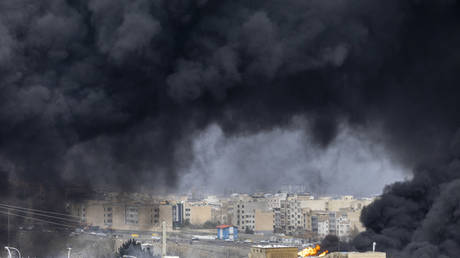
The United Arab Emirates is not merely slipping into a direct war with Iran. It is already actively fighting one, hidden behind the veneer of a fragile regional ceasefire. While traditional commentators scan the Persian Gulf for the overt flashpoints of state-on-state conventional conflict, Abu Dhabi and Tehran have quietly discarded their old playbook of cautious diplomacy. The closure of the UAE embassy in Tehran following targeted drone and missile strikes on Emirati soil marked the end of an era. Driven by the trauma of infrastructure attacks and a profound divergence from its neighbors, the UAE has crossed a strategic rubicon, pivoting from a regional commercial hub into a hardened front-line state determined to contain Iranian power.
This quiet escalation is not an accident of geography or a temporary byproduct of recent regional friction. It is a deliberate, structural transformation. To understand how the two historic trading partners reached this brink, one must look past the superficial diplomatic theater and examine the deep economic fractures, the breakdown of the Gulf Cooperation Council consensus, and the shadow intelligence war playing out across maritime choke points and financial capitals.
The Illusion of Coexistence
For decades, the relationship between Abu Dhabi and Tehran operated on a strict dual-track system. Politically, they squabbled over the disputed islands of Abu Musa and the Greater and Lesser Tunbs. Economically, Dubai served as Iran’s vital financial lungs, a re-export hub that kept the sanctioned Iranian economy breathing.
That pragmatic arrangement is dead. The sheer intensity of recent hostilities, including drone strikes directed at the Barakah nuclear plant by Iran-backed proxy networks, proved to Emirati leadership that their economic vulnerability was being weaponized against them.
The strategy in Abu Dhabi has fundamentally altered. They have realized that economic interdependence does not offer protection against a revolutionary state. The old guard believed that billions of dollars in bilateral trade would deter Tehran from taking drastic actions. The current leadership views that trade as a dangerous dependency that gives Iran leverage over the Federation’s domestic security.
Consequently, the UAE is systematically dismantling the financial networks that once allowed Iranian firms to operate in the shadows of Dubai’s free zones. This is not a subtle policy shift. It is a aggressive financial purge that has forced Tehran to aggressively search for alternative routes, including a costlier back-channel via Oman’s Musandam Peninsula using local high-speed shooti boats to bypass the tightening dragnet.
The Great Gulf Fracture
The primary driver behind the UAE’s unilateral assertiveness is a growing, bitter strategic split with Saudi Arabia. The old assumption that the Gulf Arab states would act as a monolithic bloc against the Islamic Republic has collapsed under the weight of competing national interests.
| Strategic Dimension | The Emirati Approach | The Saudi Approach |
|---|---|---|
| Iran Policy | Maximum pressure, covert containment, and alignment with external partners to force a surrender. | Diplomatic accommodation, regional de-escalation, and preservation of domestic economic megaprojects. |
| Security Alliances | Deepening intelligence and tactical coordination with Israel via the Abraham Accords framework. | Avoidance of open alignment with Israel to protect its political and religious standing in the Islamic world. |
| Choke Point Defense | Hardening alternative pipelines bypassing the Strait of Hormuz and coordinating active maritime blockades. | Focusing on Red Sea stability and managing threats from Yemen through direct negotiations. |
Riyadh, burned by past attacks on its oil facilities and focused entirely on its ambitious domestic economic transformation, has chosen the path of diplomatic appeasement. Saudi Arabia wants a quiet neighborhood at all costs, even if it means tolerating a heavily armed Iran on its doorstep.
Abu Dhabi views this Saudi stance as a dangerous delusion. Emirati planners believe that any diplomatic framework signed by Tehran is simply a stalling tactic used to gather strength. Rather than waiting for an unreliable American security umbrella or a hesitant Saudi neighbor, the UAE has chosen to build an ad-hoc, aggressive coalition of its own.
The Abraham Accords as a Weapon
The normalization of relations between the UAE and Israel was widely sold to the international community as a grand gesture of regional peace and economic cooperation. In reality, it has evolved into a hard-edged military and intelligence alliance designed explicitly for conflict with Iran.
Abu Dhabi has integrated Israeli-made Iron Dome and air defense components into its national security architecture. This integration goes far deeper than simple hardware procurement. The UAE has quietly allowed its territory to become a forward staging ground for Western and Israeli intelligence gathering, directly monitoring Iranian naval movements in the Persian Gulf and the Gulf of Oman.
Tehran has reacted with predictable fury. Through back-channel messages, the Islamic Republic warned the UAE that allowing its airspace or territory to be utilized for hostile actions would transform the federation into a legitimate, high-priority target. The assassination of an Israeli-Moldovan citizen in the UAE highlighted how the shadow war has already spilled over into the streets of Emirati cities, forcing local security forces into a state of constant, high-alert counter-intelligence operations.
The Maritime Choke Point Battle
The most dangerous variable in this silent confrontation lies in the narrow waters of the Strait of Hormuz. While global attention focuses on formal international blockades and high-seas standoffs involving major global powers, a much more intimate and volatile skirmish is occurring between the UAE Coast Guard and the Islamic Revolutionary Guard Corps Navy.
The UAE has accelerated infrastructure projects to render the Strait of Hormuz strategically irrelevant to its own survival. By routing a massive portion of its crude oil through trans-peninsula pipelines directly to the port of Fujairah on the Indian Ocean, Abu Dhabi is preparing for a scenario where the Gulf is completely closed to commercial shipping.
This infrastructure independence gives the UAE a unique tactical flexibility. Because it no longer relies entirely on the narrow strait to export its main commodity, Abu Dhabi can afford to support aggressive maritime enforcement actions that its neighbors would find ruinous. The UAE has quietly participated in limited, coordinated maritime operations to intercept illicit Iranian cargo, challenging the IRGC’s self-declared sovereignty over the waterway.
A Balance of Mutual Terror
The current standoff is defined by an unstable architecture of deterrence. Iran possesses the missile volume to cause catastrophic damage to the UAE's glass-tower economy, a reality that keeps Abu Dhabi from launching overt, unprovoked military offensives. Conversely, the UAE possesses the financial resources, the advanced air defense networks, and the sovereign alliances to inflict severe, asymmetrical damage back on the Iranian regime.
This is not a slide toward conflict. It is a highly calculated, permanent gray-zone war where an miscalculation by a single naval commander or a rogue proxy drone could instantly spark a wider conflagration. The UAE has made its choice. It has traded the profitable, comfortable illusion of neutrality for the harsh reality of a front-line combatant.


